
Correcting a defect is not the same as proving it will not recur. Refresher training, a reminder email or a revised form may close an action on paper while the process failure remains.
Test corrective action against the cause that produced the nonconformance, including conditions in which the error appears. Define effectiveness evidence and a follow-up period before closing the item.
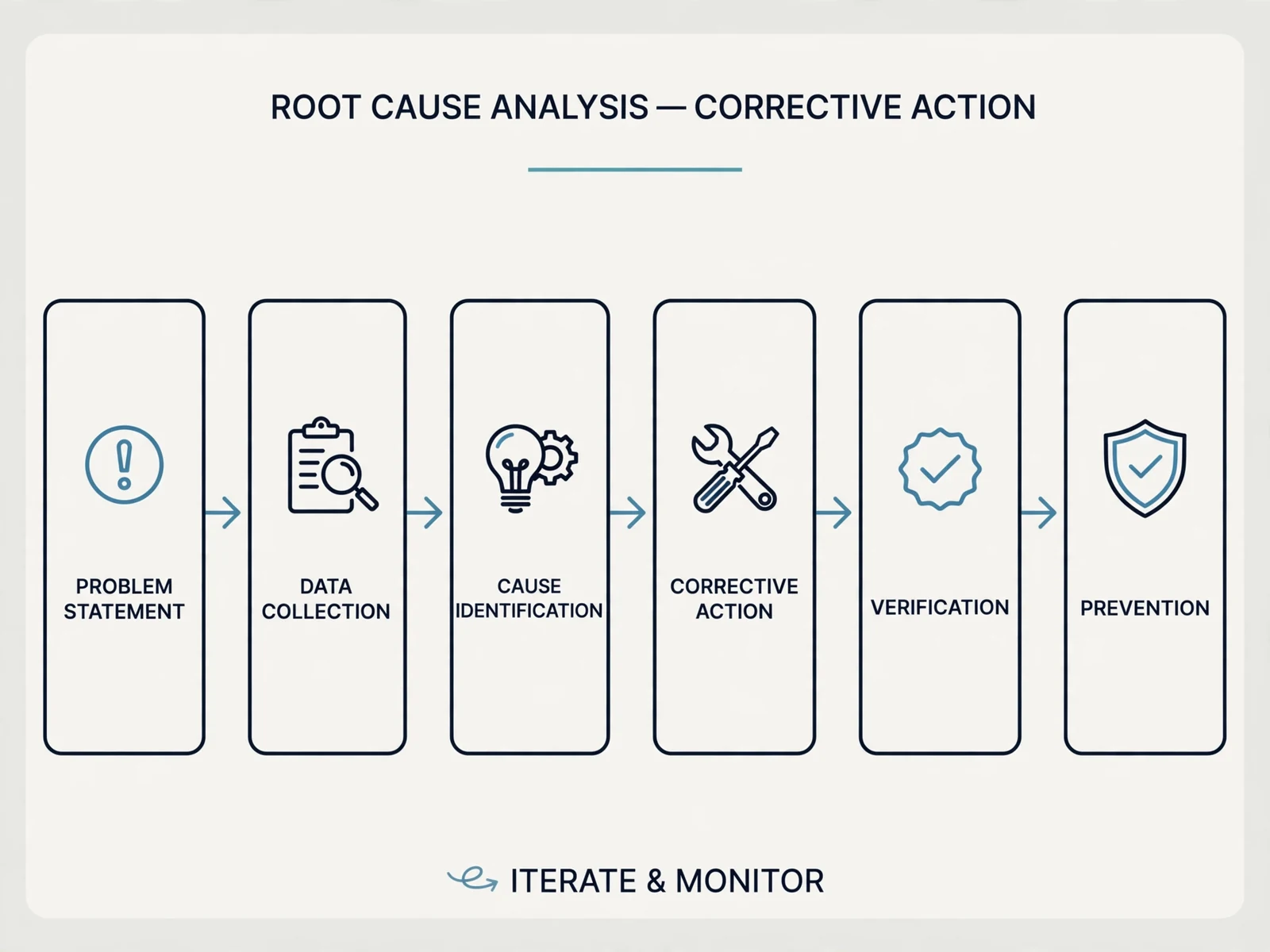
Practical framework at a glance
Verify cause
Confirm the real reason a failure recurred
Change controls
Address the process mechanism, not symptoms
Test under work
Observe the countermeasure in normal conditions
Close with evidence
Retain proof and check recurrence later
Customer And Process Requirements
Describe the violated standard or expected outcome, including affected products, customers, transactions or controls. Make the failure observable and contain current harm before redesigning the process.
Process Ownership
Assign an accountable owner with authority to change the relevant workflow and enlist adjacent teams. Actions scattered among departments often fail when no one owns the end-to-end cause.
Quality Controls
Determine which preventive or detective control failed and why. Examine the actual conditions of work rather than assuming the written procedure was followed or easily usable.
Nonconformance
Record representative evidence, timeline, frequency where verified, impact and immediate correction. Separate symptom from cause; one failed sample may not establish a systemic pattern.
Corrective Action
Choose a change that plausibly interrupts the causal mechanism, such as improving a handoff, simplifying a decision rule or repairing equipment. Training is appropriate only when a demonstrable skill or knowledge gap is involved.
Management Review And Improvement
Recheck comparable work after implementation, including periods when the original failure was likely. If the issue recurs, reopen the investigation rather than classifying another reminder as a new successful fix.
Practical Corrective Action Effectiveness Working Template
- Requirement: What standard or customer result failed?
- Cause evidence: What test supports the suspected mechanism?
- Containment: How is current risk managed while work changes?
- Intervention: Which process condition is being changed?
- Effectiveness: What comparable observation and time window will test the change?
- Decision: Who accepts evidence or reopens the action?
- Next review: Who owns the resulting decision and what evidence is needed next?
Worked Example
A factory reports repeated defects despite refresher training. The quality lead examines work variation and discovers that an equipment setup step is ambiguous under certain shifts. A clearer setup control is piloted, and subsequent representative production runs are checked before closure.
Common Mistakes to Avoid
- Treating immediate rework as proof that the cause was removed.
- Choosing training before showing a knowledge gap caused the defect.
- Closing an action when the owner marks it done rather than when it is tested.
- Using a different population or operating condition for effectiveness checks.
- Hiding recurrence to preserve a high closure rate.
Questions Managers Should Ask
- Which verified cause will this action interrupt?
- Was the short-term failure contained without masking the long-term issue?
- Can the changed process work reliably under real operating conditions?
- What evidence and period justify declaring it effective?
- Who reopens the item if the failure returns?
Management Review Checklist
Review original nonconformance, causal evidence, containment, intervention, test conditions and post-change observations. Require the owner to demonstrate effectiveness instead of merely completion.
What to Review After Three Cycles
Compare subsequent defects with prior root-cause assessments and intervention results. Adjust problem-solving methods where recurrence shows that past conclusions were premature.
A 30-Day Application Plan
- Week 1: Define the failure and collect evidence under actual conditions.
- Week 2: Test the root-cause hypothesis and select a practical intervention.
- Week 3: Implement the change and check representative work.
- Week 4: Review recurrence and close only with credible effectiveness evidence.
Capability Maturity
Basic: corrective actions have owners and due dates. Developing: cause-based changes are tested in normal operation. Mature: recurrence evidence drives better root-cause and control design.
For HR, L&D and Corporate Sponsors
Quality training should use fictional cases where an apparent fix fails; participants must specify how they would test the true cause and judge corrective-action effectiveness.
Decision Quality Test
Could a competent reviewer distinguish genuine causal improvement from paperwork closure?
Make the Method Part of Normal Work
Connect corrective-action records to normal quality and operating reviews, with a trigger for reopening when evidence deteriorates.
Related Courses in This Capability Cluster
Detailed workplace application
A factory reports that a recurring quality issue was closed after staff attended refresher training. A month later the same failure returns. The quality lead examines the original cause, verifies whether the claimed action addressed it and tests representative work under normal conditions. Ownership, evidence and a follow-up date are recorded before closure. Where training was irrelevant to the failure, process design and controls are corrected instead. Effectiveness means the problem stops recurring for a defensible reason, not that a form says ‘complete’.
Test the corrective action, not just the attendance register
Managers can work through a fictional nonconformance, identify plausible causes, agree what should change, then set an evidence-based test of whether the change endured. The root cause analysis for managers guide supports the diagnostic step. For team training, the published Root Cause Analysis and Corrective Action course can be combined with workplace supervision. The review should make clear who verifies improvement and which issues remain for management to resolve.
For an organizational cohort, request a private instructor-led training proposal with the participant roles, approximate group size and capability objective. Dates, trainers and programme terms are confirmed during scoping.
Where to Go Next
The Quality Management Systems and Continuous Improvement course develops this capability through live instructor-led practice and workplace application. For broader pathways, see Training Bundles and Corporate Academies.
Close corrective actions when the failure mechanism is demonstrably controlled, not when the activity is finished.
Develop this capability in your organization