
A quality management system is not a folder of procedures or an audit certificate. It is a practical method for consistently meeting defined customer and process requirements, identifying failures and correcting causes.
Managers need process ownership, clear controls, credible evidence, nonconformance handling and a review rhythm that changes how work is done. Document only what supports consistent delivery, accountability and improvement.
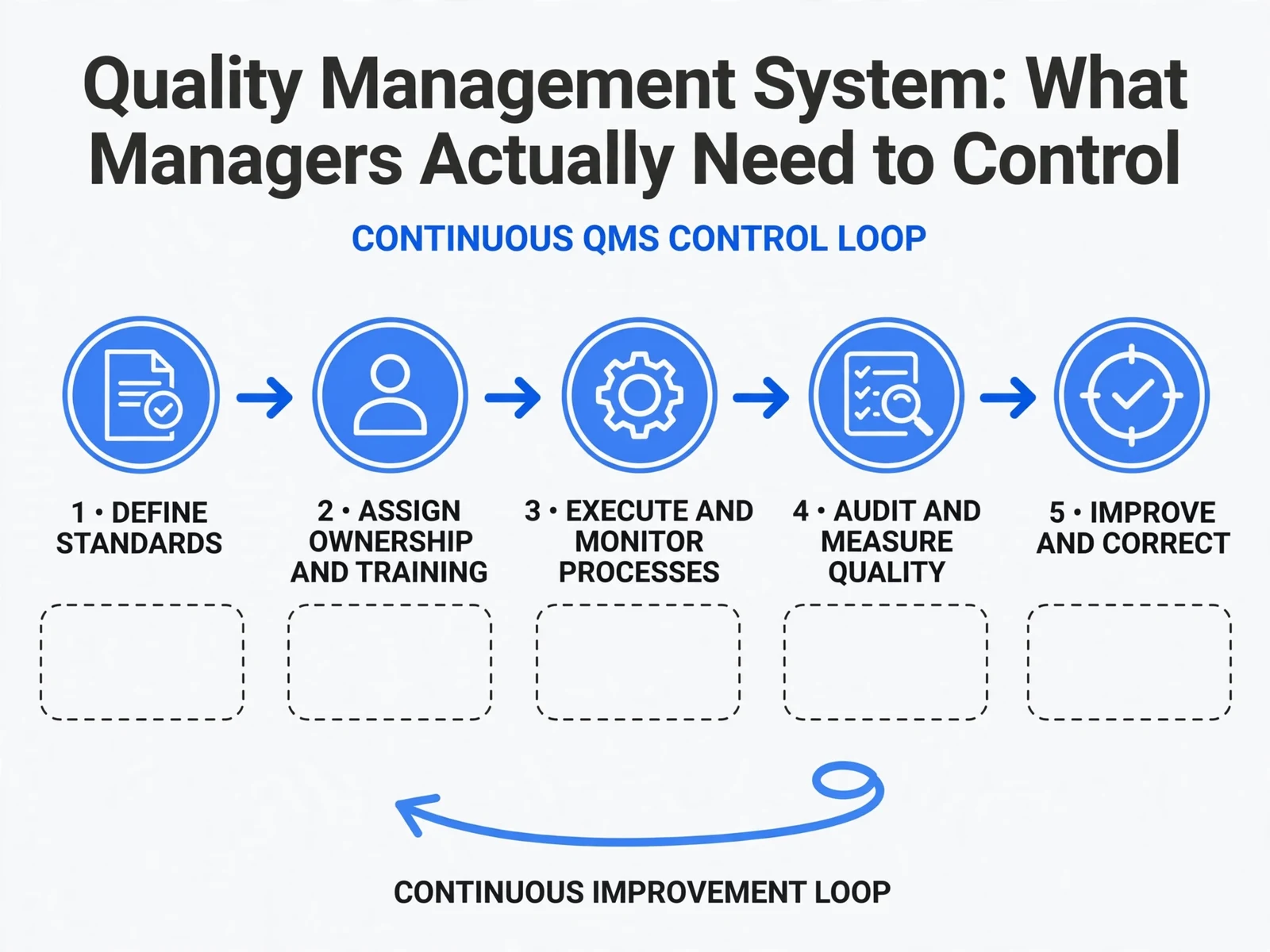
Customer And Process Requirements
Translate the customer’s relevant needs, agreed standards and applicable obligations into observable outputs. Identify the process steps where a failure could be introduced and distinguish contractual requirements from optional internal preferences.
Process Ownership
Name who controls the end-to-end process and its interfaces, including handoffs between teams. Clarify responsibility for measurements, exceptions, changes and corrective action rather than relying on a quality department to fix every operational issue.
Quality Controls
Set process checks at meaningful points of failure and describe what evidence demonstrates control. A check must be feasible for staff to perform and have an action when a defect is found.
Nonconformance
Record what requirement was not met, which work was affected, the evidence, immediate containment and who needs to know. Avoid using vague ‘human error’ labels before investigating causes.
Corrective Action
Separate short-term correction of an individual defect from action on recurring causes. Test whether the chosen change addresses the process condition and can operate reliably in normal work.
Management Review And Improvement
Review trends, customer consequences, persistent defects, control failures and follow-up evidence with business owners. Retire unnecessary paperwork and strengthen controls where repeated problems show a gap.
Practical Quality Management System Working Template
- Requirement: Which customer or process expectation must be met?
- Owner: Who has authority over the relevant workflow?
- Control: Where is failure prevented or detected?
- Evidence: What record confirms that the control actually operated?
- Nonconformance: What happened, who was affected and how was work contained?
- Effectiveness: What observation will show that the root cause was addressed?
- Next review: Who owns the resulting decision and what evidence is needed next?
Worked Example
A service provider finds different branches completing a customer task inconsistently. Managers trace failures to a shared process requirement and the handoff where the needed information is lost. They adjust the check, record defects and compare representative cases to test improvement.
Common Mistakes to Avoid
- Treating procedure volume as evidence of quality.
- Leaving cross-team process ownership unresolved.
- Recording defects without immediate containment of affected work.
- Closing corrective actions before their effectiveness is checked.
- Using audit scores as a substitute for customer and process evidence.
Questions Managers Should Ask
- Which requirement must this process deliver each time?
- Where would a defect be prevented or detected?
- What evidence shows that staff follow the control under actual conditions?
- Who investigates a recurring failure and authorizes changes?
- How will management know whether the correction endured?
Management Review Checklist
Examine requirements, process outcomes, control evidence, nonconformance themes and the effectiveness of significant corrective actions. Assign ownership to practical operating changes.
What to Review After Three Cycles
Compare recurring failure modes and control performance over several operating cycles. Update standards or guidance where evidence shows ambiguity and remove checks that do not influence results.
A 30-Day Application Plan
- Week 1: Define key customer requirements and process owners.
- Week 2: Map controls and review representative nonconformances.
- Week 3: Test one root-cause correction with operational staff.
- Week 4: Review effectiveness and update the working system.
Capability Maturity
Basic: requirements and controls are documented. Developing: process owners use failure evidence to correct causes. Mature: quality reviews continuously improve delivery and manage risk.
For HR, L&D and Corporate Sponsors
Use anonymized workplace defects in training to build process-control maps and corrective-action checks rather than simply practising document completion.
Decision Quality Test
Can the process owner demonstrate that the control prevents or detects the failure in real work?
Make the Method Part of Normal Work
Keep quality evidence with operational teams and discuss exceptions in existing performance and improvement meetings.
Related Courses in This Capability Cluster
Detailed workplace application
A service provider receives repeated complaints that work is completed inconsistently between locations. The quality manager maps the customer requirement to the process step and the control responsible for preventing failure. Staff record nonconformances with evidence, investigate recurring causes and test corrective action in comparable conditions. Managers review both defects and whether controls remain usable. The system is valuable because the work gets more reliable, not because procedures and audit forms become more extensive.
Make quality training specific to process ownership
A quality-management workshop should match the processes participants control: requirements, checks, documented exceptions, root causes and follow-up review. The root cause analysis guide helps differentiate a recurring process defect from an isolated mistake. Our organizational training options can be scoped by role and operating environment. Certificates and compliance outcomes cannot be assumed from attendance alone.
For an organizational cohort, request a private instructor-led training proposal with the participant roles, approximate group size and capability objective. Dates, trainers and programme terms are confirmed during scoping.
Where to Go Next
The Quality Management Systems and Continuous Improvement course develops this capability through live instructor-led practice and workplace application. For broader pathways, see Training Bundles and Corporate Academies.
Manage quality through clear requirements, working controls and tested correction, not documentation volume.
Develop this capability in your organization