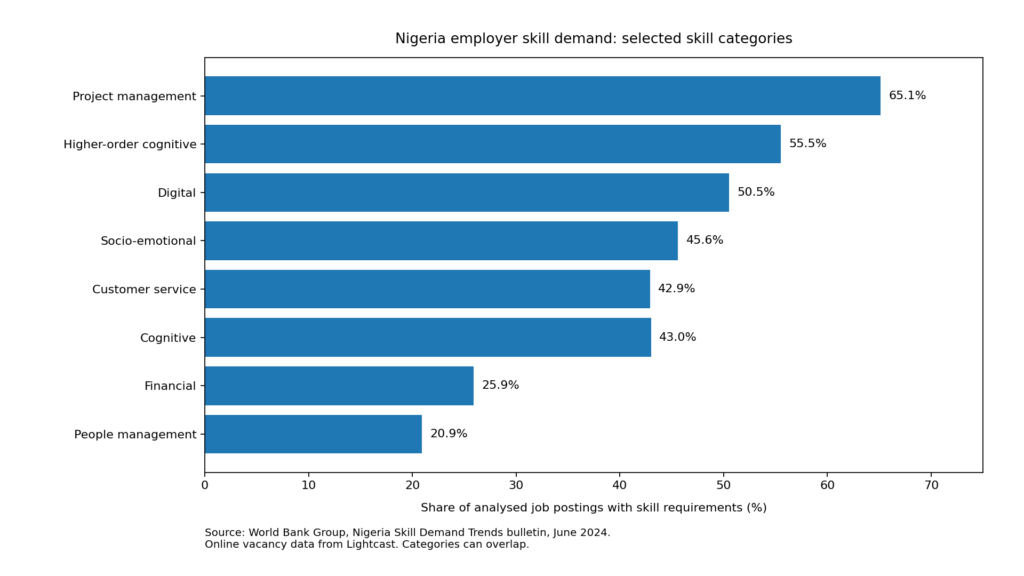
Nigeria’s labour-market and vacancy data show why professional development should not be reduced to digital training alone. In the World Bank’s online-job-vacancy analysis, project-management-related skills appeared in 65.1% of postings with skill requirements, higher-order cognitive skills in 55.5%, specialized digital skills in 50.5%, socio-emotional skills in 45.6%, customer-service skills in 42.9%, financial skills in 25.9% and people-management skills in 20.9%.
Those categories include capabilities that map directly to everyday organizational work: management, operations, planning, project management, finance, accounting, auditing, budgeting, leadership, negotiation, communication, problem solving, decision making, customer service, sales and procurement. The evidence therefore supports a broad professional-skills strategy rather than a narrow technology-only agenda.
This guide combines World Bank vacancy data with Nigeria’s National Bureau of Statistics labour-force data and current World Bank human-capital evidence. Each source measures something different. Online vacancies show what formal employers list in job adverts; the labour-force survey describes employment conditions across the wider population; and human-capital indicators describe longer-term education and workplace skill development. None should be treated as a complete measure of organizational training demand on its own.
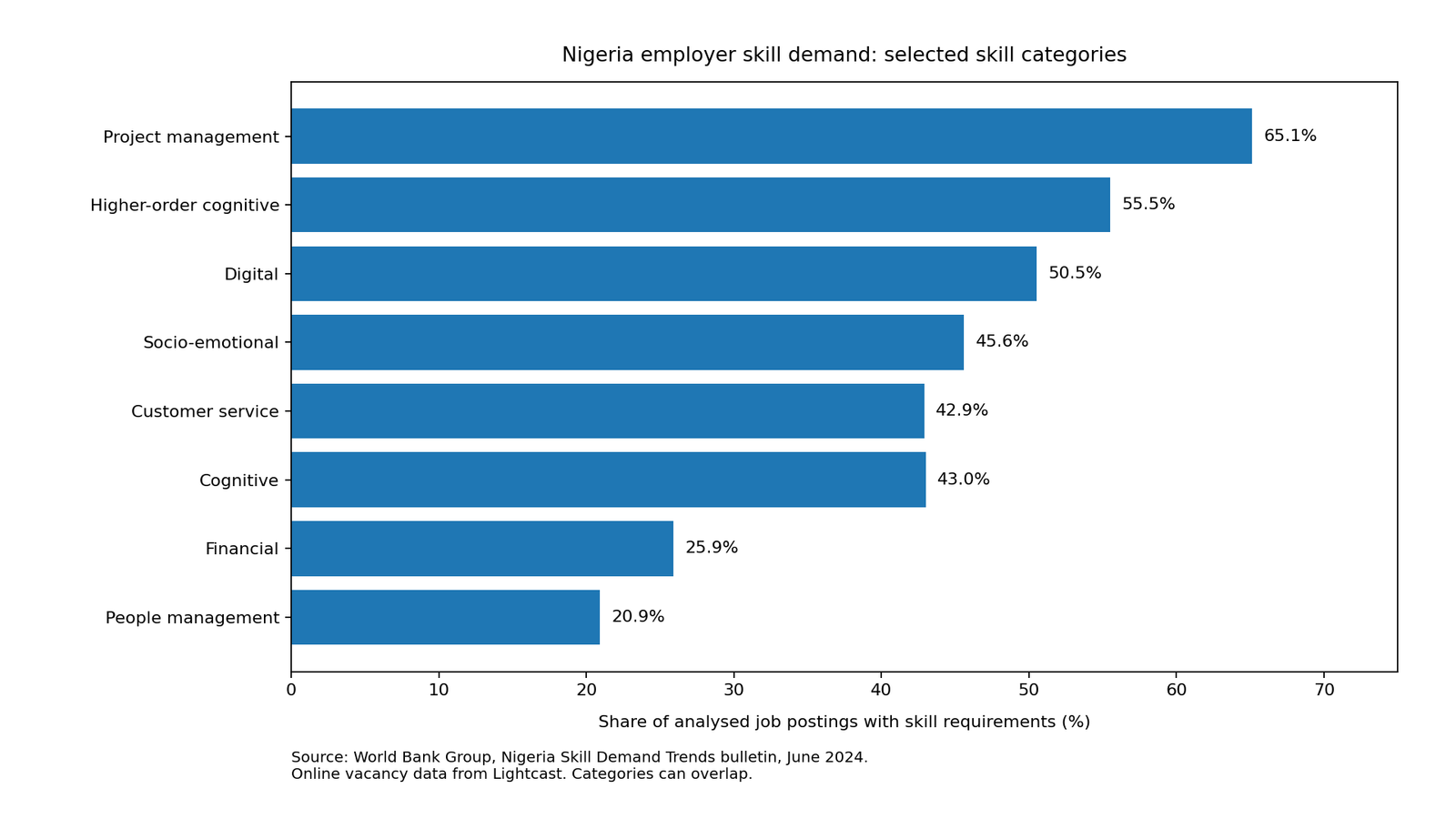
Data table: Nigeria vacancy skill categories
| Skill category | Vacancy share |
|---|---|
| Project-management-related skills | 65.1% |
| Higher-order cognitive skills | 55.5% |
| Specialized digital skills | 50.5% |
| Socio-emotional skills | 45.6% |
| Cognitive skills | 43.0% |
| Customer-service skills | 42.9% |
| Financial skills | 25.9% |
| People-management skills | 20.9% |
Source: World Bank Skills Demand Bulletin, Nigeria (June 2024; analysed online vacancy postings from 2020 to June 2024). This table reports historical job-advert skill-category shares, not a 2026 survey or a representative census of all employers.
1. Project-management-related skills appear in 65.1% of analysed Nigerian vacancies
The World Bank’s Nigeria Skills Demand Bulletin groups management, operations, planning, project management and organizational skills into its specialized project-management category. Across postings with skill requirements, that category appeared in 65.1% of the analysed vacancy data.
This does not mean that 65.1% of Nigerian workers are project managers. It means employers frequently list skills associated with managing work, plans, operations and projects across many roles.
2. Higher-order cognitive skills appear in 55.5% of postings
The World Bank category includes communication, problem solving, interpersonal communication, innovation, decision making, analytical skills, prioritization, critical thinking, business acumen, persuasive communication and strategic thinking.
These are cross-functional capabilities. A procurement professional, finance manager, HR business partner or project leader may all need them even though their technical disciplines differ.
3. Specialized digital skills appear in 50.5% of postings
The vacancy bulletin’s specialized digital category includes tools and capabilities such as presentations, Microsoft Office and Excel, computer literacy, social media and other digital requirements. Advanced digital categories also include data analysis, forecasting, programming, automation and software-related capabilities.
The important point for employers is complementarity. Digital capability is valuable, but the same labour-market evidence also shows large demand for management, financial, customer, people and higher-order cognitive skills.
4. Socio-emotional skills appear in 45.6% of postings
The World Bank classifies leadership, detail orientation, time management, multitasking, negotiation, self-motivation, teamwork, professionalism, accountability, influencing skills and ethical standards within this category.
For organizational buyers, the practical implication is that leadership and professional-behaviour capability should be built into real work. A negotiation programme should use actual commercial decisions. Leadership training should reflect the participant’s management responsibility. Accountability should be connected to roles and performance processes.
5. Customer-service skills appear in 42.9% of postings
Sales, customer service, marketing, customer relationship management, prospecting, selling techniques and related capabilities appear within the World Bank’s specialized customer-service category.
This broadens the training conversation beyond frontline service. Customer and commercial capability also matters for sales managers, account leaders, business-development teams, service operations and managers responsible for customer outcomes.
6. Cognitive skills appear in 43% of postings
The bulletin’s cognitive category includes English language, research, writing, verbal communication, mathematics, report writing, economics, market research, business strategy and other knowledge or information-processing skills.
Professional training can reinforce some of these capabilities when they are embedded in a role, but employers should avoid assuming that a short course can compensate for foundational education gaps.
7. Financial skills appear in 25.9% of postings
The World Bank’s financial category includes finance, accounting, auditing, budgeting, financial statements and related requirements. These are relevant not only to finance specialists but also to managers who approve budgets, investments, projects and commercial decisions.
For training buyers, that creates at least two different needs: specialist financial capability and financial judgement for non-finance managers.
8. People-management skills appear in 20.9% of postings
The people-management category includes business administration, coaching, mentorship, sales management, relationship management, human-resource management, employee relations, relationship building and team leadership.
This supports a role-specific approach to manager development. New managers may need delegation, feedback and team coordination, while experienced leaders may need strategic decisions, influence, coaching, governance and cross-functional execution.
9. The top Nigerian job titles are not dominated by technology roles
In the World Bank bulletin’s 2024 ranking of online job titles, the top positions included accountant, sales executive, business manager, driver, sales representative, social media manager, executive assistant, account officer, marketer and business executive.
Even within postings requiring digital or advanced ICT skills, the 2024 top titles included accountant, business manager, finance manager and marketing manager alongside technical roles. Digital requirements increasingly sit inside ordinary business occupations rather than only inside dedicated IT jobs.
10. Management vacancies show especially high demand for project-management-related skills
The World Bank’s occupation-level analysis reports specialized project-management skills in 77% of manager postings in its sample. Higher-order cognitive skills appeared in 61%, socio-emotional skills in 54%, specialized digital skills in 52%, customer-service skills in 48%, cognitive skills in 42%, financial skills in 34% and people-management skills in 30% of manager postings.
This is one of the clearest reasons not to design management development as generic motivation or communication training. Managers are expected to plan, coordinate, solve problems, use financial and digital information, work with customers and lead people.
11. Professional roles also combine digital and management capability
Among professional occupations in the World Bank data, specialized digital skills appeared in 60% of postings and specialized project-management skills in 61%. Higher-order cognitive skills appeared in 55%, cognitive skills in 46%, socio-emotional skills in 38%, customer-service skills in 37%, financial skills in 23% and people-management skills in 15%.
That combination supports integrated development for professional populations. A technical specialist moving into leadership may need management capability without abandoning the specialist expertise that made the role valuable.
12. Nigeria’s Q1 2024 labour-force participation rate was 77.3%
The National Bureau of Statistics reported labour-force participation of 77.3% in Q1 2024, down from 79.5% in Q3 2023. The employment-to-population ratio was 73.2%.
These are economy-wide labour-force measures, not corporate training indicators. They provide context for the scale and structure of Nigeria’s labour market.
13. Wage employment represented 16% of employment in Q1 2024
NBS reported that 16.0% of workers were in wage employment in Q1 2024, up from 12.7% in Q3 2023. The same report shows self-employment at 84% of employed people.
That structure matters when interpreting online vacancy data. Formal internet-based job postings naturally describe only part of a labour market where self-employment is very large.
14. Nigeria’s unemployment rate was 5.3% in Q1 2024 under the current labour-force methodology
NBS reported an unemployment rate of 5.3% in Q1 2024. The rate for people with post-secondary education was 9.0%, while youth aged 15–24 had an unemployment rate of 8.4%.
The definition and methodology matter. These figures should not be mixed with older Nigerian unemployment series calculated under different frameworks.
15. Time-related underemployment was 10.6%
The Q1 2024 labour-force survey reported time-related underemployment of 10.6%, down from 12.3% in Q3 2023. NBS also reported the combined unemployment and time-related underemployment measure at 15.3%.
16. The youth NEET rate was 14.4%
NBS reported that 14.4% of young people were not in education, employment or training in Q1 2024. This is a population-level youth indicator and should not be confused with employer demand for management training.
17. Postsecondary education changes the structure of employment
In the NBS education breakdown, 46% of employed people with post-secondary education were employees and 54% were self-employed. Among people with postgraduate education, 71.4% were employees and 28.6% were self-employed.
The same table shows informal employment of 70.7% among people with post-secondary education and 27.7% among those with postgraduate education. These figures underline the diversity of Nigeria’s employment structure even among more highly educated workers.
18. Nigeria’s 2026 human-capital brief points to a continuing skills-development challenge
The World Bank’s April 2026 Nigeria Human Capital Country Brief reports a 2025 HCI+ score of 131 for Nigeria, compared with 126 for the Sub-Saharan Africa region in that edition. A February 2026 World Bank release used a regional comparison of 127; the two editions should not be conflated. Nigeria’s education pillar score was 64, compared with the lower-middle-income-country median of 88 reported in the February release.
The February 2026 World Bank release reports tertiary education completion of 11.3%, slightly above the Sub-Saharan African average of 10.5% but below the lower-middle-income average of 17.6%. These figures describe human-capital indicators, not demand for a specific training course.
These are long-run human-capital measures. They do not tell an individual employer which course to buy, but they reinforce the importance of building skills throughout education and work.
19. Nigeria must absorb millions of new labour-force entrants
The World Bank’s current Nigeria country overview says approximately 3.5 million people enter the labour force annually. The country’s policy challenge is therefore not only job creation but also matching people and organizations with productive capabilities.
20. What this means for Nigerian employers
The vacancy evidence supports several distinct training priorities, depending on role and organizational context:
- Leadership and management: decision-making, coaching, coordination, accountability, communication and team leadership.
- Projects and programmes: planning, project management, risk, stakeholder management, PMO and execution.
- Procurement and commercial: sourcing, market analysis, negotiation, supplier decisions, contracts and local supplier development.
- Finance and governance: budgeting, finance, accounting, audit, risk, governance and management reporting.
- Sales and customer capability: sales management, key accounts, customer experience and service operations.
- HR and people capability: HR business partnering, workforce planning, talent, learning strategy and manager development.
- Digital and analytical capability: tools, data and technology integrated with business judgement rather than treated as an isolated objective.
21. How to use these statistics in a training needs analysis
National labour-market statistics are useful for market context, but an organization should not copy national rankings directly into its training plan. A better process is:
- Identify the roles and populations that matter to the organization.
- Define the decisions or work products that need to improve.
- Compare those needs with external labour-market evidence.
- Separate training gaps from process, technology, authority or staffing problems.
- Select a course or capability pathway that matches the role.
- Define how managers will reinforce application after training.
22. Implications for procurement training in Nigeria
Procurement itself appears among the top 50 skill requirements in the World Bank bulletin, while the broader data show high demand for management, planning, negotiation, finance, accountability and decision-making. Procurement training can therefore be more valuable when it integrates commercial and managerial judgement instead of focusing only on process steps.
Organizations can start with the existing Professional Training in Nigeria hub or review Strategic Procurement Management while the more specific procurement pathway remains under editorial review.
23. Implications for leadership and management training
Leadership appears within the socio-emotional skill category, but manager vacancies also carry high project-management, higher-order cognitive, digital, customer and financial requirements. Leadership development should therefore reflect the work of managers, not operate as a separate motivational topic.
Advanced Leadership and Executive Presence and Effective Leadership Skills for New Managers serve different management populations.
24. Implications for project and programme capability
Project-management-related skills were the largest category in the World Bank bulletin. Organizations should still diagnose whether the need is foundational project management, project risk, stakeholder management, PMO leadership, business analysis or major-project governance before choosing a programme.
Relevant programmes include Project Management Fundamentals and Program Management and PMO Leadership.
25. Methodology and limitations
The World Bank Skills Demand Bulletin uses Lightcast online job vacancy data from 2020 through June 2024. Online vacancies tend to represent formal, digitally advertised employment and are not a census of Nigeria’s labour market. The National Bureau of Statistics Q1 2024 Labour Force Survey uses a population survey and therefore describes a much wider employment structure. The two sources answer different questions and should not be combined as though they measure the same population.
Skill-category percentages refer to postings with skill requirements in the World Bank dataset. A skill listed in a vacancy does not prove that an employer would buy an external training course for that skill. It is evidence of labour demand, not a direct training-market forecast.
Primary sources
- World Bank Group, Nigeria Skill Demand Trends: Insights from Online Job Vacancy Data, June 2024
- National Bureau of Statistics, Nigeria Labour Force Statistics Report Q1 2024
- World Bank, Nigeria Human Capital Country Brief, April 2026
- World Bank, Nigeria Human Capital release, 12 February 2026
- World Bank, Nigeria country overview
Related Nigeria training pathways
- Professional Training in Nigeria
- Strategic Procurement Management
- Program Management and PMO Leadership
- Finance for Senior Executives
- HR Business Partner Certification
- Sales Management and Sales Leadership
- Private in-house training
Related organizational training: For Nigerian organizations translating skills needs into training briefs, explore Leadership and management training in Nigeria; Procurement training in Nigeria; Project and programme management training in Nigeria. These programme links are options for scoping, not evidence that a particular course will change the cited labour-market statistics.
Training options for organizations: See TheSkillGrid’s professional training pathways across Africa for relevant courses, country guides and private-cohort enquiries. The cited labour-market data provides background context rather than evidence of a specific training outcome.
Develop this capability in your organization