Root cause analysis is useful only when it changes what the organization does. The objective is not to name a cause quickly, but to build enough evidence to prevent the problem from recurring.
Course Overview
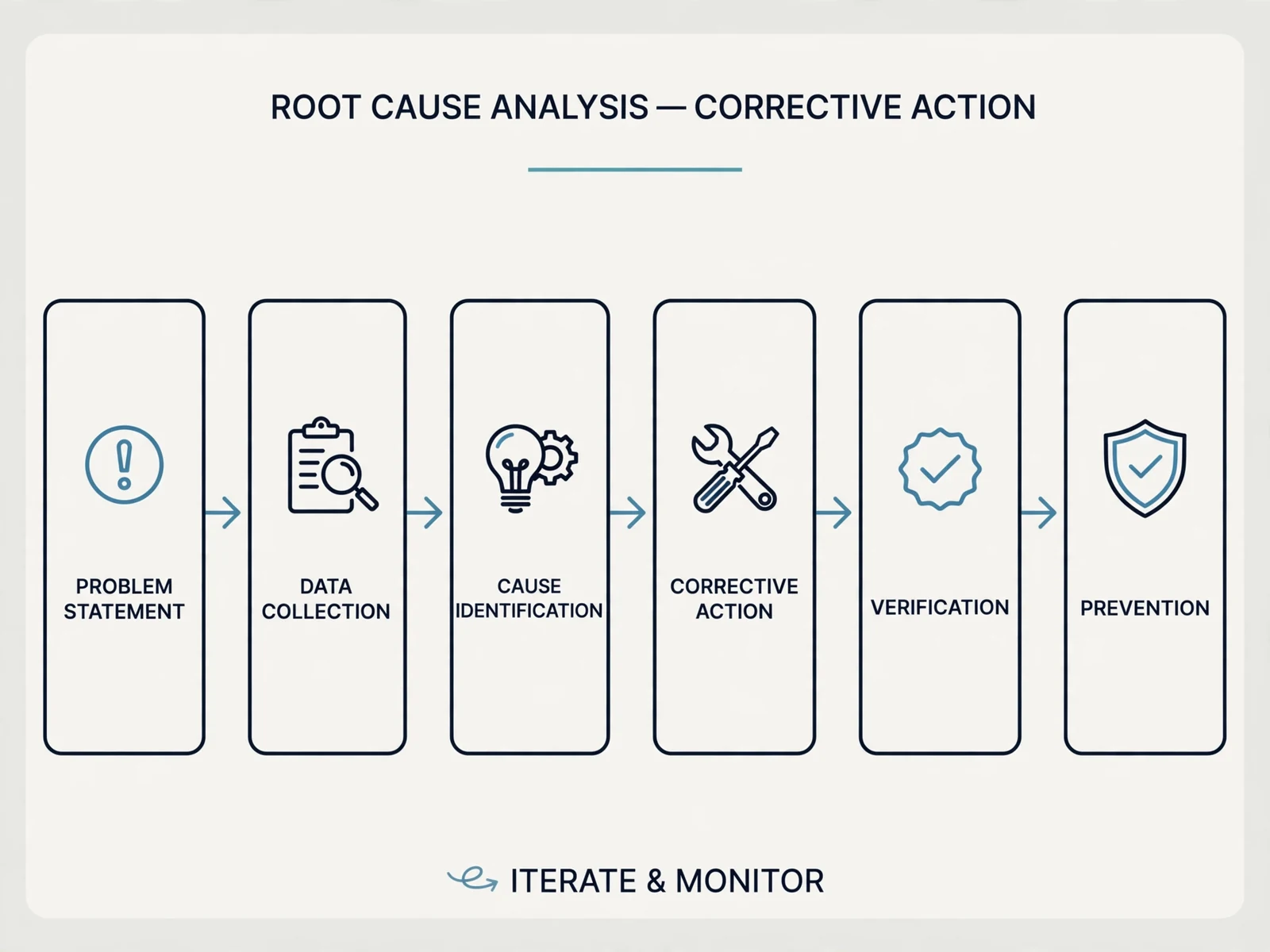
This program is for operations, quality, safety, service and management teams who investigate recurring problems, failures, complaints or incidents. It develops a disciplined approach from problem definition through corrective-action verification.
Participants separate symptoms from causes, gather evidence, use structured causal tools, test assumptions, design corrective actions and define effectiveness checks.
For organizations, the course can support quality systems, operational excellence, incident learning and teams that need a common investigation method.
Where this program fits
Operations, quality, safety, service and management teams responsible for recurring problems or incidents
Live classroom, live online or private in-house. Depth and schedule are tailored to the cohort.
Problem definition, evidence, causal analysis, human and system factors, corrective action and effectiveness
A complete root-cause and corrective-action plan for a live or realistic recurring problem
Built for Corporate Cohorts
Private delivery can be aligned to participant roles, business priorities, internal terminology and real workplace scenarios. HR, L&D and functional sponsors can use the course alone or inside a broader academy.
What Participants Will Learn
Describe what happened, where, when and with what consequence.
Avoid jumping from one observation to a preferred explanation.
Use structured tools to distinguish contributing factors from deeper causes.
Look beyond individual error to process, design, capability and control.
Match actions to the cause rather than to the visible symptom.
Define evidence that shows recurrence risk has actually reduced.
Business Problems This Program Is Designed to Address
Course Outline
Applied Practice and Scenario Work
Participants use realistic situations to practise analysis, decisions, stakeholder communication and application. Private cohorts can adapt scenarios to the organization’s context while protecting confidential information.
Participants investigate process, workload, information and control conditions before concluding.
Participants build a timeline and test evidence rather than choosing the most familiar explanation.
Participants strengthen actions by addressing process and control causes.
Participants examine whether the original cause was wrong or effectiveness was never verified.
Practical Tools and Work Products
What Strong Practice Looks Like
Strong investigations begin with a precise problem statement. If the problem is defined too broadly, analysis becomes unfocused; if it is defined around an assumed cause, the investigation becomes biased before evidence is gathered.
Evidence should establish sequence and conditions. Timelines, records, observations and interviews can reveal what changed before the event, which controls were present and where assumptions differ from actual work.
Causal tools are aids to reasoning, not proof by themselves. Five Whys, cause-and-effect diagrams and barrier analysis can structure inquiry, but the conclusions still need evidence. Participants learn to avoid forcing every problem into a single linear cause.
Human error is often a starting point rather than an end point. Leaders should ask why the action made sense in the situation, what information was available, what conditions influenced behavior and which system defenses were absent or weak.
Corrective actions should be proportionate and testable. A useful action changes the condition that produced the problem and has a clear owner, completion standard and effectiveness measure.
Questions Participants Learn to Ask
What exactly happened and what evidence confirms it?
Which cause is supported rather than assumed?
What system condition made recurrence possible?
How will we know the corrective action reduced the risk?
Implementation Pitfalls and Cross-Functional Interfaces
Capability in this topic depends on how decisions move across the organization. Private cohorts can map where ownership, information or incentives currently break down and use those interfaces as part of the learning design.
- Quality teams for nonconformance and corrective-action systems
- Operations for process and equipment conditions
- Safety or risk teams for incident learning
- Leadership for systemic actions requiring resources or policy change
A common implementation mistake is to add a framework without changing the management routine around it. Participants identify where the tool will be used, who needs to be involved, what evidence is required and what decision or behavior should become different after application.
Advanced Application Considerations
Investigation quality can be damaged by hindsight. After an event, the correct action often appears obvious even though the people involved did not have the same information at the time. Participants reconstruct the situation as it was experienced rather than judging only from the final outcome.
Another challenge is causal depth. Teams can keep asking why indefinitely. The practical stopping point is where evidence supports a controllable condition and further analysis would not materially change the corrective action.
Organizations also need a mechanism for shared learning. A root cause found in one location may exist elsewhere. Participants consider where the same condition could recur and whether corrective action should be local or enterprise-wide.
Before the Program Begins
For a private cohort, participants can identify one current case, decision or recurring problem related to the topic. Anonymized patterns can be used to weight practice without turning the program into a review of confidential internal matters.
After the Program
Participants can use one work product in the next relevant work cycle and discuss the result with a manager or peer. The goal is to reinforce application while the participant has a live opportunity to use the capability.
Manager Reinforcement and Evidence of Application
Sponsors can look for observable changes such as clearer decisions, stronger preparation, better use of the relevant work product, improved ownership or better escalation. These are indicators that the capability is being applied, not automatic claims that attendance caused a business result.
Participants should select one or two applications first rather than trying to use every concept at once. Managers can ask what was tried, what response followed and what should be adjusted next time.
Designing a Private Cohort Around Real Work
Before private delivery, the sponsor can define participant roles, experience level, common workplace situations, internal terminology and one or two practical outputs that would be useful after the program.
- Participant roles and experience.
- Recurring decisions or problems the cohort needs to handle better.
- Relevant internal frameworks or governance.
- Practical work products participants can use afterward.
- How managers will reinforce application.
Capability Maturity and Management Judgement
Investigators also need to distinguish causal factors from control failures. A condition may contribute to an event while a separate failed barrier explains why the event was not prevented or detected. Participants map both so corrective actions can address cause and protection.
Interview technique matters because people can unintentionally reshape memories after an incident. The course emphasizes open questions, sequence reconstruction and evidence cross-checking rather than leading interviewees toward the investigator’s initial theory.
Corrective-action quality improves when actions are tested for unintended consequence. A stronger control may create delay, workload or a new failure mode elsewhere. Participants consider implementation risk before an action is treated as complete.
For corporate cohorts, these maturity questions can be used to compare current practice with a stronger operating model and identify one or two realistic changes that would improve control, decision quality or performance.
The final investigation report should also separate evidence, interpretation and action. That distinction makes review easier, reduces hindsight bias and helps future teams understand why a corrective action was selected rather than seeing only the final conclusion.
This gives sponsors a practical way to distinguish basic tool use from mature application: the participant can explain not only what method was used, but why it was appropriate, what evidence supported it and how the decision will be reviewed.
Who Should Attend
- Quality and operational excellence professionals
- Operations and maintenance managers
- Safety, service and incident-investigation teams
- Managers responsible for corrective action
Organizational Benefits
- Improve investigation discipline
- Reduce blame-based conclusions
- Strengthen corrective-action quality
- Improve recurrence prevention
- Create a common organizational RCA method
Delivery and Pricing
The program is live and instructor-led. It can be delivered in the classroom, live online or in-house. Duration is flexible and should reflect participant level, selected depth, organizational objectives and the amount of applied practice required.
Public and private pricing: current public fees are confirmed with scheduled cohorts. Private and customized programs are quoted according to cohort size, location, scope and customization. Request a proposal.
Frequently Asked Questions
Can this be delivered privately for one organization?
Yes. Private cohorts can be calibrated to participant roles, business context and priority scenarios.
Is the duration fixed?
No. Delivery depth and schedule are adapted to the cohort and learning objective.
Can we use our own scenarios?
Yes. Organization-relevant situations can be used while protecting confidential information.
Can this sit inside a broader academy?
Yes. It can be combined with related programs into a role, function or leadership pathway.
Is this self-paced?
No. TheSkillGrid programs are live and instructor-led.
Related Programs
- Operational Excellence and Process Improvement
- Quality Management Systems and Continuous Improvement
- Enterprise Risk Management for Managers and Leaders
- Business Process Management and Process Redesign
Build a Cohort Around the Capability Need
TheSkillGrid can combine this course with adjacent programs into a coherent corporate pathway.
Upcoming Dates & Venues
Request course availability with your preferred date, location and group size. We will confirm available public-session and private-team options before any booking or payment.
Ready to Take the Next Step?
Register your interest for a public session or request private in-house delivery for your team.