
If the same problem keeps returning, the organization is probably managing the symptom rather than the cause. Root cause analysis helps managers understand why the failure occurs and which change is most likely to prevent recurrence.
Write a Precise Problem Statement
Avoid broad labels such as poor communication or low quality. State what happened, where, when, how often and what consequence followed. A precise problem statement keeps the investigation anchored to evidence.
Contain the Immediate Risk
Root cause analysis does not mean waiting while the problem continues. Use temporary containment where necessary to protect customers, safety, compliance or operations. Make clear that containment is not the permanent solution.
Collect Evidence Before Opinions
Review data, records, process steps, timing, physical conditions and stakeholder accounts. Separate what is known from what is assumed. Teams often jump to the most visible explanation because it fits a familiar story.
Map the Process Around the Failure
Understand what happened before and after the problem. Look at handoffs, approvals, system steps, workload, inputs, environment and exceptions. The cause may sit upstream from where the failure becomes visible.
Use Five Whys Carefully
The Five Whys can help, but it should not become a ritual that forces a single linear cause. Ask why each condition existed and verify the answer with evidence. Complex problems may have several interacting causes.
Use Cause Categories
Consider people, process, technology, information, materials, environment, policy, incentives and management system. Categories help the team avoid blaming the nearest person when the system created the conditions for failure.
Distinguish Root Cause From Contributing Factors
A root cause is a condition that, if effectively addressed, materially reduces recurrence. Contributing factors make the problem more likely or more severe. Record both. Removing one factor may still be worthwhile even if it is not the deepest cause.
Test the Cause Hypothesis
Ask whether the proposed cause explains the evidence. If the cause were removed, would the failure be less likely? Can similar cases be found? Does the timeline fit? Treat the analysis as a hypothesis to test, not a conclusion to defend.
Choose Countermeasures That Change the System
Training may be appropriate when capability is genuinely missing, but many recurring problems require changes to workflow, data, tooling, approval, workload, supplier conditions, standards or decision rights. Match the countermeasure to the diagnosed cause.
Assign Owners and Review Effectiveness
A corrective action is not complete because it was implemented. Review whether the failure rate changed, whether new problems appeared and whether the standard was updated. If the problem continues, reopen the analysis.
Share Learning Across Similar Processes
One root cause may exist in several teams or sites. Ask whether the same condition appears elsewhere. This turns a local incident into an opportunity for preventive improvement.
Inspect the Management System
Repeated failures can reveal weaknesses in escalation, review cadence, ownership or measures. If leaders only notice the problem after customer impact, the management system may need redesign as much as the operational process.
Practical Working Template
- Problem statement
- Immediate containment
- Evidence collected
- Process step where failure appears
- Possible causes
- Verified cause
- Contributing factors
- Countermeasure
- Owner
- Effectiveness measure
- Review date
- Learning to share
Worked Example
A team repeatedly sends incorrect customer invoices. The first response is to remind staff to check more carefully. Analysis shows the billing system pulls an outdated pricing table whenever one contract type is selected. Staff attention can reduce some errors, but the system condition keeps creating them. The permanent fix is to correct the data logic and add a control that detects mismatches before invoices are issued.
Common Mistakes to Avoid
- Blaming an individual before examining the system
- Using Five Whys without evidence
- Treating retraining as the default corrective action
- Stopping at the first plausible cause
- Closing actions without checking effectiveness
- Failing to update standards after the fix
Questions Managers Should Ask
- What exactly failed?
- What evidence supports the suspected cause?
- What condition allowed the failure to happen?
- Would the countermeasure prevent recurrence or only detect it earlier?
- Where else could the same cause exist?
How to Apply This Over 30 Days
- Week 1: map the current process, exposure or decision and identify the biggest uncertainty.
- Week 2: apply the framework to one live case and capture the evidence.
- Week 3: review the result with the people who own related decisions or dependencies.
- Week 4: decide what should become a repeatable management standard, trigger or review routine.
Use a Cause-and-Evidence Table
For each suspected cause, record the evidence for it, the evidence against it and what test would confirm or reject the hypothesis. This reduces the risk that the team falls in love with the first explanation. It also makes disagreement useful because people can challenge evidence rather than defend opinions.
Distinguish Human Error From System Design
Human error can be real, but managers should ask what made the error likely, hard to detect or easy to repeat. Interface design, workload, unclear standards, poor data, conflicting incentives or missing checks may sit underneath the visible mistake. Corrective action should address those conditions where appropriate.
Know When to Stop the Analysis
Root cause analysis can also become excessive. Stop when the team has enough evidence to choose a countermeasure that is proportionate to the consequence and can be tested. Do not keep searching for a deeper philosophical cause when the actionable condition is already clear.
Use Recurrence as a Management Signal
If the same class of problem appears in several areas, the issue may sit above the local process. Review common systems, policies, training, technology or governance. Recurrence across teams is evidence that a local fix may not be enough.
Worked Example: Repeated Late Deliveries
A team blames a supplier for late delivery because the shipment arrives after the requested date. The investigation shows purchase orders are routinely approved three days later than planned, which causes the supplier to miss the original window. Supplier performance still matters, but the internal approval delay is a material cause. Without mapping the timeline, the organization would have negotiated with the supplier while leaving the main internal problem untouched.
Build Corrective-Action Levels
Not every finding needs the same response. A minor isolated issue may need a local correction. A recurring process failure may need a formal countermeasure and standard update. A high-consequence systemic issue may need senior governance, wider testing and cross-functional action. Scaling the response to consequence keeps the process rigorous without making every problem bureaucratic.
Final Management Checklist
- Is the business purpose clear?
- Are the assumptions and evidence visible?
- Does the process distinguish routine issues from material exceptions?
- Is there one accountable owner for the next action?
- Is there a trigger for escalation or review?
- Will the team know what changed at the next cycle?
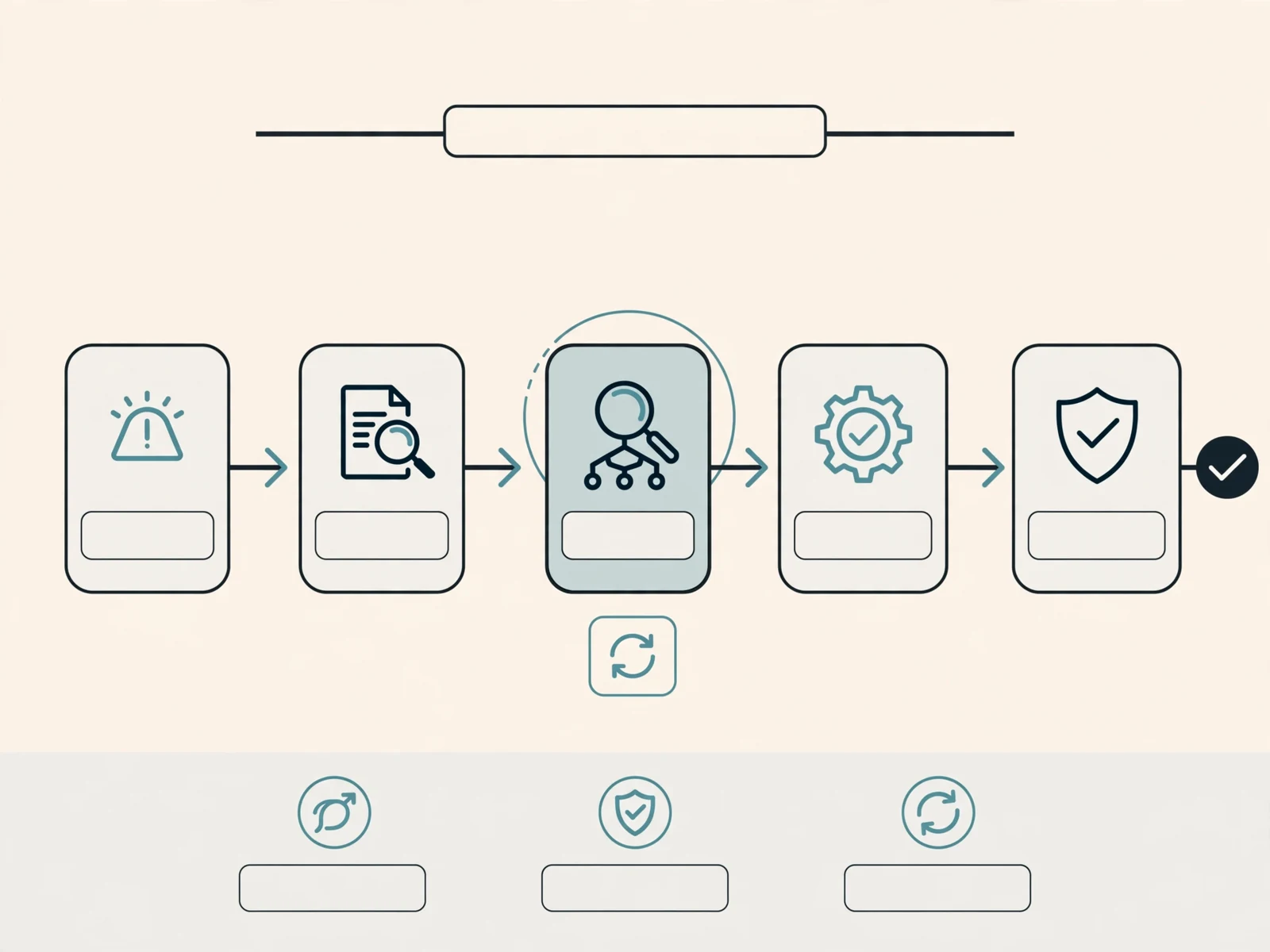
Describe failure, scope and consequence
Protect customer and operation now
Compare hypotheses with real evidence
Check countermeasure and recurrence
Distinguish the symptom from the failure mechanism
A useful problem statement describes what failed, where, when, under which conditions and how the expected standard differed from the observed result. Avoid explanations such as ‘people did not care’ until actual evidence supports a behavioral cause. Separate the immediate containment required to protect customers from longer-term corrective action. Fixing today’s incident does not establish why it happened or whether the same mechanism is present elsewhere.
Different methods serve different questions. Five Whys can help explore one causal chain but may be misleading when several interacting factors caused an event. A fishbone diagram can organize candidate causes across people, materials, equipment, methods and environment, but a diagram filled with guesses is not a validated analysis. Choose the tool based on the complexity of the failure and available evidence.
Worked case: refresher training did not stop the defect
A production team sees the same quality error repeatedly and closes each incident with an instruction to operators to be more careful. Months later, the defect returns. An analyst observes the work and compares affected lots. They find that a component can be assembled in the wrong orientation because the fixture accepts both positions and the written instruction lacks a clear inspection point. Training alone did not alter the failure mechanism.
The team tests a fixture change and a verification step on representative production runs, while checking whether the change introduces other quality or safety issues. Engineering and quality owners approve the revised standard. A later effectiveness review examines whether the defect recurs during ordinary shifts, not just while supervisors are watching. If the failure persists, the cause hypothesis is revised rather than marking the corrective action complete.
Use a cause-and-evidence register
For each proposed cause, record why it might explain the observed failure, the evidence that would support it, the evidence that might refute it and the person responsible for testing it. A correlation between a new employee and a defect does not by itself establish that training was the root cause. Ask whether the process allowed the error, whether instructions were consistent, whether equipment performed within tolerance and whether quality controls detected the issue early enough.
Prioritize hypotheses that can explain the pattern and be tested safely. Avoid repeatedly asking ‘why’ until someone supplies a convenient personal explanation. When uncertainty remains, state it. Some incidents have interacting causes; a defensible analysis can identify several controls that need improvement rather than forcing every case into one final root.
| Situation | Evidence or constraint | Management response |
|---|---|---|
| Observed symptom | What failed and under which conditions? | Case records and direct observation |
| Possible cause | What evidence would confirm or refute it? | Test owner and method |
| Corrective action | How does it change the mechanism? | Control design and implementation |
| Effectiveness | Did failure stop during ordinary work? | Independent follow-up evidence |
Verify corrective action under normal conditions
Choose an action that addresses the established mechanism. It might be a fixture redesign, improved information at the point of work, a reliable approval route, maintenance change or updated specification. Name an owner and target state. Trial the change and evaluate both effectiveness and unintended consequences. A form showing that employees attended training or signed an acknowledgement is not proof that a recurring technical problem has been solved.
Close the review only after appropriate evidence is gathered over a meaningful operating period. Communicate relevant lessons to similar teams or sites. If the intervention is too expensive or the root remains uncertain, escalate for a risk-based decision rather than quietly declaring success.
Where to Go Next
The Operational Excellence and Process Improvement develops this capability through live instructor-led practice and work application. Related programs include Change Management and Organizational Transformation and Business Analysis and Requirements Management.
Use the framework on a live decision, learn from the result, and then build the repeatable standard.
Build Root Cause Analysis Skills Around Real Process Problems
Tell us which operational problems your team needs to investigate, who will participate and what improvement decisions they own. TheSkillGrid can assess a role-specific private training format, subject to facilitator availability and a confirmed proposal.
Develop this capability in your organization