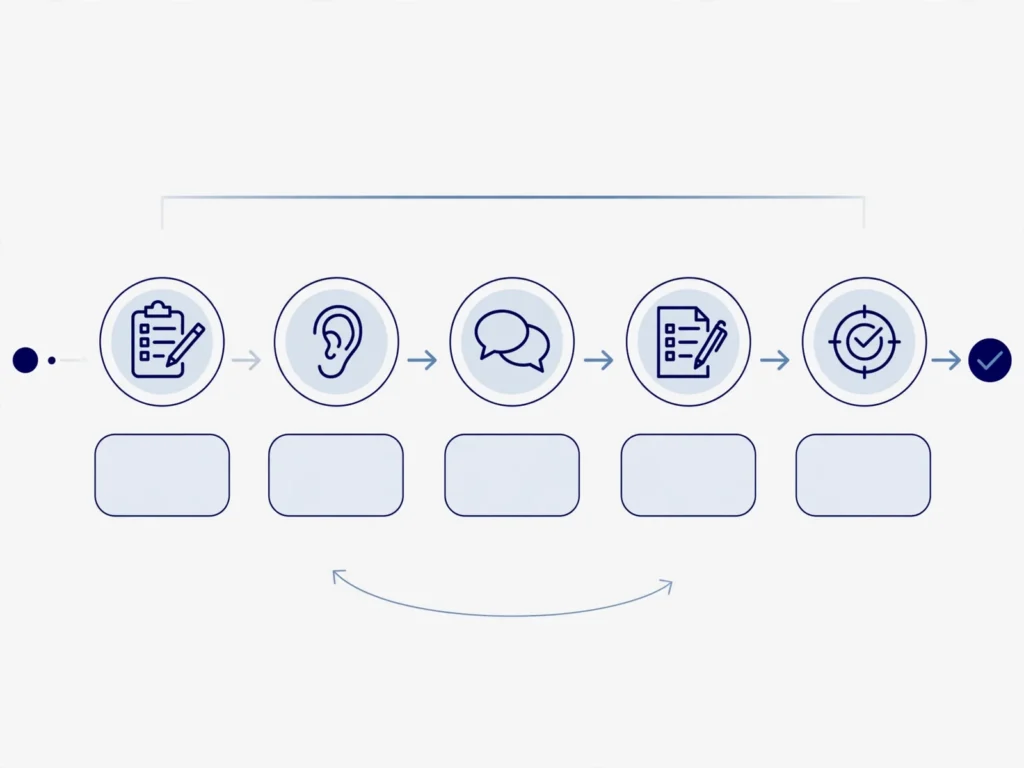
Coaching is not a softer version of telling someone what to do. A useful coaching conversation helps the employee think more clearly, take ownership and leave with a specific action they can test.
Choose the Right Moment
Not every issue needs coaching. Immediate safety, compliance or urgent performance situations may require clear direction. Coaching is most useful when the employee has enough capability and context to think through options and the manager wants to build judgement rather than only secure immediate compliance.
Agree the Focus
Start by defining what the employee wants or needs to work through. A vague conversation about development is hard to coach. Narrow the topic to a decision, recurring challenge, relationship, goal or behavior.
Ask for the Employee’s View First
Before offering your analysis, ask what they think is happening. This reveals assumptions, evidence, confidence and gaps in judgement. If the manager answers too quickly, the employee learns to wait for solutions.
Listen for the Thinking, Not Only the Story
Notice how the employee frames the issue. Are they assuming intent? Avoiding a difficult stakeholder? Focusing only on one option? Missing evidence? Coaching listens for the quality of thinking underneath the description.
Use Questions That Create Reflection
Useful questions include: What outcome are you trying to create? What evidence do you have? What else might explain the situation? What options have you considered? What are you avoiding? What would you recommend if I were not here?
Challenge Respectfully
Coaching is not passive agreement. Challenge weak assumptions, contradictions or avoidance. Use evidence and curiosity. A question such as ‘What makes you confident that stakeholder will support the plan?’ can be more developmental than simply saying the assumption is wrong.
Separate Advice From Coaching
Sometimes the manager has information the employee genuinely needs. Share it, but label the shift. You might say, ‘I want to step out of coaching for a moment and give you context you may not have.’ Then return ownership of the decision where appropriate.
Move From Options to Choice
A conversation becomes useful when the employee chooses a next move. Ask which option they recommend, why, what risk they see and what support they need.
Define Commitment
Clarify the action, timing and what the employee will do if the first attempt does not work. Avoid vague endings such as ‘I’ll think about it.’ Coaching should produce movement.
Agree Follow-Up
Set a natural review point. The purpose is not surveillance. Follow-up helps the employee learn from the result and prevents the conversation from becoming a one-time discussion disconnected from work.
Coach Patterns, Not Only Events
If the same issue appears repeatedly, coach the underlying pattern. An employee may repeatedly delay escalation, avoid conflict or over-analyze decisions. Pattern coaching creates broader development than solving each event separately.
Know When to Switch to Performance Management
Coaching is not a substitute for clear standards. If expectations are understood and performance remains below the required level, the manager may need a direct performance conversation and formal process rather than endless coaching.
Practical Working Template
- Focus
- Desired outcome
- Employee’s view
- Evidence
- Assumptions
- Options
- Manager challenge
- Employee recommendation
- Action
- Support required
- Follow-up date
- Learning
Worked Example
An employee says a project stakeholder is impossible and asks the manager to intervene. Instead of taking over, the manager asks what outcome is needed, what the stakeholder has actually said, what concern may be driving the resistance and what conversation the employee could have next. The employee realizes they have been sending updates but have never asked what risk the stakeholder is trying to protect.
Common Mistakes to Avoid
- Turning coaching into disguised advice
- Asking leading questions with a predetermined answer
- Coaching when direct instruction is required
- Letting the conversation end without action
- Taking ownership of the employee’s problem
- Avoiding performance accountability by calling everything coaching
Questions Managers Should Ask
- What outcome are you trying to create?
- What evidence supports your view?
- What assumption should we test?
- What options do you have?
- What do you recommend?
- What will you do next and when?
Use Silence Deliberately
Managers often fill silence because they are uncomfortable waiting. Give the employee time to think. A short pause after a difficult question can produce a more reflective answer than asking three follow-up questions immediately.
Coach With Evidence
When challenging an assumption, return to observable facts. Ask what happened, what was said, what result followed and what evidence supports the conclusion. This helps the employee separate interpretation from reality and improves judgement.
Build a Coaching Log Without Bureaucracy
Managers can record the development theme, agreed action and follow-up date in a few lines. The purpose is continuity, not surveillance. A lightweight record helps the manager see patterns and avoid having the same conversation repeatedly without progress.
Calibrate Coaching to Experience
A new employee may need more structure, context and examples. An experienced employee may benefit from broader questions and more autonomy. Good coaching adjusts the balance between guidance and ownership based on capability and risk.
30-Day Application Plan
- Week 1: define the current decision, process or population and capture the baseline.
- Week 2: apply the framework to one live case and identify the biggest uncertainty or gap.
- Week 3: review the evidence with the relevant manager, partner or functional owner.
- Week 4: decide which part of the approach should become a repeatable management routine.
Final Review Checklist
- Is the management question clear?
- Are definitions and assumptions explicit?
- Is ownership visible?
- Is there a trigger for action or escalation?
- Will the next review show what changed?
Worked Example: Coaching Instead of Taking Over
A manager is asked to step into a difficult stakeholder relationship. Instead of immediately intervening, the manager asks the employee to describe the stakeholder’s concern, what outcome is needed, what evidence supports their interpretation and what conversation they have not yet tried. The employee recognizes that they have been defending the project rather than exploring the stakeholder’s risk. They design a new conversation and retain ownership of the relationship.
Use Coaching to Build Decision Quality
Managers can coach around decisions by asking the employee to frame options, trade-offs, assumptions and recommendation. This is particularly useful for developing future managers because it makes judgement visible. The goal is not to make every decision slow. It is to deliberately practise better thinking on decisions that matter.
Know When to End the Coaching Loop
If the same issue returns with no application between conversations, switch from exploration to accountability. Ask what commitment was made, what happened and what barrier prevented action. Coaching remains developmental only when the employee is expected to use the insight.
Final Management Checklist
- Has the employee described the situation and proposed a way forward?
- Does the manager know whether this requires coaching, advice or an explicit instruction?
- What one behaviour or decision will be practised before the next conversation?
- What feedback will be based on observable work rather than impressions?
- When will manager and employee review the result and adjust the support level?
A useful coaching conversation ends with a realistic next action owned by the employee, not a longer list of questions.
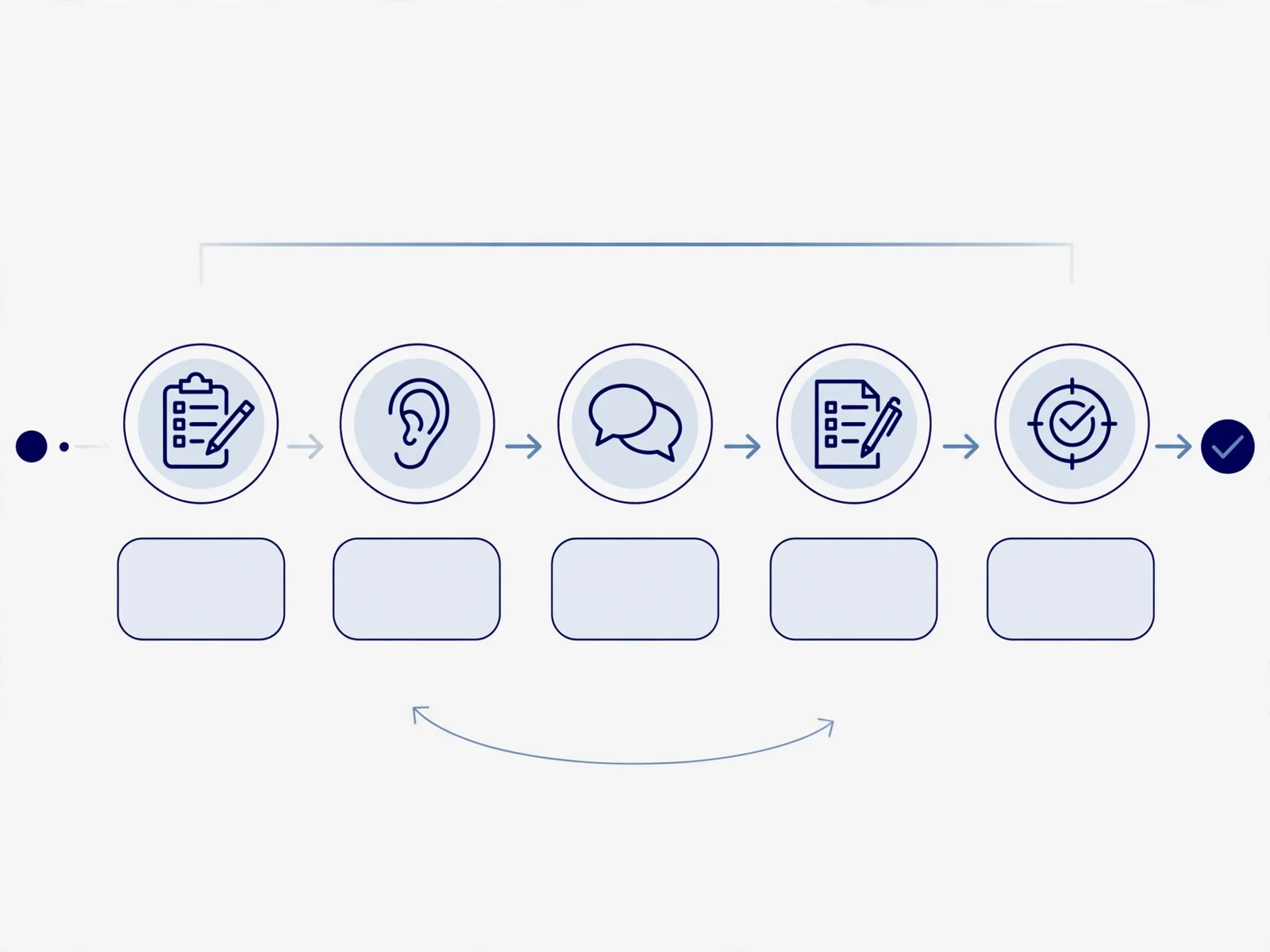
Choose one behavior or decision
Reconstruct the actual case
Test alternatives and feedback
Observe what changes on the job
Distinguish coaching from directions and formal performance management
A manager should not use questions mechanically when the employee urgently needs an instruction, a safe escalation or clarity about a non-negotiable standard. Coaching is most useful when someone has enough context to reflect on a difficult decision and develop their judgment. Begin by identifying the concrete work behavior or result to improve. A vague invitation such as ‘How can you do better?’ can feel like a disguised reprimand when the employee has no idea which example matters.
Explain the purpose of the conversation and invite the person’s view. When a performance or conduct issue requires formal action, follow the appropriate organizational process rather than disguising it as optional coaching. A manager can be supportive and still be specific about expected standards.
Worked example: an unproductive customer escalation
A team lead notices that an experienced account coordinator repeatedly sends client complaints to a director without making an initial assessment. The manager could order them to ‘take more initiative’. Instead, she selects one recent case and asks what information the employee had, which decisions were unclear and what they believed could go wrong. The employee explains that a previous customer remedy was reversed by another manager, so the authority boundary feels unreliable.
The manager confirms the actual contract and remedy limits, invites the coordinator to propose two suitable responses and rehearses how to communicate the next step to the customer. They agree which exception should be escalated. At the next meeting, they review one real case, checking not only whether escalations fell but whether customers received consistent remedies. The conversation improves both individual judgement and the process that had undermined it.
Ask questions that expose reasoning, not just feelings
Useful questions include ‘What was the result you needed?’, ‘Where did your original assumption fail?’, ‘What other route was realistically available?’ and ‘What evidence would change your next decision?’ Avoid leading questions where the only acceptable answer is the manager’s preferred view. Give the employee time to think, and test ideas against actual customer, safety, contractual and operational constraints.
If the person lacks an essential skill or policy knowledge, provide instruction, a model example or specialist support. Coaching cannot replace information they have never been given. Ask the employee to describe which alternative they will try, why it makes sense and what would signal the need to pause or seek help.
| Situation or measure | Decision question | Evidence or action |
|---|---|---|
| Employee lacks information | Explain the relevant rule and example | Check comprehension before independent work |
| Decision is ambiguous | Explore options and constraints | Agree one bounded next attempt |
| Urgent safety or compliance issue | Give direction and escalate | Record responsible follow-up |
| Repeated underperformance | Follow formal standards and support | Use documented, fair performance process |
Turn insight into a specific experiment
Agree one manageable practice assignment. For example, the employee could draft a short diagnosis and proposed resolution for the next routine customer complaint before deciding whether escalation is needed. Define the boundaries, reviewer and timeframe. At follow-up, examine the work product and the business outcome. If it did not work, revise the assumption or support, not just the person’s confidence.
Record only the needed developmental actions and avoid turning informal reflection into unnecessary sensitive personnel notes. Managers should follow applicable data and employment policies. The best sign of successful coaching is a more dependable work decision under real conditions, not a lengthy one-to-one transcript.
Where to Go Next
The Coaching Skills for Managers and Leaders develops this capability through live instructor-led practice and workplace application. Related programs include Performance Management and Employee Engagement and Leading High-Performing Teams for Women Managers.
Use the framework on one real decision first, then build the repeatable practice from what you learn.
Structured Coaching Conversations for Teams
Managers can practise short, purposeful coaching conversations using situations from their own teams, with specific follow-up actions.
Choose the right manager response: The coaching versus telling guide helps decide when to ask, advise or direct. The one-to-one questions guide provides prompts for regular performance and development meetings.
Develop this capability in your organization