A better one-to-one begins with a genuine management question, not a checklist of motivational phrases. The manager wants to understand work, obstacles, performance and growth. The employee needs a conversation that changes what happens next. This guide explains which questions to ask, how to respond to answers and how to turn the discussion into visible support and accountability.
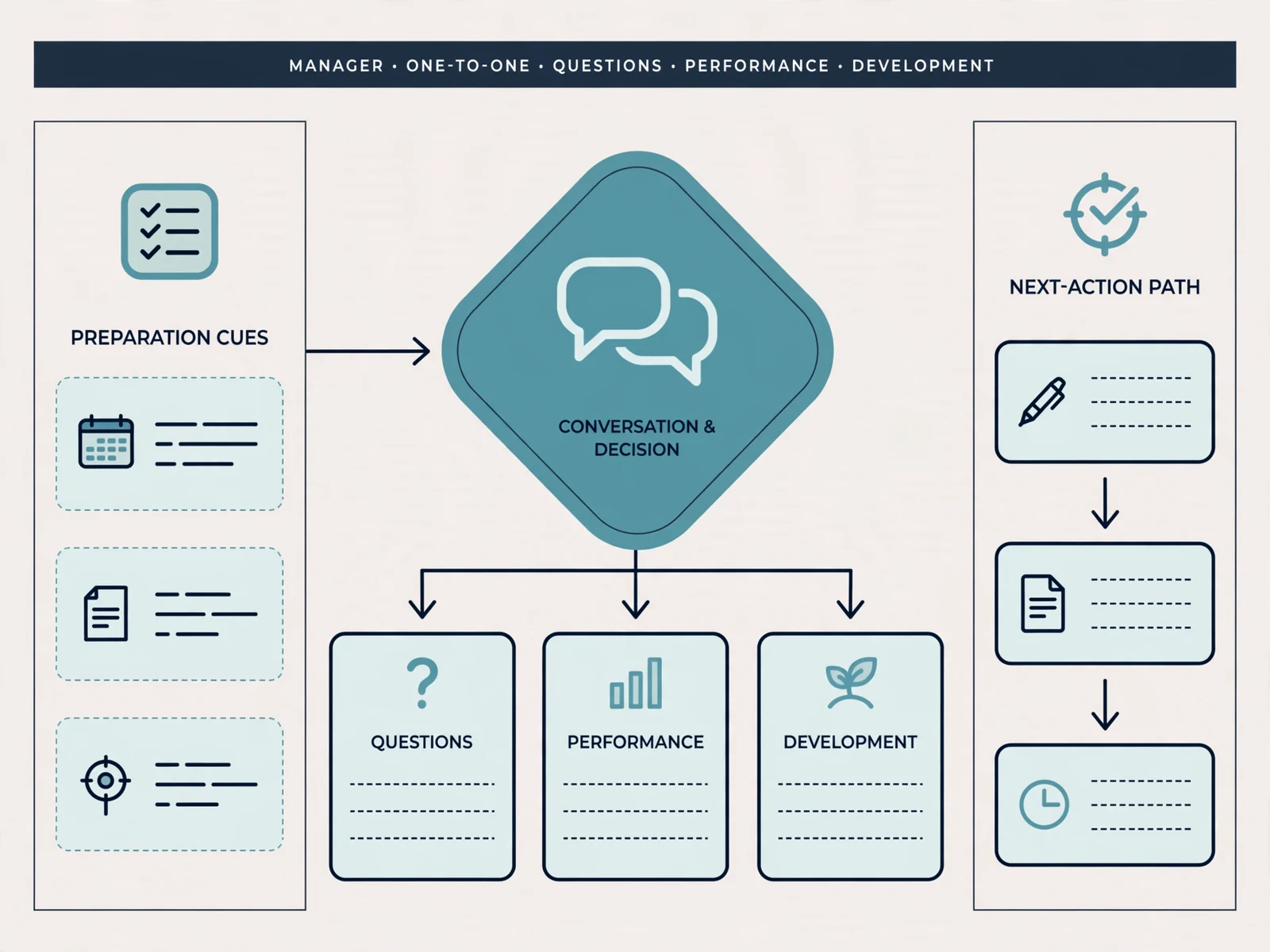
Visual guide · from question to outcome
What changed or needs attention?
What is the evidence and cause?
What action and support are agreed?
What outcome will we check next time?
A one-to-one creates value when a real management action follows the conversation.
What a useful one-to-one is actually for
A one-to-one is not a miniature team-status meeting. It is the manager’s opportunity to discover what an employee needs to deliver, develop and stay effective. The employee should leave with clearer priorities, fewer unresolved obstacles or a better understanding of their next step. A manager should leave with evidence of what is happening rather than merely a reassuring feeling that the conversation went well.
A common failure is asking a long list of friendly questions without acting on the answers. Another is turning the conversation into an unannounced performance review. A predictable rhythm helps: agree what has changed, explore the issue that matters most, make the next decision, then record commitments. The agenda can flex for a new employee, a senior specialist, or someone under pressure, but clarity and follow-through should remain constant.
Prepare without scripting every minute
Invite the employee to identify one or two discussion items in advance. Look back at promises from the previous meeting, current outcomes, workload pressure and recent feedback. Avoid filling the agenda exclusively with the manager’s priorities. If an employee raises a sensitive subject, make space for it rather than trying to finish every planned question.
Managers should also separate fact from assumption before entering the room. “Two client reports were late” is observable; “you are disengaged” is an interpretation. If a concern must be discussed, bring examples, identify the required standard and ask for the employee’s perspective. Preparation should make the conversation safer and more specific, not make the employee feel that a verdict has already been reached.
Eight questions that uncover what matters
Begin with an open invitation: “What would be most useful for us to cover today?” This gives the employee room to surface issues that may be invisible in dashboards. Follow with “What has changed since we last spoke?” and “Which outcome matters most before our next meeting?” These questions distinguish a current priority from a familiar but lower-value activity.
To discover obstacles, ask “What is taking longer than it should, and why?” or “Which decision or handoff is preventing progress?” To explore ownership, ask “What have you tried, and what would you recommend next?” To understand management support, ask “What could I clarify, unblock or stop doing?” A strong final question is “What have we agreed, and who will do what by when?” These questions are starting points, not a script; use follow-ups that respond to the answer.
| Need | Ask | Follow-up evidence |
|---|---|---|
| Priority clarity | What must be different by next week? | Agreed outcome and trade-off |
| Delivery blocker | Where does the work stop moving? | Decision or handoff owner |
| Performance concern | What happened in this example? | Behavior, standard and next attempt |
| Growth | Which capability should you practise next? | Stretch assignment and review |
| Manager support | What could I change to unblock you? | Manager action and due point |
The questions to use in four different situations
When goals are unclear, concentrate on outcomes, trade-offs and the definition of finished work. Ask: “If only one result moves this week, which should it be?” “Which request would you decline or renegotiate?” and “What would acceptable quality look like?” In this situation, more motivational questions will not compensate for ambiguous priorities.
When someone is struggling, ask for a reconstruction of a real example: “Where did the task start going differently than expected?” “Which assumption proved wrong?” “What feedback have you received?” Then identify one specific behavior to test. When someone is performing strongly, explore autonomy, stretch and contribution: “Which decision could you own without further approval?” “What capability do you want to practise?” When engagement seems lower, avoid diagnosis by guesswork. Ask about workload, meaningful work, relationships and obstacles without pressing for personal information the employee does not wish to share.
Worked example: a missed deadline with two possible causes
An analyst misses a recurring report deadline. The manager could assume poor time management and demand tighter updates. Instead, they begin with the facts: “We delivered the last two reports after the agreed time. Talk me through the steps and where the delay occurred.” The analyst explains that two departments send source data late and that a new validation step takes longer than expected. The manager asks which part the analyst can change independently and which requires cross-team authority.
Together they decide that the analyst will test an earlier data request and provide a draft of the validation checklist. The manager will speak with the data owners about a firm handoff time. They agree to review the next two reporting cycles for timeliness and rework. If the evidence later shows that the analyst also needs help with a technical step, they can address that specifically. The conversation neither excuses the missed deadline nor treats an untested assumption as a performance diagnosis.
Feedback that leads to an actual change
Feedback is most useful when it identifies behavior, context, impact and a next attempt. Instead of “be more proactive,” say: “During Monday’s handoff, two open client issues were not assigned an owner. The next team lost time locating them. At the next handoff, please name an owner and expected update time for every unresolved issue.” Invite the employee to challenge the account if it omits important context.
Positive feedback also needs evidence. “You handled the meeting well” is pleasant but hard to repeat. “You summarized the disputed scope, asked both teams to confirm the decision and sent a clear action note” names a practice worth reinforcing. Use the same clarity when asking for upward feedback: “What could I do differently to help you make faster decisions?” Then demonstrate that asking was not a ceremonial exercise by acting on a manageable suggestion.
Development and career conversations without false promises
Development is not always promotion. It may mean gaining confidence in a difficult conversation, taking ownership of a new process, working with a different stakeholder or learning a specialist skill. Ask which capability the employee wants to build, why it matters to current work, and what assignment would provide real practice. A useful stretch task should offer challenge alongside support and feedback, not simply add more work.
For career planning, discuss interests, capability evidence, future role demands and opportunities that actually exist. Avoid promising a role that has not been approved. Document the next development experience and what successful application would look like. The manager might arrange a presentation to senior stakeholders or invite the employee to lead one improvement meeting, then review a tangible work product rather than relying only on attendance at a training course.
Protect trust, dignity and boundaries
One-to-ones may reveal stress, conflict or personal challenges. Do not turn curiosity into unwanted probing. Let employees choose how much private information to share, and focus your management discussion on work adjustments, resources and professional support pathways. For serious concerns involving safety, harassment, discrimination or policy obligations, follow the organization’s established reporting and escalation processes rather than promising absolute confidentiality.
Keep routine notes focused on decisions and support: owners, agreed actions, deadlines and follow-up. Avoid informal psychological labels or unnecessary sensitive details. If you use AI to summarize meeting notes, follow company data-handling rules and obtain any required approval. For remote meetings, reduce interruptions, allow silence after questions and confirm what both parties understood, because body language and side conversations offer fewer cues.
An agenda for a 25-minute conversation
Use the first few minutes for the employee’s most pressing change since the last meeting. Spend the largest block on one performance, workload, stakeholder or development issue. Reserve time to test assumptions and agree decisions rather than spending every minute collecting updates. End by reviewing responsibilities. This is an illustrative meeting structure, not a fixed formula: a new starter may need more clarification and an employee facing a serious issue may need a longer, separate discussion.
A manager who has only five minutes should choose a useful single question and set a proper follow-up instead of pretending to have completed a developmental conversation. A high-trust one-to-one is built through many relevant discussions over time. An employee is more likely to be candid when the manager closes loops, avoids surprises and does not punish reasonable early warnings.
A simple follow-through record
After each meeting, capture the priority or problem, the decision made, the employee-owned action, the manager-owned action, and the point at which progress will be checked. Keep it short enough to maintain. For a blocker, note whether the employee needs a decision, a resource, an introduction or a change in priority. For development, record the task they will practise and the evidence that will demonstrate improvement.
At the next meeting, begin by reviewing the outstanding manager commitments as well as the employee’s. If you promised a customer escalation or an introduction and failed to deliver, acknowledge it and re-plan. Consistently following through on management commitments makes later accountability conversations more credible and helps employees raise risks while they can still be solved.
Frequently asked questions
How often should managers hold one-to-ones?
Choose a rhythm that suits the role and amount of change. New employees or active performance problems often need more frequent contact; established specialists may benefit from a different cadence. Consistency, availability between meetings and follow-through matter more than enforcing a universal frequency.
Should the employee or manager set the agenda?
Both should contribute. Invite the employee’s priorities first while making space for the manager to raise important standards, organizational changes or unresolved decisions. If every meeting becomes a manager-led interrogation, people will stop surfacing issues proactively.
How should a manager respond to an unexpected concern?
Clarify what is being raised, what immediate support may be required and whether it belongs in a separate discussion with the appropriate support function. Do not force a sensitive concern into a routine performance agenda. Agree when and how the conversation will continue.
Where to go next
The Performance Management and Employee Engagement course supports practical performance conversations, objectives, feedback and employee engagement. New managers can explore Effective Leadership Skills for New Managers. For organization-wide development, see TheSkillGrid corporate academies. The most useful question is the one that changes the next management action.
Develop this capability in your organization