
Coaching, advising and directing solve different management problems. A manager who only asks questions can delay a time-critical decision; one who always gives instructions may prevent employees from building judgment. Choose the response based on risk, urgency, experience and who must own the outcome.
Use coaching when the employee can work through options, advice when experience would shorten the path, and clear direction when safety, policy or immediate operational risk requires it. Change your approach as capability develops.
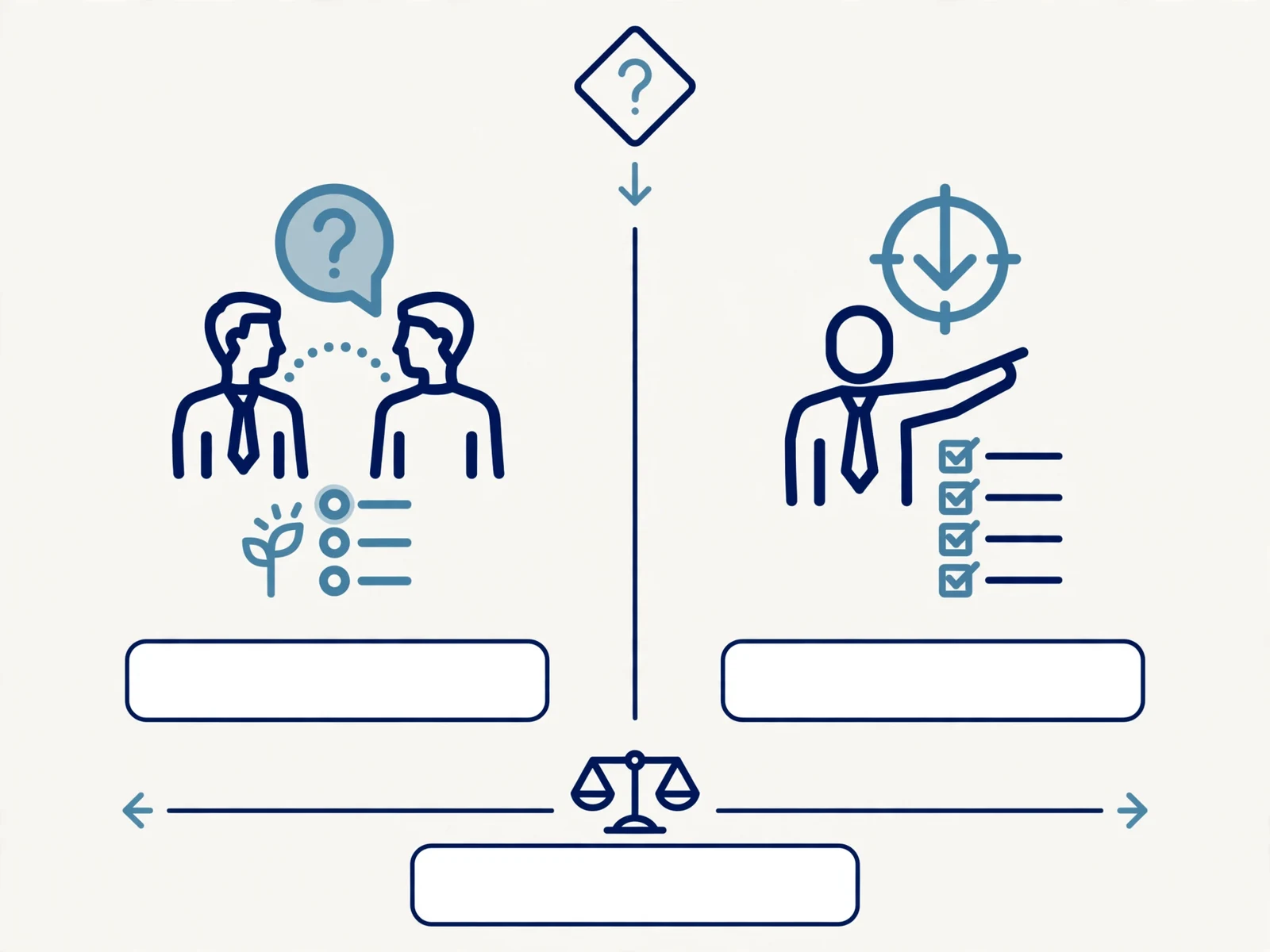
Diagnose the situation before choosing a style
Managers often default to either advice or questions regardless of urgency and capability. Consider risk, time pressure, experience and ownership before deciding how to respond.
Coach when judgement needs to grow
Questions are useful when the employee can reason through the issue and learning matters. Ask for their assessment, options and recommendation before adding your view.
Advise when experience can shorten the path
Advice is useful when the person still owns the decision but would benefit from relevant experience. Offer the principle or option, then return ownership to the employee.
Direct when risk or urgency requires clarity
Some situations need an explicit instruction rather than a developmental conversation. Be clear about the required action, reason and boundary.
Do not disguise an instruction as a question
Managers damage trust when the answer is already fixed but they pretend the employee has choice. State the non-negotiable part and invite input on what remains open.
Shift styles as capability develops
The same employee may need direction today and coaching later. Reduce manager control as evidence of judgement grows.
Practical Working Template
- Diagnose the situation before choosing a style: Consider risk, time pressure, experience and ownership before deciding how to respond.
- Coach when judgement needs to grow: Ask for their assessment, options and recommendation before adding your view.
- Advise when experience can shorten the path: Offer the principle or option, then return ownership to the employee.
- Direct when risk or urgency requires clarity: Be clear about the required action, reason and boundary.
- Do not disguise an instruction as a question: State the non-negotiable part and invite input on what remains open.
- Shift styles as capability develops: Reduce manager control as evidence of judgement grows.
- Owner: Name one person accountable for the next action.
- Evidence: Record the evidence that supports the decision.
- Review point: Define when the team will revisit the result.
Worked Example
A new manager is coaching an analyst through a recurring client issue. The analyst understands the facts but lacks confidence. Instead of giving the answer, the manager asks for the analyst’s recommendation. Later, when a compliance deadline becomes urgent, the manager switches to a direct instruction and explains why. The value of the framework is that it turns a vague concern into a small number of explicit decisions, owners and review points. The team can then learn from the result instead of debating the same issue again at the next meeting.
Common Mistakes to Avoid
- Treating “diagnose the situation before choosing a style” as a documentation task rather than a management decision.
- Treating “coach when judgement needs to grow” as a documentation task rather than a management decision.
- Treating “advise when experience can shorten the path” as a documentation task rather than a management decision.
- Treating “direct when risk or urgency requires clarity” as a documentation task rather than a management decision.
- Treating “do not disguise an instruction as a question” as a documentation task rather than a management decision.
- Adding measures or fields that no one uses to make a decision.
- Confusing a completed template with evidence that the underlying capability has improved.
Questions Managers Should Ask
- What evidence would tell us whether we are strong enough on diagnose the situation before choosing a style?
- What evidence would tell us whether we are strong enough on coach when judgement needs to grow?
- What evidence would tell us whether we are strong enough on advise when experience can shorten the path?
- What evidence would tell us whether we are strong enough on direct when risk or urgency requires clarity?
- What evidence would tell us whether we are strong enough on do not disguise an instruction as a question?
- What evidence would tell us whether we are strong enough on shift styles as capability develops?
How to Apply This Over 30 Days
- Week 1: choose one live case and capture the current baseline, assumptions and owner.
- Week 2: apply the framework and record where judgement or evidence is weak.
- Week 3: review the result with the people who own adjacent decisions or dependencies.
- Week 4: decide which part should become a repeatable management standard and which should remain situational.
Capability Maturity
Basic: the team can describe the process and use the main tool. Developing: managers use consistent definitions, owners and review points. Mature: the capability changes decisions early, adapts when evidence changes and connects cleanly to adjacent functions. The right target depends on the consequence and complexity of the work.
For HR, L&D and Corporate Sponsors
This topic works well in employer-sponsored development because participants can apply the framework to live work between sessions. A private cohort can compare anonymized cases, identify recurring judgement gaps and agree a shared standard where consistency creates value.
Sponsors should look for stronger questions, clearer work products, more explicit trade-offs, better ownership and earlier escalation. Those are credible signs of application. Attendance alone should not be treated as proof of business impact.
Match the Style to Consequence and Reversibility
A useful distinction is whether the employee’s decision is easy to reverse. When the consequence is low and learning value is high, coaching is usually appropriate. When the decision is difficult to reverse, carries material customer or compliance risk, or must be made quickly, more direction may be justified. Managers should explain that shift rather than making it feel arbitrary.
Avoid Over-Coaching Routine Work
Not every conversation needs a coaching framework. If the person already knows the standard and simply needs a clear priority, a short direct conversation may be more respectful. Over-coaching can create frustration when the employee wants a decision or when the issue is too minor to justify prolonged reflection.
Build Independence Deliberately
Track whether the employee is bringing stronger diagnosis, options and recommendations over time. If the manager keeps asking the same questions forever, development may have stalled. The objective is increasing judgement and ownership, not permanent dependence on the coaching conversation.
Management Review Checklist
Before turning the approach into a standard, review five things. First, is the business purpose clear enough that people know why the method exists? Second, are the assumptions and definitions explicit enough to avoid different interpretations? Third, does one person clearly own the next action? Fourth, is there a natural trigger for escalation or review? Fifth, will the next cycle produce evidence that tells the team whether the approach is working? If those questions cannot be answered quickly, simplify the process before adding more measures or documentation.
What to Review After Three Cycles
After the method has been used several times, look for patterns rather than isolated anecdotes. Which questions consistently improve judgement? Which fields are ignored? Where do decisions still stall? Which handoffs repeatedly create confusion? Remove anything that produces no action, strengthen evidence where managers still rely on opinion, and clarify ownership where issues bounce between functions. A useful management framework should become easier to use as the team learns.
A worked application scenario
A team member asks how to handle a recurring client complaint. If the employee knows the context and the decision is reversible, the manager asks for two options and a recommendation to build judgement. When the employee lacks critical knowledge, the manager offers a relevant example and explains the boundary. When an immediate safety or compliance issue arises, the manager gives a clear instruction and records who will follow up. During the next one-to-one, both review which style was justified, whether the employee learned, and what authority can be transferred next time.
What happens if the decision is wrong?
What does the employee already know?
Ask, demonstrate or instruct
What will show improved judgment?
The right style depends on the decision, not the manager’s personality
A manager may prefer coaching because it feels empowering or direct instructions because they seem efficient. Neither is always appropriate. Begin by considering urgency, potential harm, employee knowledge, authority boundaries and whether the decision can be reversed. A person facing a genuinely time-critical safety or compliance issue needs a clear direction and the right escalation. An experienced colleague working through a reversible customer decision may benefit more from reflecting on options and evidence.
Do not disguise a mandatory decision as an open question when employees have no real discretion. Equally, avoid issuing instructions where the team member is authorized to develop an answer and the consequences are manageable. Explain why a style is appropriate so people understand both the decision and the learning opportunity.
Worked example: a new manager handling an angry customer
A newly appointed supervisor receives an upset customer’s demand for a refund. The organization’s policy permits certain remedies but requires higher approval for exceptional contract terms. The senior manager first checks whether the customer is at immediate risk and whether a contractual deadline applies. If an urgent commitment is threatened, the manager gives specific direction to protect the business and customer. For an ordinary remedy inside the supervisor’s limits, the manager can ask them to propose a response and explain the trade-offs.
After the case, the manager reviews how the supervisor used evidence and authority. If the person did not understand the policy, the next step is instruction and a worked example. If they understood it but were hesitant, a coaching conversation may improve confidence and judgment. The same employee can need different styles in different situations; a fixed label such as ‘needs directing’ is not a useful diagnosis.
Apply coaching, advising and directing clearly
When coaching, ask for the intended outcome, evidence, realistic options, likely downsides and proposed next action. Let the employee think rather than asking questions designed only to elicit the manager’s preselected answer. When advising, share a relevant experience or example and explain why it may or may not transfer to the present situation. When directing, identify the required action, standard, owner and escalation conditions without implying that instruction is a punishment.
In each mode, check understanding. A manager may give excellent advice that the employee cannot implement because the required resources or authority are missing. Providing tools and access is part of responsible management, not an optional extra. For regulated, legal or specialist matters, refer to qualified colleagues and applicable organizational rules.
| Situation | How to assess | Response |
|---|---|---|
| Coach | Capable employee; manageable uncertainty | Ask for options and evidence |
| Advise | Knowledge or experience gap | Provide example, explanation and feedback |
| Direct | Urgent or controlled requirement | State action, standard and escalation |
| Escalate | Beyond delegated authority or expertise | Refer to named decision or specialist owner |
Build independent judgement through safe progression
Agree one bounded assignment after the conversation. The employee could assess the next routine service exception, draft a recommendation and explain why it is within their authority. Review a real outcome together, including any customer impact and learning. Increase discretion when repeated evidence justifies it rather than delegating a high-consequence decision simply to demonstrate trust.
If the same failure recurs, distinguish missing knowledge, ambiguous process design and performance concerns. Formal performance or misconduct issues require the appropriate company process. A coaching conversation is useful when it changes an observable next decision; it should not become a substitute for fair, documented management standards.
Where to Go Next
The Coaching Skills for Managers and Leaders course develops this capability through live instructor-led practice, scenarios and work application. Organizations building a broader pathway can also review TheSkillGrid Training Bundles and Corporate Academies.
Use the framework on one real decision first, then build the repeatable standard from what you learn.
Coaching and Manager Conversations for Teams
Managers can practise when to coach, advise or direct, applying the distinctions to the actual responsibility levels and workplace situations of their teams.
Practise better manager conversations: Use the coaching conversation framework to structure questions and action ownership. The manager one-to-one questions guide helps bring those habits into routine discussions.
Develop this capability in your organization