
A cross-functional process can fail customers even while every department reports meeting its own targets. End-to-end accountability must be explicit.
Name the result, a process owner with workable authority, and the handoffs that need control. Functional managers still operate their teams, but unresolved boundary failures need one accountable route.
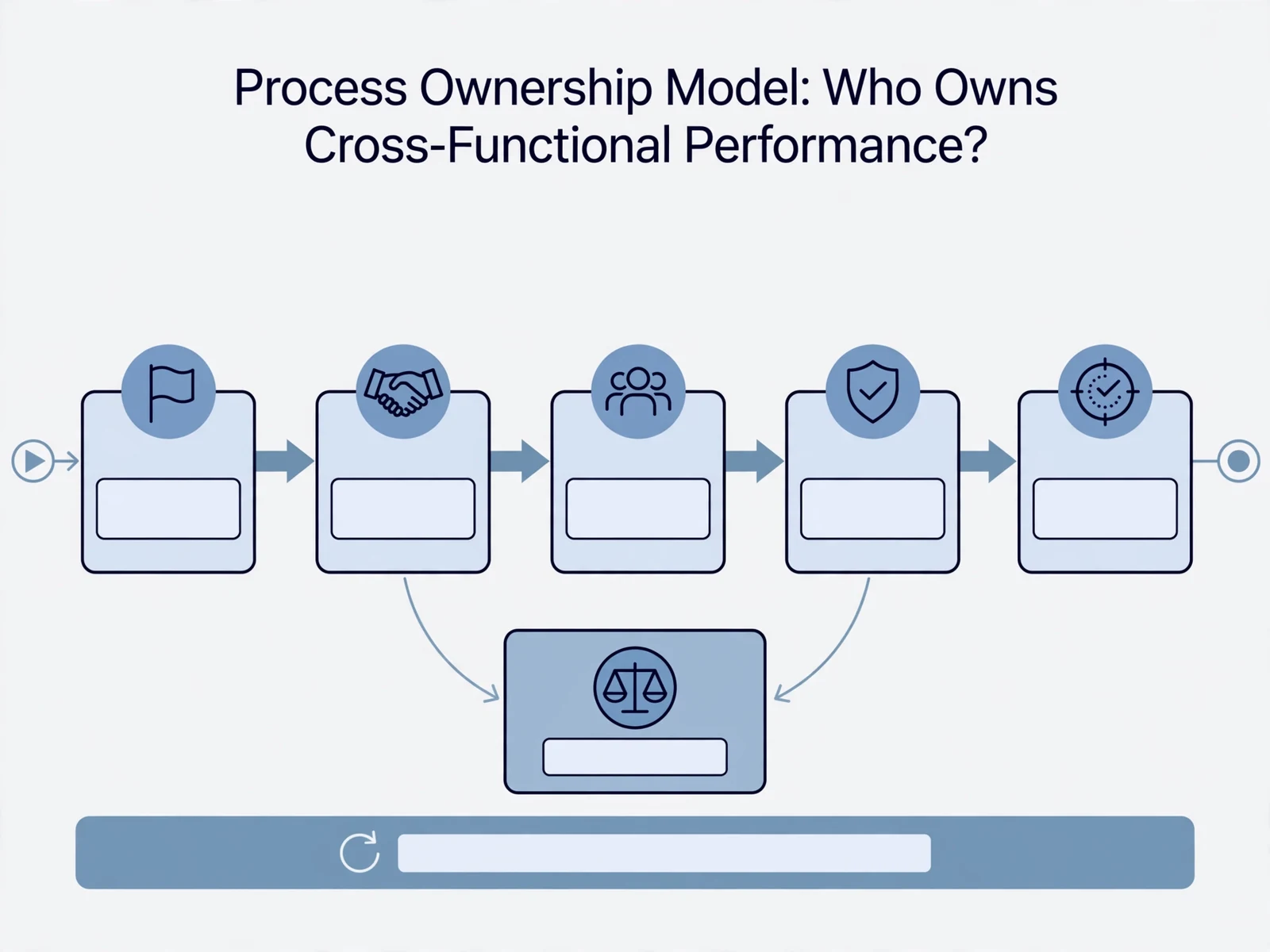
Process Purpose And Outcome
Define the complete service outcome and who receives it, not just a series of departmental outputs.
Actual Current-State Flow
Follow representative transactions across functions and record decisions that lack a single accountable owner.
Handoffs And Exceptions
Set clear handoff acceptance, exception return and escalation rules. One shared outcome should not be assigned to several equally accountable managers.
Process Measures
Measure completed customer or operational outcomes alongside internal delivery. Check whether one team’s apparent improvement shifts work elsewhere.
Future-State Redesign
Give the process owner a clear mandate to propose interface changes, coordinate functional leaders and escalate material trade-offs.
Automation And Process Ownership
Define system-change, data and exception responsibilities. Automation improves a controlled process but cannot replace accountability.
Practical Process Ownership Model Working Template
- 1. Which outcome spans team boundaries?
- 2. Who accepts accountability for completion?
- 3. Which authority does that person actually have?
- 4. How is a failed handoff resolved?
- 5. What measures show end-to-end success?
- 6. Where do unresolved trade-offs escalate?
- Decision owner: Who acts next and what evidence will be checked?
Worked Example
A service case moves between sales, finance and operations while all three departments report green results. A process owner establishes a shared completion standard and clear exception ownership so the customer’s unresolved request becomes visible.
Common Mistakes to Avoid
- Assigning ownership with no decision authority.
- Giving one outcome several competing owners.
- Optimizing department measures at the customer’s expense.
- Letting exceptions depend on informal personal relationships.
Questions Managers Should Ask
- Who decides when two departments disagree?
- Can the owner change a failing handoff?
- Which outcome measure cannot be improved by shifting work elsewhere?
- Who is accountable when an exception remains unresolved?
Management Review Checklist
Review actual end-to-end failures, boundaries, owner authority and unresolved decisions. Agree escalation timing and the operational evidence required to accept improvement.
Decision Quality Test
Can one accountable person resolve a failure that falls between departments?
What to Review After Three Cycles
Compare successive real cases and note where assumptions, control failures or decision results changed. Include cross-functional outcomes in existing operating reviews and document process-owner escalation authority.
Make the Method Part of Normal Work
Include cross-functional outcomes in existing operating reviews and document process-owner escalation authority.
A 30-Day Application Plan
- Week 1: Define the full outcome and candidate owner.
- Week 2: Map interfaces and decisions that stall.
- Week 3: Pilot clearer handoff and escalation rules.
- Week 4: Compare completed cases and refine ownership.
Capability Maturity
Basic: tasks have departmental owners. Developing: one owner can coordinate process outcomes. Mature: cross-functional evidence informs authority and improvement.
For HR, L&D and Corporate Sponsors
Use a fictional cross-team service failure to practise assigning an accountable end-to-end owner, interface conditions and decision rights.
Implementation Boundary
For process ownership model, standardize only the definitions, evidence, ownership and escalation rules where inconsistency creates real risk or confusion. Leave professional judgement open where circumstances differ materially. The objective is reliable decisions without forcing every case through an identical script.
Evidence to Bring to the Next Review
At the next process ownership model review, bring the actual work product, the evidence that changed the team’s view, the decision that followed and the assumption that still matters most. This makes follow-up useful for learning and accountability instead of repeating a status summary.
Related Courses in This Capability Cluster
Applied example for management teams
A company operates a customer order process across sales, credit, warehouse and delivery teams. Each function meets its local target, yet orders still miss customer commitments. The sponsor assigns a cross-functional process owner with authority to convene handoff reviews and escalate unresolved trade-offs. Individual managers retain their operational responsibilities, but common outcome measures track end-to-end performance. The group tests whether exceptions are being resolved earlier and which decision rights remain unclear. Process ownership becomes an operating practice, not a name on a chart.
Connect process owners to the decision rights they need
Cross-functional processes often fail because participants know their own tasks but not who has authority to resolve disagreements across teams. The transformation governance guide covers decision owners and stage gates, and the Business Process Management and Process Redesign course provides a practical route for process owners. In a private cohort, review escalation, performance measures and accountability using permitted scenarios.
For an organizational cohort, request a private instructor-led training proposal with the participant roles, approximate group size and capability objective. Dates, trainers and programme terms are confirmed during scoping.
Where to Go Next
The Business Process Management and Process Redesign course develops this capability through live instructor-led practice and workplace application. For broader pathways, see Training Bundles and Corporate Academies.
Give the whole process a responsible owner who can improve the boundaries where work fails.
Develop this capability in your organization