
South Africa’s current labour-market and vacancy evidence shows why employer capability cannot be reduced to one category such as digital skills. In the World Bank’s online-job-vacancy analysis, specialized project-management skills appeared in 58.9% of postings with skill requirements, digital skills in 47.7%, higher-order cognitive skills in 43.7%, customer-service skills in 38.0%, socio-emotional skills in 36.9%, cognitive skills in 35.2%, financial skills in 27.7% and people-management skills in 17.4%.
The same bulletin’s list of frequently requested skills includes communication, management, sales, customer service, planning, problem solving, operations, leadership, finance, accounting, project management, auditing, decision making, budgeting, negotiation, data analysis and coaching. For organizational buyers, the implication is clear: management, finance, governance, projects, customer capability and digital capability often need to work together.
This 2026 guide combines the World Bank vacancy bulletin with current Statistics South Africa labour-force and employment data. The sources answer different questions. Online vacancies describe formal employer demand in advertised roles; Stats SA describes labour-market outcomes and formal non-agricultural employment. The figures should not be treated as one combined dataset.
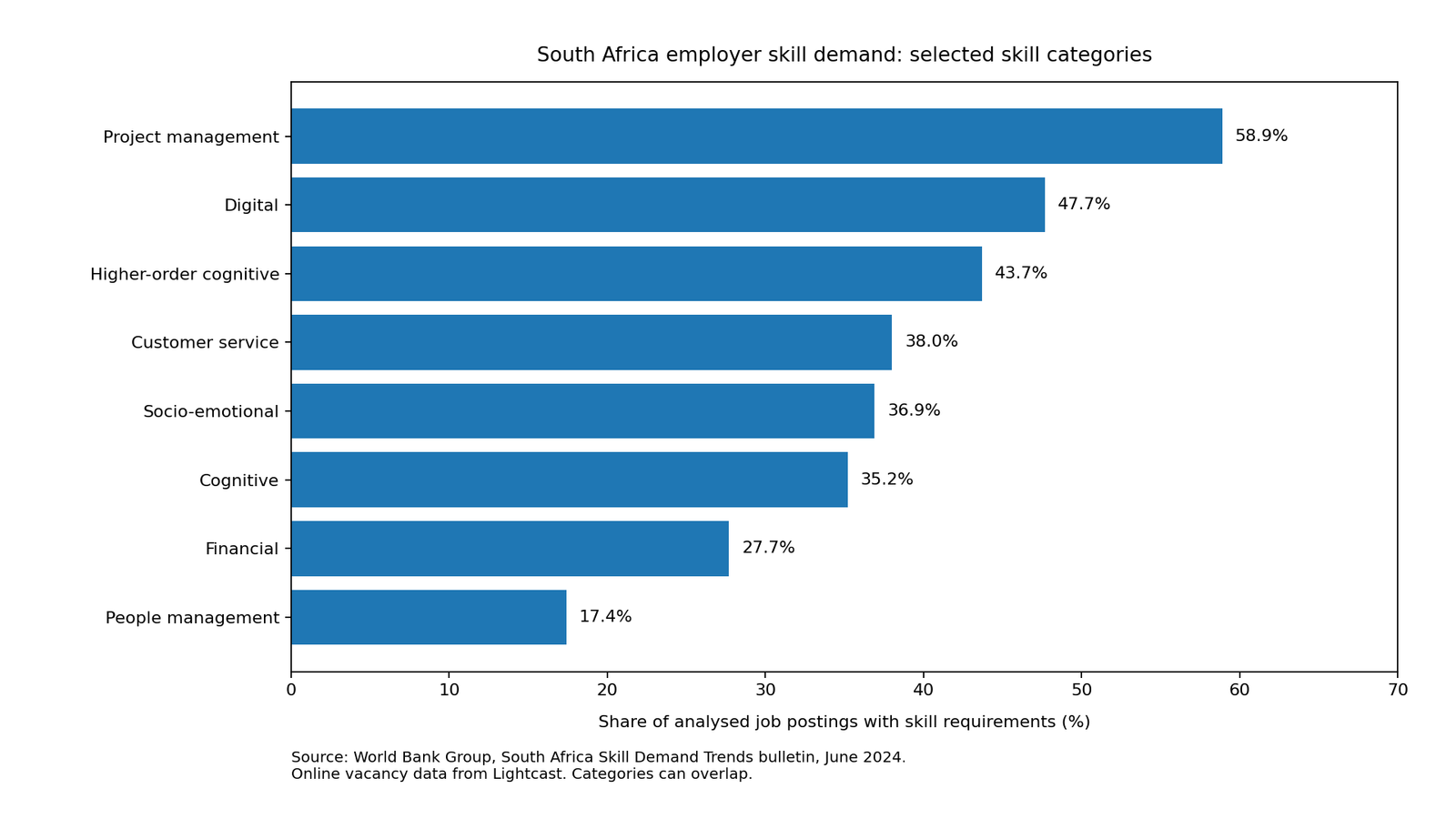
Data table: South Africa vacancy skill categories
| Skill category | Vacancy share |
|---|---|
| Project-management-related skills | 58.9% |
| Digital skills | 47.7% |
| Higher-order cognitive skills | 43.7% |
| Customer-service skills | 38.0% |
| Socio-emotional skills | 36.9% |
| Cognitive skills | 35.2% |
| Financial skills | 27.7% |
| People-management skills | 17.4% |
Source: World Bank Skills Demand Bulletin, South Africa (June 2024; analysed online vacancy postings from 2020 to June 2024). This table reports historical job-advert skill-category shares, not a 2026 survey or a representative census of all employers.
1. Project-management-related skills appear in 58.9% of analysed vacancies
The World Bank category includes management, planning, operations, project management, organizational skills, agile methodology, business development, scheduling, risk management, KPIs, business requirements and workflow management.
This is broader than the project-manager occupation. It captures execution capability used across many managerial and professional roles.
2. Digital skills appear in 47.7% of postings
Computer literacy, Microsoft Excel, Office, presentations, computer science, forecasting, data analysis, SQL, automation and related tools appear in the bulletin’s digital categories.
Digital demand is substantial, but the same evidence shows strong demand for project, cognitive, customer, financial and leadership capability.
3. Higher-order cognitive skills appear in 43.7% of postings
Communication, problem solving, interpersonal communication, innovation, decision making, analytical skills, prioritization, business acumen, critical thinking and strategic thinking sit within this category.
4. Customer-service skills appear in 38.0% of postings
Sales, customer service, marketing, selling techniques, CRM, sales prospecting and related capabilities are prominent. This supports training relevance for sales leadership, key-account management, service excellence and customer-experience management.
5. Socio-emotional skills appear in 36.9% of postings
Detail orientation, leadership, time management, self-motivation, negotiation, teamwork, accountability, ethical conduct and influencing are included in this category.
6. Cognitive skills appear in 35.2% of postings
English language, research, writing, verbal communication, mathematics, business process, quality assurance, investigation, business strategy and report writing appear in the cognitive list.
7. Financial skills appear in 27.7% of postings
Finance, accounting, auditing, budgeting, invoicing, financial statements, procurement, purchasing and financial management are included in the World Bank financial category.
8. People-management skills appear in 17.4% of postings
Coaching, mentorship, sales management, change management, administration, supervision, HR management and employee relations are among the people-management skills identified.
9. Financial-manager roles dominate the top online job titles
In the World Bank’s 2024 top-ten job-title list for South Africa, financial manager, financial accountant and accountant occupy the first three positions. Sales representative, bookkeeper, sales consultant, project manager, creditors clerk, finance manager and receptionist also appear.
This mix reinforces the commercial relevance of finance, projects, sales and customer capability alongside technology skills.
10. Project manager appears consistently in the leading job titles
Project manager appears in the top-ten lists for 2021, 2022, 2023 and 2024. That is a demand signal for project capability, although it should not be interpreted as a direct estimate of the external training market.
11. Manager postings show project-management-related skills in 76%
Among manager postings, the World Bank data show project-management-related skills in 76%, higher-order cognitive skills in 49%, digital skills in 47%, socio-emotional skills in 45%, customer-service skills in 42%, financial skills in 39%, cognitive skills in 31% and people-management skills in 25%.
A management-development strategy that ignores finance, customers, projects or digital information would therefore miss a large part of what managers are expected to do.
12. Professional roles show especially strong digital demand
Among professional occupations, digital skills appear in 60% of postings and project-management-related skills in 58%. Higher-order cognitive skills appear in 43%, cognitive in 37%, socio-emotional in 30%, customer service in 29%, financial in 26% and people management in 13%.
13. Communication and management are among the most frequently requested individual skills
The World Bank’s top-50 list begins with communication, management, sales, customer service, planning, problem solving, detail orientation, computer literacy, operations and leadership. Finance, accounting, project management and auditing also appear near the top.
The order matters less than the pattern: employers are listing a portfolio of capabilities rather than one narrow skill family.
14. South Africa’s official unemployment rate was 33.7% in Q3 2026
Statistics South Africa reports an official unemployment rate of 33.7% in the third quarter of 2026, up slightly from 33.6% in Q2. Employment increased by 101,000 to 16.8 million, while unemployment increased by 97,000 to 8.6 million.
15. The expanded labour-underutilisation measure reached 46.3%
Stats SA reports the composite LU4 measure at 46.3% in Q3 2026. The measure combines time-related underemployment, unemployment and the potential labour force as a share of the extended labour force.
These figures describe labour-market pressure, not employer training demand. They provide context for the importance of productive, employable and transferable capability.
16. Formal non-agricultural employment stood at 10.425 million in June 2026
The Quarterly Employment Statistics reported 10.425 million jobs in the formal non-agricultural sector in Q2 2026, down 14,000 from March 2026 and down 95,000 year-on-year.
17. Full-time formal employment fell by 40,000 in Q2 2026
Full-time formal non-agricultural employment declined from 9.370 million to 9.330 million between Q1 and Q2 2026. Part-time employment increased by 26,000 to 1.095 million.
18. Community services added 29,000 formal jobs in Q2
Stats SA reports that community services added 29,000 jobs in the formal non-agricultural sector, while electricity, mining and construction each added about 1,000.
19. Manufacturing lost 20,000 formal jobs in the quarter
Manufacturing recorded the largest Q2 decline at 20,000 jobs, followed by business services at 13,000, trade at 8,000 and transport at 5,000.
20. Finance gained employment in the Q2 labour-force survey
In the Q2 2026 Quarterly Labour Force Survey, Finance recorded an employment gain of 11,000 people, while Trade gained 70,000 and Construction 39,000.
21. Youth unemployment remained above 47% in the second and third quarters of 2026
Stats SA reported that unemployed youth aged 15–34 increased by 264,000 to 5.0 million in Q2 2026, while employed youth declined by 40,000 to 5.6 million. The youth unemployment rate rose to 47.4% in that quarter. Its official Q3 2026 presentation subsequently shows 47.3% for the same 15–34 age group, a slight quarterly decline rather than a substantial improvement.
22. What this means for South African employers
National unemployment statistics do not dictate a corporate training plan. The more useful employer signal comes from the combination of vacancy requirements and role-specific capability gaps.
- Leadership and management: planning, communication, problem solving, decision-making, coaching, change and accountability.
- Governance and risk: board oversight, enterprise risk, internal control, audit, third-party risk and ethical decision-making.
- Projects and operations: project management, programme governance, operations, risk, KPIs and continuous improvement.
- Finance: budgeting, financial management, audit, business cases and executive financial judgement.
- Sales and customer capability: sales leadership, key accounts, customer experience and service management.
- Digital capability: tools and data embedded in business roles rather than treated as an isolated technical objective.
23. Implications for corporate-governance training
South Africa’s formal economy and regulatory environment make governance capability commercially relevant, but governance training should not be sold as generic compliance. Boards and executives need decision rights, risk oversight, information quality and accountable management interfaces.
Relevant programmes include Corporate Governance Essentials, Enterprise Risk Appetite and Board Risk Oversight and Internal Audit and Control Assurance for Managers.
24. Implications for project and operational capability
Project-management-related skills are the largest category in the World Bank vacancy analysis. Organizations should distinguish project fundamentals, PMO leadership, operational excellence, stakeholder management and major-project governance rather than treating them as one course.
25. Implications for finance training
Finance and accounting roles dominate the top job-title list, and financial skills appear in more than a quarter of analysed postings. Finance capability can therefore serve both specialist finance populations and non-finance managers responsible for budgets, investments or commercial decisions.
26. Implications for leadership development
Manager postings combine project, cognitive, customer, digital, financial and people-management requirements. Leadership programmes should therefore be built around role responsibility and work decisions, not generic motivational content.
27. How to use the data in a training needs analysis
- Define the population and role level.
- Identify decisions, processes or work products that need to improve.
- Use external labour-market evidence to test relevance.
- Separate skill gaps from structural or resource problems.
- Select a course or pathway matched to the actual work.
- Define evidence of application and manager follow-up.
28. Methodology and limitations
The World Bank Skills Demand Bulletin uses Lightcast online vacancy data from 2020 through June 2024. Online vacancies overrepresent formal and digitally advertised employment and are not a census of South Africa’s entire labour market. Skill categories overlap, so the category shares must not be added together.
Statistics South Africa’s QLFS and QES are separate official statistical programmes. QLFS describes the broader labour force, while QES reports formal non-agricultural employment in surveyed businesses and institutions. Their totals should not be used interchangeably.
A listed skill requirement is evidence of employer demand for that capability, not proof of demand for a particular external training provider or course.
Primary sources
- World Bank Group, South Africa Skill Demand Trends: Insights from Online Job Vacancy Data, June 2024
- Statistics South Africa, Quarterly Labour Force Survey Q3 2026 key findings
- Statistics South Africa, Quarterly Employment Statistics Q2 2026
- World Bank, South Africa country overview
Related South Africa training pathways
- Professional Training in South Africa
- Corporate Governance Essentials
- Enterprise Risk Management for Managers and Leaders
- Internal Audit and Control Assurance for Managers
- Operational Excellence and Process Improvement
- Project Finance and Financial Modelling for Infrastructure Projects
- Private in-house training
Related organizational training: For South African organizations planning management and governance capability, explore Leadership and management training in South Africa; Corporate governance training in South Africa. These programme links are options for scoping, not evidence that a particular course will change the cited labour-market statistics.
Related evidence and practical guidance
South Africa-specific labour-market indicators should not be treated as interchangeable with Africa-wide online recruitment or survey samples. Use each as context, then test local role-level capability needs. For context, read Africa workforce and management-skills evidence and workforce demand and capability forecasting.
Training options for organizations: See TheSkillGrid’s professional training pathways across Africa for relevant courses, country guides and private-cohort enquiries. The cited labour-market data provides background context rather than evidence of a specific training outcome.
Develop this capability in your organization