Business Process Management and Process Redesign
View Dates & OptionsBusiness process management gives leaders a way to manage how work flows across functions. Process redesign is useful when it removes friction, clarifies ownership and improves the end-to-end outcome rather than simply changing a diagram.
Course Overview
This program is for process owners, operations managers, business analysts, transformation teams and functional leaders responsible for improving cross-functional work. It combines process management with practical redesign.
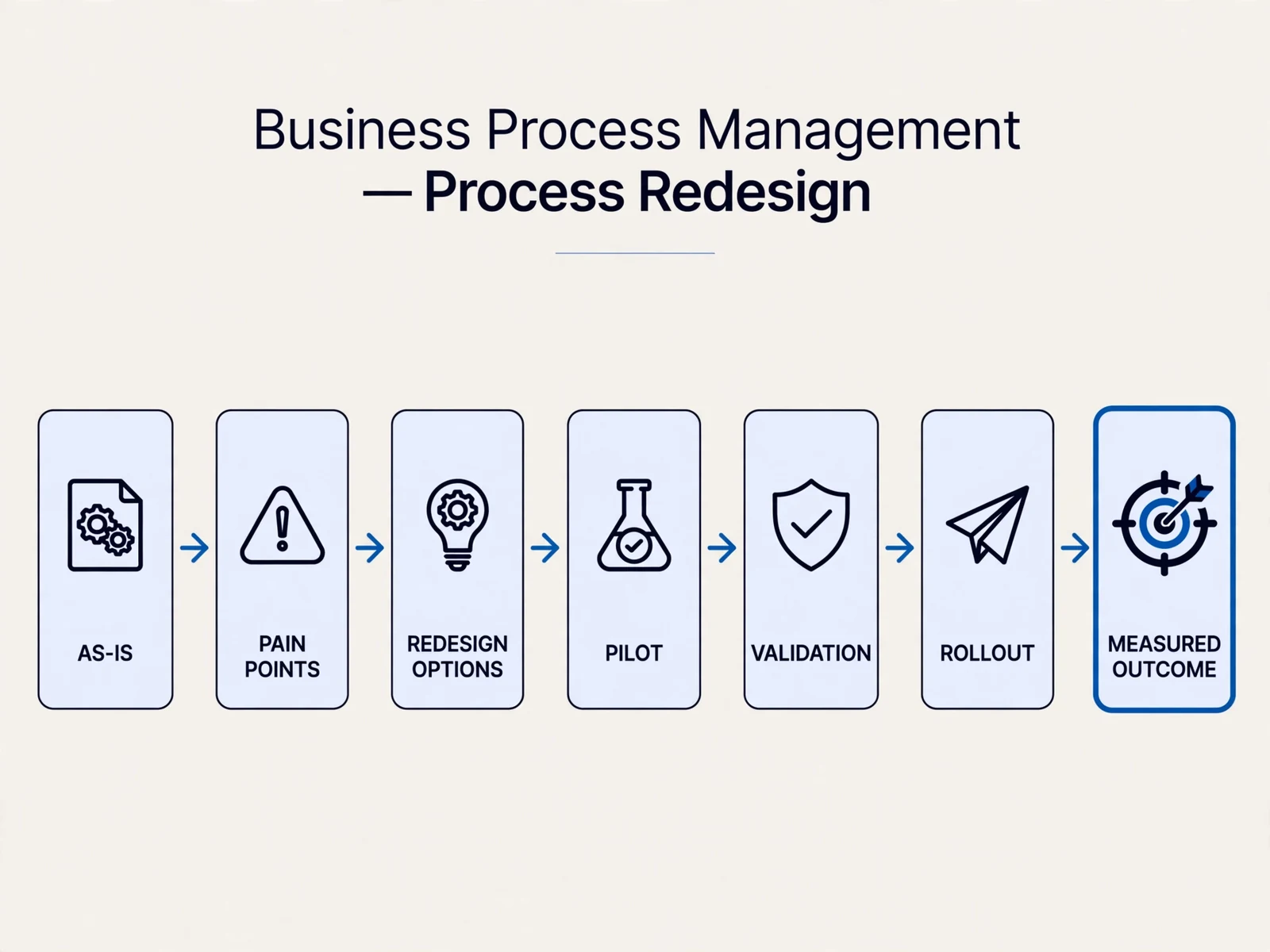
Participants map current-state processes, identify failure demand, handoffs, controls and decision points, define measures and design a future state. The course also helps teams decide when automation supports the process and when the process itself should be simplified first.
For organizations, the program can support operating-model improvement, service redesign, digital transformation and process-owner capability.
Where this program fits
Process owners, operations managers, business analysts and transformation professionals
Live classroom, live online or private in-house. Depth and schedule are tailored to the cohort.
Process architecture, current state, handoffs, ownership, measures, redesign, automation readiness and governance
A current-state diagnosis and future-state redesign for a live business process
Built for Corporate Cohorts
Private delivery can be aligned to participant roles, business priorities, internal terminology and real workplace scenarios. HR, L&D and functional sponsors can use the course alone or inside a broader academy.
What Participants Will Learn
See work across functions rather than optimizing isolated departmental steps.
Capture actual workflow, decisions, handoffs and exceptions.
Identify delay, rework, failure demand, unclear ownership and unnecessary control.
Create a future state around outcome, flow, decision quality and customer need.
Avoid automating waste or unclear processes.
Define owners, measures and review routines after redesign.
Business Problems This Program Is Designed to Address
Course Outline
Applied Practice and Scenario Work
Participants use realistic situations to practise analysis, decisions, stakeholder communication and application. Private cohorts can adapt scenarios to the organization’s context while protecting confidential information.
Participants distinguish necessary control from historical accumulation and redesign the decision path.
Participants decide what should be simplified before technology is introduced.
Participants create an end-to-end performance view.
Participants test future-state trade-offs before implementation.
Practical Tools and Work Products
What Strong Practice Looks Like
Business processes are how strategy becomes repeatable work. A process perspective is valuable because customers and business outcomes rarely align neatly with organizational charts. Leaders need to see how work crosses functions and where value is delayed or lost.
Current-state mapping should show reality, including exceptions and workarounds. A sanitized process map can hide the very problems redesign is supposed to solve. Participants use interviews, evidence and observation to distinguish the formal process from actual work.
Process redesign should begin with the outcome and constraints. Removing steps is not automatically improvement if those steps manage material risk or provide needed information. The aim is to remove unnecessary friction while preserving or strengthening the controls that matter.
Automation can multiply both good and bad process design. A clear, stable, high-volume rule-based activity may be a strong automation candidate, while ambiguous decisions or poorly designed handoffs may need redesign before any technology decision.
Process governance keeps improvement from fading. Owners need measures, authority and a review rhythm that lets them see whether the process is still meeting the required outcome as demand, systems and organizational conditions change.
Questions Participants Learn to Ask
What end-to-end outcome is this process responsible for?
Where does work wait, return or fail?
Which control is necessary and which is historical friction?
What should change before we automate anything?
Implementation Pitfalls and Cross-Functional Interfaces
Capability in this topic depends on how decisions move across the organization. Private cohorts can map where ownership, information or incentives currently break down and use those interfaces as part of the learning design.
- Business analysis for problem and requirement definition
- Technology teams for automation and workflow
- Risk and compliance for control requirements
- Functional managers for ownership and adoption
A common implementation mistake is to add a framework without changing the management routine around it. Participants identify where the tool will be used, who needs to be involved, what evidence is required and what decision or behavior should become different after application.
Advanced Application Considerations
Process redesign often exposes organizational choices that cannot be solved inside a workshop. Decision rights, policy constraints, incentives and system architecture may require sponsor action. Participants learn to separate what the process team can change from what must be escalated.
Process architecture also matters at scale. Improvement efforts can conflict when teams redesign connected processes independently. Organizations benefit from a shared view of core, supporting and management processes so local changes do not create downstream problems.
Measures should balance flow and outcome. Speed alone can create rework, while perfect quality can become prohibitively slow. Participants choose a small set of measures that make trade-offs visible and support deliberate management decisions.
Before the Program Begins
For a private cohort, participants can identify one current case, decision or recurring problem related to the topic. Anonymized patterns can be used to weight practice without turning the program into a review of confidential internal matters.
After the Program
Participants can use one work product in the next relevant work cycle and discuss the result with a manager or peer. The goal is to reinforce application while the participant has a live opportunity to use the capability.
Manager Reinforcement and Evidence of Application
Sponsors can look for observable changes such as clearer decisions, stronger preparation, better use of the relevant work product, improved ownership or better escalation. These are indicators that the capability is being applied, not automatic claims that attendance caused a business result.
Participants should select one or two applications first rather than trying to use every concept at once. Managers can ask what was tried, what response followed and what should be adjusted next time.
Designing a Private Cohort Around Real Work
Before private delivery, the sponsor can define participant roles, experience level, common workplace situations, internal terminology and one or two practical outputs that would be useful after the program.
- Participant roles and experience.
- Recurring decisions or problems the cohort needs to handle better.
- Relevant internal frameworks or governance.
- Practical work products participants can use afterward.
- How managers will reinforce application.
Capability Maturity and Management Judgement
Process redesign also needs explicit decision criteria. Teams can generate many possible future-state changes, but the organization still needs to choose among them. Participants compare options using customer impact, cycle time, control, cost, capacity and implementation difficulty rather than relying on preference alone.
Another challenge is local workaround removal. Workarounds often exist because the formal process cannot handle real demand, exceptions or timing. Eliminating them without understanding why they developed can make performance worse. Participants treat workarounds as evidence about the current system.
Process ownership becomes more important after redesign because performance can drift. The process owner needs enough authority and information to coordinate across functions, review measures and trigger further improvement when operating conditions change.
For corporate cohorts, these maturity questions can be used to compare current practice with a stronger operating model and identify one or two realistic changes that would improve control, decision quality or performance.
Process redesign also benefits from piloting. A future-state design that appears elegant in a workshop may behave differently under real volume, exceptions and time pressure. Participants identify which parts of the new process should be tested first and what evidence would justify wider rollout.
This gives sponsors a practical way to distinguish basic tool use from mature application: the participant can explain not only what method was used, but why it was appropriate, what evidence supported it and how the decision will be reviewed.
Who Should Attend
- Process owners
- Operations managers
- Business analysts
- Transformation and digital-improvement teams
Organizational Benefits
- Improve end-to-end process ownership
- Reduce delay and rework
- Create stronger automation readiness
- Improve cross-functional performance measures
- Build repeatable process-redesign capability
Delivery and Pricing
The program is live and instructor-led. It can be delivered in the classroom, live online or in-house. Duration is flexible and should reflect participant level, selected depth, organizational objectives and the amount of applied practice required.
Public and private pricing: current public fees are confirmed with scheduled cohorts. Private and customized programs are quoted according to cohort size, location, scope and customization. Request a proposal.
Frequently Asked Questions
Can this be delivered privately for one organization?
Yes. Private cohorts can be calibrated to participant roles, business context and priority scenarios.
Is the duration fixed?
No. Delivery depth and schedule are adapted to the cohort and learning objective.
Can we use our own scenarios?
Yes. Organization-relevant situations can be used while protecting confidential information.
Can this sit inside a broader academy?
Yes. It can be combined with related programs into a role, function or leadership pathway.
Is this self-paced?
No. TheSkillGrid programs are live and instructor-led.
Related Programs
- Operational Excellence and Process Improvement
- Business Analysis and Requirements Management
- Change Management and Organizational Transformation
- Digital Transformation Leadership
Build a Cohort Around the Capability Need
TheSkillGrid can combine this course with adjacent programs into a coherent corporate pathway.
Upcoming Dates & Venues
Request course availability with your preferred date, location and group size. We will confirm available public-session and private-team options before any booking or payment.
Ready to Take the Next Step?
Register your interest for a public session or request private in-house delivery for your team.