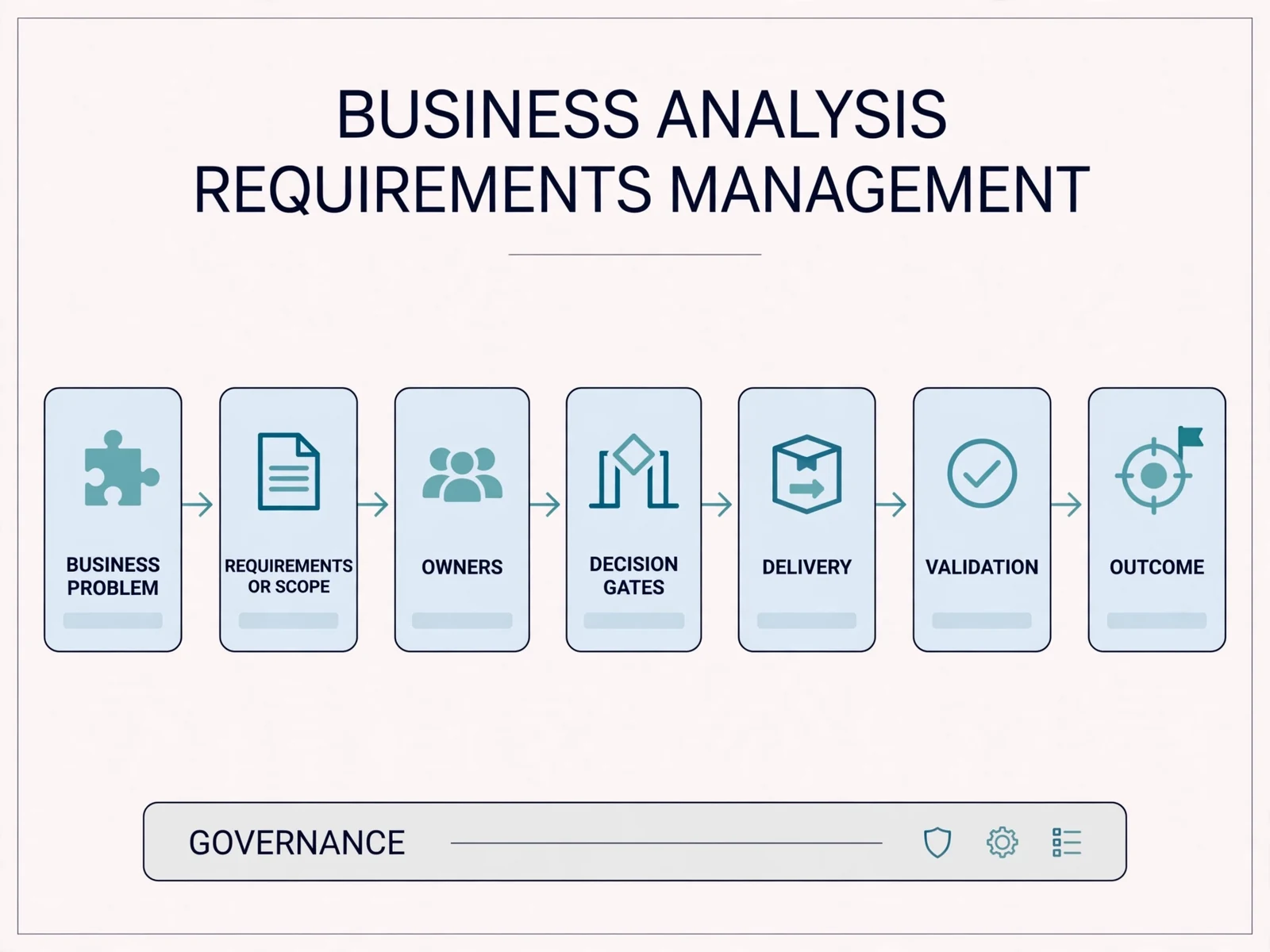
Business analysis begins before a solution is chosen. The analyst’s job is to understand the problem, stakeholders, process and value clearly enough that the organization solves the right thing.
Course Overview
This program is for business analysts, project professionals, product teams and functional managers who translate business needs into change requirements. It focuses on structured analysis and decision support rather than on one methodology or software tool.
Participants work with ambiguous requests, competing stakeholders, process problems, requirements conflicts and solution options. They learn to separate stated requests from underlying needs and create requirements that can be understood, tested and traced.
For organizations, the course can support BA capability, transformation teams, project offices and employees moving into analysis-heavy roles.
Where this program fits
Business analysts, project professionals, product teams and functional specialists involved in requirements
Live classroom, live online or private in-house. Depth and schedule are tailored to the cohort.
Problem definition, stakeholders, processes, requirements, options, value and traceability
A structured analysis pack for a live business problem
Built for Corporate Cohorts
Private delivery can be aligned to participant roles, business priorities, internal terminology and real workplace scenarios. HR, L&D and functional sponsors can use the course alone or inside a broader academy.
What Participants Will Learn
Separate symptoms, requests and root business needs.
Understand users, decision-makers, constraints and conflicting interests.
Make current-state work, pain points and handoffs visible.
Write requirements that are clear, testable and connected to business value.
Compare alternatives without assuming the requested solution is automatically correct.
Connect requirements to objectives, design choices and acceptance.
Business Problems This Program Is Designed to Address
Course Outline
Applied Practice and Scenario Work
Participants use realistic situations to practise analysis, decisions, stakeholder communication and application. Private cohorts can adapt scenarios to the organization’s context while protecting confidential information.
Participants test whether the delay comes from technology, process, policy or role design.
Participants clarify interests, constraints and decision authority.
Participants create a value and dependency view.
Participants trace where validation failed and redesign the analysis checkpoints.
Practical Tools and Work Products
What Strong Practice Looks Like
Strong business analysis protects the organization from solving the wrong problem efficiently. Analysts need the confidence to ask what outcome the requester is trying to achieve, what evidence shows the current problem and which assumptions are already embedded in the preferred solution.
Requirements are useful when they support shared understanding and future acceptance. More detail is not always better. Requirements should be precise enough to guide design and testing while remaining connected to the business objective they support.
Process analysis matters because needs rarely exist in isolation. A request may be caused by a handoff, duplicate data entry, approval structure, policy or incentive. Mapping the current state helps teams identify whether a system change is necessary and where redesign may create greater value.
Analysts also play an important role in option evaluation. A business case improves when alternatives, constraints and trade-offs are visible. The analyst does not need to own the final decision, but should make the reasoning easier for decision-makers to assess.
Questions Participants Learn to Ask
What business outcome is the requester trying to improve?
Which part of the current process creates the observed problem?
What makes a requirement necessary rather than merely preferred?
How will we know the selected solution satisfies the original need?
Implementation Pitfalls and Cross-Functional Interfaces
Capability in this topic depends on how decisions move across the organization. Private cohorts can map where ownership, information or incentives currently break down and use those interfaces as part of the learning design.
- Project managers for scope and change control
- Product or technology teams for solution feasibility
- Operations for process reality and adoption
- Finance or sponsors for value and option decisions
A common implementation mistake is to add a framework without changing the management routine around it. Participants therefore identify where the tool will be used, who needs to be involved, what evidence is required and what decision or behavior should become different after application.
How Participants Work During the Program
The learning design moves through diagnosis, practice, challenge and application. Participants begin with a real problem or decision, test a framework, receive challenge from peers and the facilitator, build a practical work product and identify the first workplace action after the course.
For employer-sponsored cohorts, managers can agree one current situation before delivery and review the participant’s application afterward. This creates a direct connection between learning and work without turning development into a heavy assessment exercise.
Manager Reinforcement and Evidence of Application
Sponsors can look for observable changes such as clearer decision briefs, better stakeholder preparation, stronger use of the relevant work product, more explicit trade-offs, improved ownership or better escalation. These are indicators that the capability is being applied, not automatic claims that attendance alone caused a business result.
Participants should select one or two applications first rather than attempting to use every concept at once. Managers can ask what was tried, what response followed, what became clearer and what the participant would adjust next time.
Designing a Private Cohort Around Real Work
Before private delivery, the sponsor can define participant roles, experience level, common workplace situations, internal terminology and one or two practical outputs that would be useful after the program. Examples and practice can then be calibrated while the core professional principles remain intact.
- Participant roles and experience.
- Recurring decisions or problems the cohort needs to handle better.
- Relevant internal frameworks or governance.
- Practical work products participants can use afterward.
- How managers will reinforce application.
Advanced Application Considerations
Business analysts often work in environments where stakeholders use the same words to mean different things. Participants learn to expose those differences early through examples, models, process views and acceptance criteria rather than allowing ambiguity to remain hidden inside a requirements document.
Another important discipline is deciding when analysis is sufficient. Endless discovery can delay value just as surely as weak requirements can create rework. Analysts need to identify which uncertainties are material to the decision and which details can be refined later without changing the solution direction.
Change control is also part of good requirements management. New information will emerge, but not every request should automatically expand scope. Participants learn to trace the proposed change back to business value, constraints and impact before recommending whether it should be accepted, deferred or rejected.
Before the Program Begins
For a private cohort, participants can be asked to identify one current case, decision or recurring problem related to the topic. The facilitator can use anonymized patterns from those examples to weight the practice without turning the program into a review of confidential internal matters. This gives participants a concrete application target from the start.
After the Program
A practical follow-up is to ask each participant to use one work product within the next relevant work cycle, then discuss what changed with a manager or peer. The objective is not to prove a financial return from a single course. It is to reinforce the capability while the participant still has a live opportunity to use it.
Who Should Attend
- Business analysts
- Project managers and coordinators
- Product and transformation professionals
- Functional specialists moving into analysis roles
Organizational Benefits
- Reduce weak or misunderstood requirements
- Improve stakeholder alignment before solution design
- Strengthen project and transformation decision quality
- Reduce late rework caused by poor analysis
- Build a consistent business-analysis method
Delivery and Pricing
The program is live and instructor-led. It can be delivered in the classroom, live online or in-house. Duration is flexible and should reflect participant level, selected depth, organizational objectives and the amount of applied practice required.
Public and private pricing: current public fees are confirmed with scheduled cohorts. Private and customized programs are quoted according to cohort size, location, scope and customization. Request a proposal.
Frequently Asked Questions
Can this be delivered privately for one organization?
Yes. Private cohorts can be calibrated to participant roles, business context and priority scenarios.
Is the duration fixed?
No. Delivery depth and schedule are adapted to the cohort and learning objective.
Can we use our own scenarios?
Yes. Organization-relevant situations can be used while protecting confidential information.
How should managers reinforce the learning?
Agree one or two work applications, then review what the participant tried, what happened and what should change next.
Can this sit inside a broader academy?
Yes. It can be combined with related programs into a role, function or leadership pathway.
Is this self-paced?
No. TheSkillGrid programs are live and instructor-led.
Related Programs
- Project Management Fundamentals
- Change Management and Organizational Transformation
- Strategic Planning and Execution
- AI Tools for Managers and Professionals
Build a Cohort Around the Capability Need
TheSkillGrid can combine this course with adjacent programs into a coherent corporate pathway.
Upcoming Dates & Venues
Request course availability with your preferred date, location and group size. We will confirm available public-session and private-team options before any booking or payment.
Ready to Take the Next Step?
Register your interest for a public session or request private in-house delivery for your team.