
A process map based only on a procedure manual misses actual handoffs, delays and exceptions. Track real work from request to outcome before proposing improvements.
Observe representative cases, compare them with the formal procedure, identify rework and assign an accountable process owner. The goal is an evidence-backed change, not a beautiful diagram.
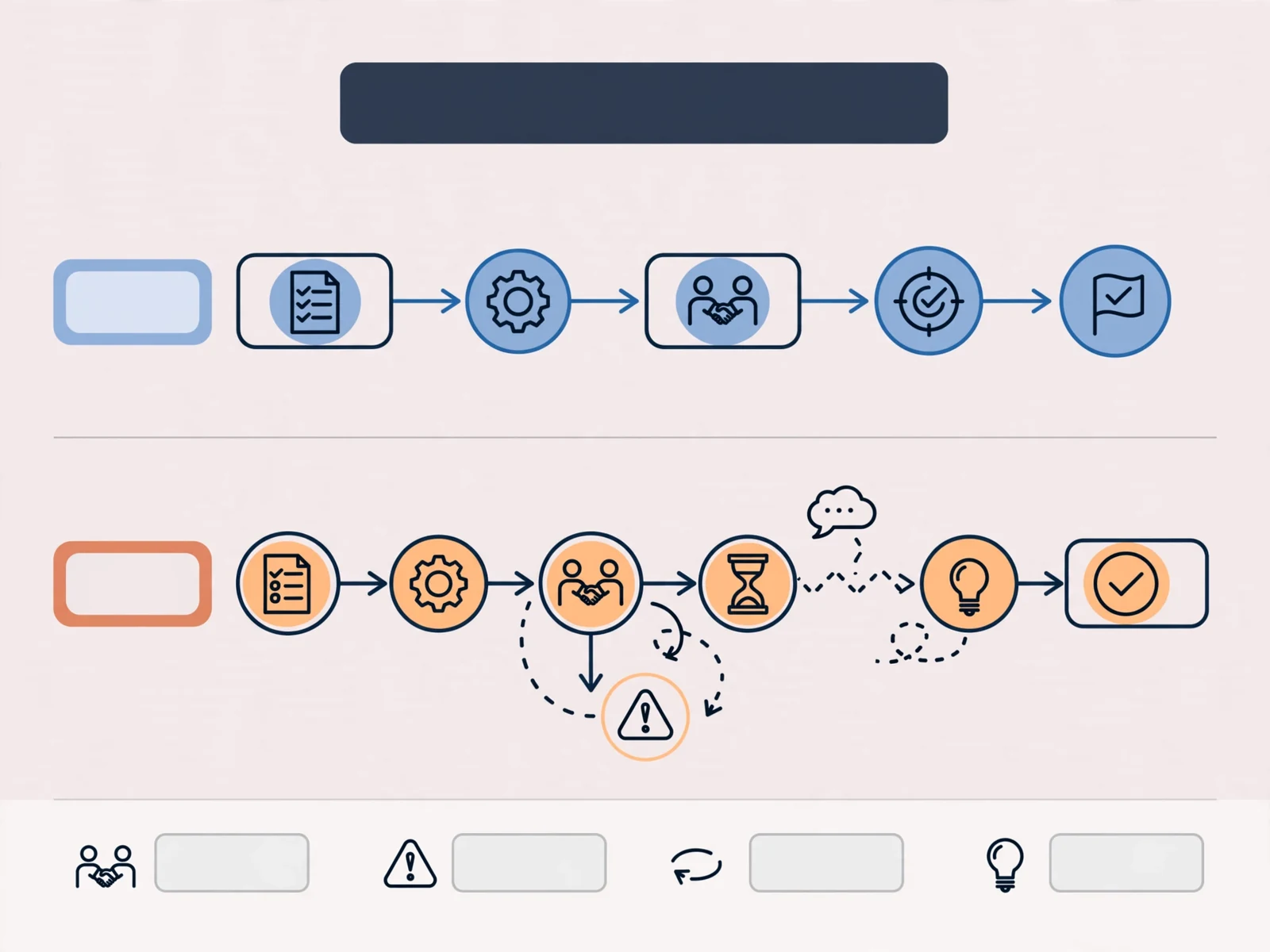
Process Purpose And Outcome
Define which customer or operational result the process must deliver, its trigger and its end point. Include failed and exceptional outcomes in scope.
Actual Current-State Flow
Follow live cases through employees, systems, email handoffs and queues. Mark waits, approvals, rework and workarounds separately from the intended route.
Handoffs And Exceptions
Identify where information is incomplete, ownership changes or an exception returns to a previous step. Establish who can resolve ambiguous handoffs.
Process Measures
Measure end-to-end completion, waiting and rework with documented event definitions. Compare representative cases without inventing average times.
Future-State Redesign
Test whether the largest problem is caused by a rule, role, control or system limitation. Pilot the smallest practical change before redesigning the whole workflow.
Automation And Process Ownership
Name the end-to-end process owner and the people who can adjust data, technology and controls. Automation should follow a stable, understood process.
Practical Business Process Mapping Working Template
- 1. Where does a case start and what counts as resolved?
- 2. Which observed steps differ from the manual?
- 3. Where do exceptions loop or stall?
- 4. Who owns each cross-team handoff?
- 5. What source records confirm delays and rework?
- 6. What narrow change can be tested safely?
- Decision owner: Who acts next and what evidence will be checked?
Worked Example
An invoice-approval map appears simple until real transactions reveal repeated missing-document requests and an undocumented finance handoff. Recording those loops produces a useful control decision before any software purchase.
Common Mistakes to Avoid
- Mapping the ideal rather than observed work.
- Ignoring failed or exceptional transactions.
- Using departmental speed as proof of end-to-end completion.
- Automating before clarifying ownership and process rules.
Questions Managers Should Ask
- Which real case confirms the map is accurate?
- Where does work wait or return, and what creates that delay?
- Which handoff lacks an accountable decision maker?
- What evidence would prove the redesign improves completion?
Management Review Checklist
Review observed cases, validated flow, control exceptions and proposed ownership change with affected staff. Record decisions and evidence gaps before adopting a new process.
Decision Quality Test
Would the proposed change still be justified after examining a failed transaction?
What to Review After Three Cycles
Compare successive real cases and note where assumptions, control failures or decision results changed. Keep maps under the process owner’s control and refresh them when procedures, responsibilities or systems change.
Make the Method Part of Normal Work
Keep maps under the process owner’s control and refresh them when procedures, responsibilities or systems change.
A 30-Day Application Plan
- Week 1: Trace representative transactions and define scope.
- Week 2: Validate handoffs and process exceptions with employees.
- Week 3: Pilot one evidence-backed improvement.
- Week 4: Recheck end-to-end outcomes and update controls.
Capability Maturity
Basic: current steps are visible. Developing: observed exceptions inform improvement. Mature: process evidence guides cross-functional operating changes.
For HR, L&D and Corporate Sponsors
A useful training exercise maps anonymized real work, including exceptions, and produces an operational improvement decision rather than an idealized chart.
Implementation Boundary
For business process mapping, standardize only the definitions, evidence, ownership and escalation rules where inconsistency creates real risk or confusion. Leave professional judgement open where circumstances differ materially. The objective is reliable decisions without forcing every case through an identical script.
Evidence to Bring to the Next Review
At the next business process mapping review, bring the actual work product, the evidence that changed the team’s view, the decision that followed and the assumption that still matters most. This makes follow-up useful for learning and accountability instead of repeating a status summary.
Related Courses in This Capability Cluster
Applied example for management teams
An operations analyst is asked to map the invoice-approval process. The documented route has four steps, but actual cases reveal repeated email clarifications, exceptions for incomplete purchase orders and an undocumented finance handoff. The analyst follows recent real cases, marks waiting time separately from processing time and asks staff why each rework loop occurs. The future-state map removes duplicate checks while retaining necessary controls. A process owner tests the change with a representative sample and reviews completion time and errors after implementation.
Train teams to map the process they actually perform
An operations team can compare its written procedure with a de-identified, real-life flow and identify waits, handoffs, rework and unclear ownership. The operational excellence framework links the map to ongoing review, while the business process management course addresses redesign and role interfaces. An in-house programme can then focus on one relevant cross-functional process rather than unrelated generic diagrams.
For an organizational cohort, request a private instructor-led training proposal with the participant roles, approximate group size and capability objective. Dates, trainers and programme terms are confirmed during scoping.
Where to Go Next
The Business Process Management and Process Redesign course develops this capability through live instructor-led practice and workplace application. For broader pathways, see Training Bundles and Corporate Academies.
Map the real work first, then redesign what the evidence shows is failing.
Develop this capability in your organization