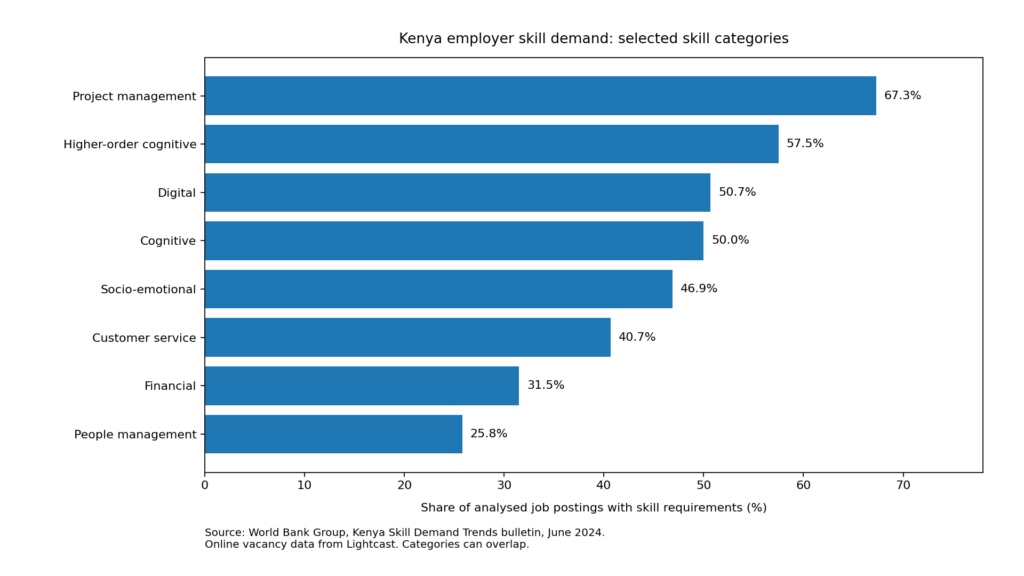
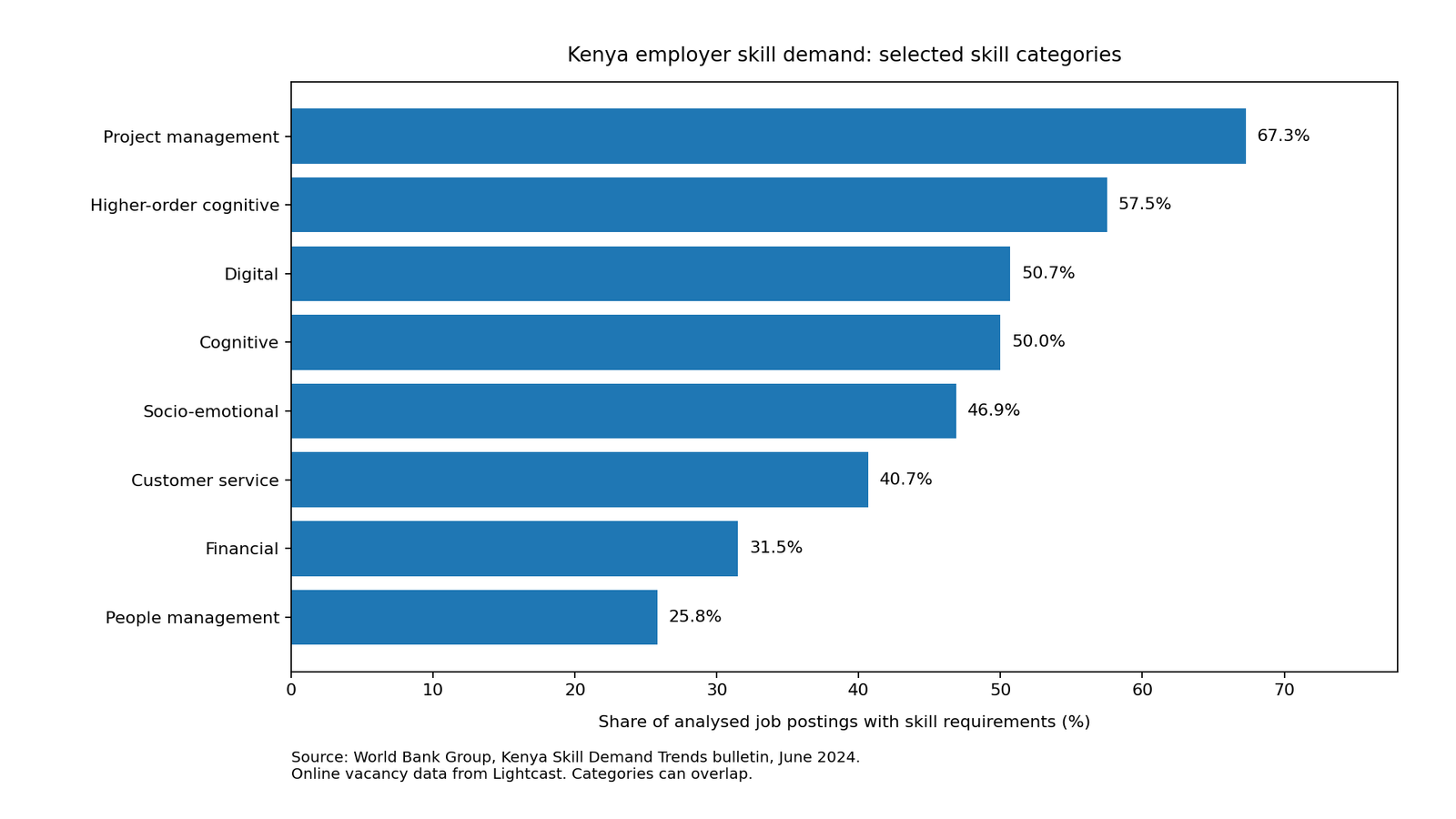
Kenya’s labour-market evidence supports a broad professional-skills strategy. In the World Bank’s online-job-vacancy analysis, specialized project-management skills appeared in 67.3% of postings with skill requirements, higher-order cognitive skills in 57.5%, specialized digital skills in 50.7%, cognitive skills in 50%, socio-emotional skills in 46.9%, customer-service skills in 40.7%, financial skills in 31.5% and people-management skills in 25.8%.
These categories cover capabilities such as management, planning, operations, project management, strategic planning, risk management, governance, finance, auditing, accounting, budgeting, procurement, leadership, negotiation, communication, decision making, problem solving, customer service and sales. The evidence therefore does not support a training strategy built around digital skills alone.
This 2026 guide combines the World Bank’s Kenya Skills Demand Bulletin with the Kenya National Bureau of Statistics 2026 Economic Survey and current World Bank human-capital evidence. Online vacancies, national employment statistics and human-capital indicators answer different questions, so they are kept separate rather than blended into one headline number.
Data table: Kenya vacancy skill categories
| Skill category | Vacancy share |
|---|---|
| Project-management-related skills | 67.3% |
| Higher-order cognitive skills | 57.5% |
| Specialized digital skills | 50.7% |
| Cognitive skills | 50.0% |
| Socio-emotional skills | 46.9% |
| Customer-service skills | 40.7% |
| Financial skills | 31.5% |
| People-management skills | 25.8% |
Source: World Bank Skills Demand Bulletin, Kenya (June 2024; analysed online vacancy postings from 2020 to June 2024). This table reports historical job-advert skill-category shares, not a 2026 survey or a representative census of all employers.
1. Project-management-related skills appear in 67.3% of analysed Kenyan vacancies
The World Bank category includes management, planning, operations, project management, organizational skills, business development, strategic planning, risk management, programme management, KPIs, governance and training and development.
That breadth is important. The category is not simply a count of people employed as project managers. It captures management and execution skills used across many occupations.
2. Higher-order cognitive skills appear in 57.5% of postings
Communication, interpersonal communication, problem solving, decision making, innovation, analytical skills, prioritization, critical thinking, business acumen and strategic thinking sit within this category.
These capabilities often determine whether technical knowledge can be applied in ambiguous organizational situations.
3. Specialized digital skills appear in 50.7% of postings
The World Bank bulletin includes coordinating, presentations, Microsoft Excel, computer literacy, Microsoft Office, data analysis, computer science, forecasting and other digital capabilities within its specialized digital taxonomy.
Advanced digital demand is real, but the same dataset shows even greater prevalence for project-management-related skills and substantial demand for finance, people management, communication and customer capability.
4. Cognitive skills appear in 50% of postings
The bulletin’s cognitive category includes research, English language, writing, verbal communication, quality assurance and other information-processing or knowledge-based skills.
5. Socio-emotional skills appear in 46.9% of postings
Leadership, detail orientation, time management, negotiation, teamwork and related professional behaviours appear in this category.
For training buyers, these skills are best developed inside the work context. Negotiation in procurement differs from negotiation in sales. Leadership for a new manager differs from board-level leadership.
6. Customer-service skills appear in 40.7% of postings
Customer service, sales, marketing, teaching and selling techniques are among the listed skills. The commercial implication is broader than frontline customer care: sales leadership, key accounts, customer experience and service operations all require structured capability.
7. Financial skills appear in 31.5% of postings
Finance, auditing, accounting, budgeting and procurement appear among the leading specialized financial skills in the bulletin. Financial capability therefore matters beyond finance departments alone.
8. People-management skills appear in 25.8% of postings
Business administration, mentorship, coaching, public relations, HR management, sales management, relationship management, fundraising, change management and employee relations appear within the people-management category.
This supports differentiated manager development rather than one generic leadership programme.
9. Procurement officer is among Kenya’s top 2024 online job titles
The World Bank’s 2024 top job-title list includes accountant, sales executive, procurement officer, accounts assistant, driver, finance manager, sales representative, project manager, business manager and administrative assistant.
The presence of procurement, project, finance, sales and business-management roles in the same top-ten list reinforces the breadth of professional capability demand.
10. Project manager remains visible among the leading job titles
Project manager appears in the World Bank top-ten job-title lists for 2020, 2021, 2023 and 2024. This does not prove a specific course market size, but it supports the relevance of project-management and PMO capability in Kenya’s formal online vacancy market.
11. Manager postings show project-management-related skills in 80%
Among manager vacancies in the World Bank dataset, specialized project-management skills appeared in 80% of postings. Higher-order cognitive skills appeared in 67%, socio-emotional skills in 59%, digital skills in 55%, cognitive skills in 51%, customer-service skills in 45%, financial skills in 43% and people-management skills in 39%.
This is strong evidence that Kenyan management roles combine planning, execution, financial, customer, people and analytical responsibilities.
12. Transversal digital skills appear in 71% of manager postings
The World Bank’s digital taxonomy reports transversal skills in 71% of manager postings, compared with basic ICT in 36% and advanced ICT in 22%. The transversal category includes communication, coordination, problem solving, decision making, innovation and analytical skills.
This again shows that management capability cannot be reduced to software proficiency.
13. Professional vacancies also combine project and digital capability
Among professional occupations, project-management-related skills appeared in 65% of postings, digital skills in 57%, higher-order cognitive skills in 56%, cognitive skills in 54%, socio-emotional skills in 41%, customer-service skills in 40%, financial skills in 27% and people-management skills in 21%.
14. Kenya recorded 21.6 million jobs in 2025 excluding small-scale farming and pastoral activities
The Kenya National Bureau of Statistics 2026 Economic Survey reports total recorded employment of 21.6 million people in 2025, up from 20.8 million in 2024. The measure excludes rural small-scale agriculture and pastoral activities.
15. Kenya added 822,100 recorded jobs in 2025
KNBS reports 822.1 thousand new jobs in 2025. The informal sector accounted for 87.2% of those new jobs.
That employment structure matters when interpreting online vacancy data. Formal internet-advertised vacancies describe an important but incomplete part of the labour market.
16. Informal-sector employment reached about 18.1 million
KNBS reports informal-sector employment of 18.106 million in 2025, up from 17.389 million in 2024.
17. Modern-sector wage employment reached 3.315 million
Modern-sector wage employment increased from 3.214 million in 2024 to 3.315 million in 2025, according to the 2026 Economic Survey.
18. Private-sector wage employment reached 2.245 million
KNBS reports private-sector wage employment of 2.245 million in 2025, up 2.5%. Manufacturing was the largest private wage-employment industry, representing 16.3%, followed by agriculture, forestry and fishing at 13.9% and wholesale and retail trade at 12.5%.
19. Financial and insurance employment grew 4.4%
The Economic Survey reports 4.4% growth in private-sector wage employment in financial and insurance activities in 2025. Education grew 3.5% and electricity, gas, steam and air-conditioning supply grew 3.8%.
20. Public-sector wage employment grew 4.6%
KNBS reports public-sector wage employment growth of 4.6% in 2025. Public administration and defence recorded 6.6% growth, while health and social work grew 5.5%.
Education represented 44.9% of public-sector employment and public administration and defence 35.1%.
21. Kenya’s 2026 World Bank update says 83.8% of jobs remain informal
The World Bank’s November 2026 Kenya Economic Update notes that employment is growing but 83.8% of jobs remain informal. This is consistent with the broader KNBS picture of a labour market dominated by informal employment.
22. Governance remains a major business and public-sector issue
The World Bank’s November 2026 update reports that 39% of firms identify corruption as a major constraint. It also argues that governance reform could support stronger growth and job creation.
For training providers, this does not justify making legal or anti-corruption outcome claims. It does support demand relevance for governance, procurement, ethics, public financial management and institutional-performance capability.
23. Kenya’s HCI+ score is above regional and income-group averages
The World Bank’s April 2026 Human Capital Country Brief reports a Kenya HCI+ score of 171, compared with a Sub-Saharan Africa average of 126 and a lower-middle-income-country average of 153.
The education pillar score is 109, above the regional average of 61, while the employment pillar score is 25, slightly below the regional average of 29.
24. Human-capital strength does not remove the need for workplace learning
Kenya’s relatively strong education component coexists with labour-market informality and employer demand for project, analytical, financial, customer and management capability. That combination supports lifelong learning focused on actual work responsibilities rather than only initial qualifications.
25. What Kenyan employers should take from the data
- Project and programme capability: project management, PMO, risk, stakeholder engagement, planning and execution.
- Leadership and management: communication, decision-making, coaching, change, negotiation and accountability.
- Procurement and commercial: procurement, sourcing, contracts, supplier risk, negotiation and commercial judgement.
- Finance and governance: budgeting, finance, auditing, internal control, enterprise risk and governance.
- Sales and customer capability: sales management, customer service, key accounts and relationship management.
- HR and people capability: HR management, coaching, mentorship, change management and learning strategy.
- Digital capability: tools, analysis and digital literacy integrated into professional roles.
26. Implications for project-management training in Kenya
Project-management-related skills are the largest category in the World Bank vacancy analysis, and project manager appears among the top job titles. Organizations should still diagnose the specific need before choosing training: foundational project skills, project risk, stakeholder management, PMO leadership, business analysis or major-project governance.
Relevant current programmes include Project Management Fundamentals, Risk Management in Projects and Program Management and PMO Leadership.
27. Implications for procurement training in Kenya
Procurement appears among the leading financial-category skill requirements and procurement officer is among the 2024 top job titles. Procurement training should connect process knowledge with market analysis, evaluation, contracts, supplier risk and commercial judgement.
Relevant programmes include Strategic Procurement Management, Strategic Sourcing and Supplier Market Analysis and Contract Management and Administration.
28. Implications for leadership and management development
Manager postings in the World Bank data combine project-management-related, cognitive, socio-emotional, digital, financial and customer capabilities. That supports role-based management development rather than isolated “soft skills” training.
29. How to use the statistics in a training needs analysis
- Identify the participant population and role level.
- Define the decisions and work products that need to improve.
- Use labour-market data as external context, not as the training brief itself.
- Separate skill gaps from unclear authority, broken processes or unavailable resources.
- Select one course or a coherent capability pathway.
- Define manager reinforcement and evidence of application.
30. Methodology and limitations
The World Bank Skills Demand Bulletin uses Lightcast online job-vacancy data from 2020 through June 2024. Online vacancies are not a census of Kenya’s labour market and are likely to overrepresent formal, internet-advertised employment. Skill categories can overlap, so percentages should not be added together.
The KNBS Economic Survey uses national statistical sources and reports employment stocks that exclude rural small-scale agriculture and pastoral activities in the cited total. It describes a much broader employment structure than the online vacancy dataset.
A skill appearing in a vacancy does not prove an employer will purchase external training. The evidence is useful for market relevance and course positioning, not for claiming a specific training-market size.
Primary sources
- World Bank Group, Kenya Skill Demand Trends: Insights from Online Job Vacancy Data, June 2024
- Kenya National Bureau of Statistics, Economic Survey 2026
- World Bank, Kenya Human Capital Country Brief, April 2026
- World Bank, Kenya Economic Update, November 2026
Related Kenya training pathways
- Professional Training in Kenya
- Project Management Fundamentals
- Program Management and PMO Leadership
- Strategic Procurement Management
- HR Business Partner Certification
- Finance for Senior Executives
- Private in-house training
Related organizational training: For Kenyan teams choosing role-specific learning pathways, explore Leadership and management training in Kenya; Procurement training in Kenya; Project management training in Kenya. These programme links are options for scoping, not evidence that a particular course will change the cited labour-market statistics.
Related evidence and practical guidance
A Kenyan employer’s own role requirements should be evaluated separately from continent-wide job-advertisement patterns and cross-country survey statistics. For context, read Africa workforce and management-skills evidence and practical training-needs assessment for African organizations.
Training options for organizations: See TheSkillGrid’s professional training pathways across Africa for relevant courses, country guides and private-cohort enquiries. The cited labour-market data provides background context rather than evidence of a specific training outcome.
Develop this capability in your organization