Employers across African labour markets are not asking only for narrow technical expertise. Recent vacancy research across South Africa, Nigeria, Kenya and Uganda shows a much broader pattern: communication, problem-solving, leadership, interpersonal skills, decision-making and occupation-specific knowledge appear alongside digital requirements. For training buyers, that matters because a workforce strategy built only around software or AI courses can miss the management and professional capabilities needed to apply technical knowledge in real work.
This 2026 reference uses current evidence from the World Bank and International Labour Organization. The core World Bank study analysed approximately 4.9 million unique online job postings across South Africa, Nigeria, Kenya and Uganda from 2020 through August 2024. Online vacancies are not a complete census of each labour market, and the study itself cautions that transversal skills are often complementary rather than substitutes for occupation-specific expertise. The figures below should therefore be used as demand signals, not as a claim that one training course or one skill will cause a particular employment or business outcome.
Key finding: the evidence supports rounded capability development. Employers want technical and occupation-specific expertise, but they also repeatedly ask for communication, problem-solving, leadership and other skills that help people coordinate work, make decisions and operate across functions.
1. Transversal skills appear in a large share of African job postings
The World Bank’s 2025 working paper Exploring Digital Skills Demand: Key Insights from Online Job Vacancies in South Africa, Nigeria, Kenya, and Uganda reports that the demand for at least one transversal skill averaged around 65% of job postings across the four-country dataset. By August 2024, the average shown in the study was about 71%.
| Country | Approximate share of postings requiring at least one transversal skill, 2024 | Interpretation |
|---|---|---|
| South Africa | ~62% | Transversal skills appeared in a clear majority of analysed online vacancies. |
| Nigeria | ~73% | Demand was substantially above the level observed at the start of the series. |
| Kenya | ~66% | Transversal requirements remained common, though the series was more volatile. |
| Uganda | ~84% | The highest 2024 share in the four-country comparison. |
| Four-country average | ~71% | Up from roughly two-thirds of postings earlier in the period. |
Source: World Bank, authors’ calculations using Lightcast online vacancy data, 2020–2024. Values are read from Figure 4.4 and are approximate. 2024 data run through August. Online vacancies are not a complete representation of all employment in each country.
The important management implication is not that every employee needs a generic “soft skills” course. It is that professional capability is often bundled. A project manager may need project controls plus stakeholder communication. A procurement manager may need market analysis plus negotiation and decision judgement. A finance manager may need technical finance plus the ability to explain trade-offs to operating leaders.
2. Communication is the most frequently listed transversal skill
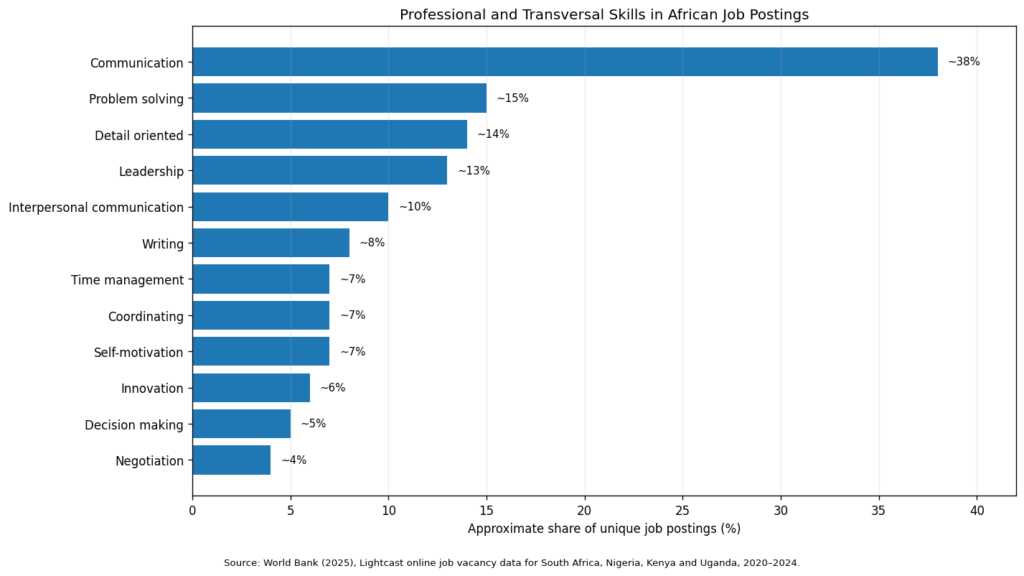
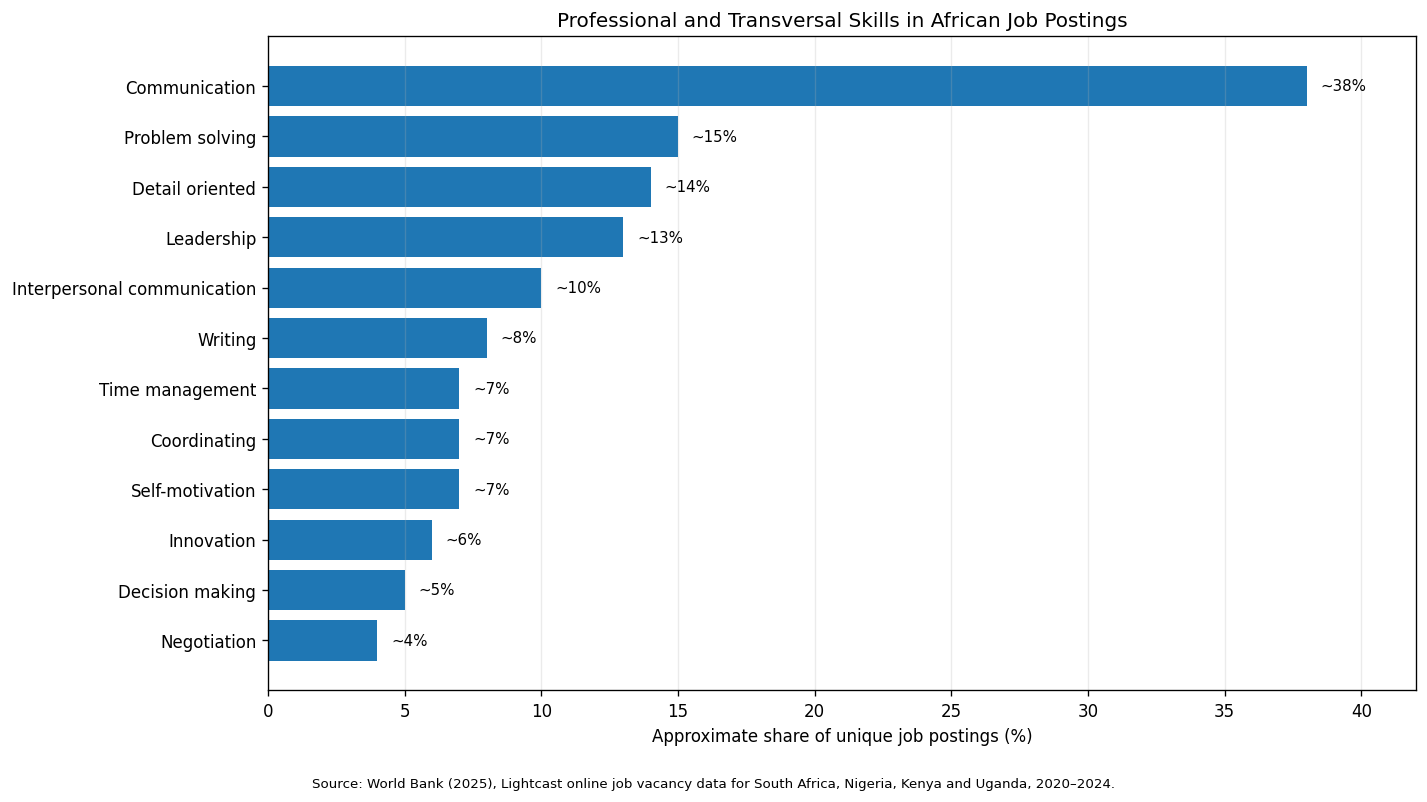
In the same World Bank analysis, communication appeared in more than 35% of unique job postings across the combined four-country dataset. The study’s Figure 4.5 places it at roughly 38%, well ahead of the other transversal skills.
| Transversal skill | Approximate share of unique postings |
|---|---|
| Communication | ~38% |
| Problem solving | ~15% |
| Detail oriented | ~14% |
| Leadership | ~13% |
| Interpersonal communication | ~10% |
| Writing | ~8% |
| Time management | ~7% |
| Coordinating | ~7% |
| Self-motivation | ~7% |
| Innovation | ~6% |
| Decision making | ~5% |
| Negotiation | ~4% |
Source: World Bank Figure 4.5, based on Lightcast data. Percentages are approximate readings of the published chart, not independent survey estimates.
These categories should not be treated as isolated training products. “Leadership” in a vacancy may sit beside budgeting, operations, customer service, project management or technical responsibilities. “Communication” may mean writing a report, presenting an investment case, handling a difficult stakeholder or coordinating a cross-functional process.
For organizational training, the better question is therefore: where does the skill show up in the work? If a management team struggles with stakeholder alignment, the learning should use real stakeholder decisions. If procurement staff need stronger negotiation, the programme should connect negotiation to sourcing strategy, commercial limits and contract risk.
3. Digital demand is important, but it does not replace management capability
The World Bank paper found that nearly half of analysed postings required at least one digital skill. Basic digital skills appeared in roughly one-third of postings, while advanced competencies such as computer science and data analysis appeared in about one-fifth. Those are significant signals, but the paper also found transversal skills across occupational groups regardless of digital intensity.
That distinction matters for employers planning training. A company can invest heavily in tools while still underperforming because managers cannot prioritize use cases, teams cannot redesign workflows, governance is weak, or employees do not know how to evaluate outputs. Likewise, a finance, procurement or project professional may use digital tools every day without being employed as a technology specialist.
The ILO’s 2026 Lifelong learning and skills for the future reaches a similar conclusion from a broader international evidence base. It argues that a narrow focus on technical skills, including AI and green tasks, is not enough. Employers increasingly seek rounded profiles combining technical expertise with digital literacy, social abilities and critical thinking.
4. African employers need combinations of technical, cognitive and socio-emotional skills
The ILO’s Africa-specific 2026 research brief says labour-market transformations reinforce the importance of lifelong learning, but also emphasizes that employers seek rounded skills profiles. Its analysis of online vacancy data from Egypt and South Africa shows technical skills being demanded alongside foundational socio-emotional and cognitive capabilities.
The broader ILO skill taxonomy is particularly relevant to professional training because it separates several types of capability that frequently work together:
- Core cognitive skills: planning, problem solving, strategic thinking and analysis.
- Financial skills: budgeting, accounting and finance.
- Project and process management: project, process, product and supply management.
- Social skills: communication, teamwork, presentation and advice.
- People management: supervisory capability, leadership, mentoring and staff development.
- Customer-service skills: client and commercial interaction.
- Digital and AI skills: from general computer capability to advanced technical specialisms.
This is much closer to the reality of organizational capability than a simple “digital versus non-digital” distinction. A senior manager often needs several categories at once.
5. Kenya’s vacancy data illustrates the breadth of professional demand
A World Bank skills-demand bulletin for Kenya shows that 2024 online vacancies included roles such as accountant, sales executive, procurement officer, finance manager, project manager and business manager among the top job titles. The underlying taxonomy also classifies finance, customer service, people management and project management as specialized skills rather than treating professional demand as a purely technical category.
The bulletin is based on online vacancy data, so it should not be interpreted as a ranking of the entire Kenyan labour force. It does, however, show why a professional-training offer in Kenya should not be built only around digital courses. Procurement, finance, project, sales and management roles are visible in the same demand data.
6. Leadership demand should be connected to real managerial work
The World Bank four-country chart places leadership at roughly 13% of unique postings. That is a meaningful signal, but it does not tell an employer which leadership intervention to buy.
A useful leadership needs analysis should separate at least four populations:
- New managers who need delegation, feedback, performance conversations and team coordination.
- Experienced managers who need stronger decision-making, stakeholder influence and cross-functional execution.
- Senior leaders who need strategic judgement, governance, risk oversight and organizational alignment.
- Functional leaders in finance, HR, procurement, projects, sales or operations who need leadership integrated with their professional discipline.
That is why one generic leadership programme cannot sensibly cover every organizational need.
7. Problem solving and decision making are cross-functional capabilities
Problem solving appears in roughly 15% of the World Bank’s combined vacancy data and decision making in about 5%. Their commercial importance is broader than those percentages might imply because many occupation-specific requirements embed the same capability without using those exact labels.
For example:
- A procurement professional performs problem solving when supply conditions change.
- A project manager uses it when schedule, scope and stakeholder constraints conflict.
- A finance manager uses it when a variance requires explanation and action.
- An HR business partner uses it when workforce data and manager requests point in different directions.
- An operations manager uses it when a process repeatedly fails despite local fixes.
Training is more likely to transfer into work when participants practise those decisions in the professional context where they actually occur.
8. Negotiation is not only a sales skill
Negotiation appears at roughly 4% in the World Bank transversal-skill chart. The figure should not be read as the total demand for commercial negotiation, because employers may list related occupation-specific skills separately. What it does show is that negotiation is a cross-cutting capability appearing in the vacancy evidence.
In organizations, negotiation can sit inside procurement, contracts, stakeholder management, sales, key accounts, project change, supplier management and leadership. A training buyer should therefore distinguish the context before selecting a course.
9. Training access and training quality are separate problems
The ILO’s 2026 Africa brief says access to quality learning remains limited and unequal, especially when learning is expected to lead to recognized skills or qualifications. The global report also notes that smaller enterprises and lower-qualified or informal workers often face greater barriers to structured learning.
For employers, availability alone is not enough. The design of the intervention matters. The ILO points to stronger outcomes when training develops rounded skill profiles and combines classroom learning with practical or work-based experience.
For corporate and institutional programmes, that supports a practical design principle: the training should include decisions, scenarios, work products and manager follow-up that connect the learning to the participant’s actual role.
10. What African organizations should measure before buying training
A capability decision should start with organizational evidence, not a continental headline. Useful questions include:
- Which roles or teams are affected?
- What decisions, processes or conversations are currently weak?
- Is the issue knowledge, judgement, tools, incentives, process design or authority?
- What do strong performers already do differently?
- Which work product should improve after training?
- Can the manager reinforce the new practice after the programme?
- Does the cohort need one skill or a combination of professional and management capabilities?
A training programme should not be used to compensate for a broken system. If the real problem is unclear authority, missing data, unrealistic targets or a defective process, training alone is unlikely to solve it.
11. Implications for leadership, HR, procurement, projects and finance
Leadership and management
The evidence supports practical management capability built around communication, problem solving, coordination, leadership and decision-making, but the content should match the participant’s level and responsibilities.
HR and learning and development
HR teams should avoid dividing development into “technical” and “soft” silos. Rounded capability often combines professional knowledge, analytical judgement and interpersonal execution.
Procurement and supply chain
Procurement capability can combine market analysis, commercial judgement, negotiation, stakeholder communication, risk and supplier decision-making.
Projects and programmes
Project capability requires planning and controls, but also problem solving, stakeholder management, coordination, communication and decision discipline.
Finance and governance
Technical financial competence becomes more useful when managers can interpret evidence, explain trade-offs, challenge assumptions and connect financial information to operational decisions.
12. Country-level training strategy should follow demand, not templates
The four-country data show meaningful differences in the share and trajectory of skill requirements. That is another reason not to build an “Africa training” strategy by cloning the same course landing page across dozens of countries.
A better approach is to combine:
- country-level search and buyer evidence;
- the organization’s existing course catalogue;
- sector and institutional context;
- the roles of the likely training buyers;
- actual lead and enquiry data once traffic begins to arrive.
The result should be a small number of strong country and capability pages first, followed by expansion only where search visibility, buyer enquiries, outreach response or institutional opportunities justify it.
13. Methodology and limitations
The principal labour-demand source used here is the World Bank’s November 2025 working paper based on Lightcast online vacancy data from South Africa, Nigeria, Kenya and Uganda. It covers January 2020 to August 2024 and approximately 4.9 million unique postings. Online vacancies can overrepresent formal, internet-based recruitment and particular occupations. The 2024 period is incomplete.
The World Bank also cautions that widely listed transversal skills may partly reflect their general value and routine inclusion in job adverts. They are typically complementary to occupation-specific requirements rather than substitutes for them.
The ILO evidence is used to interpret the broader training-design implication: employers increasingly value combinations of technical, cognitive and socio-emotional capability, and effective lifelong-learning systems require more than narrow technical training.
None of these sources establishes that a particular TheSkillGrid programme will increase productivity, employment, revenue or promotion rates by a specific percentage. Those outcomes require organization-specific evidence.
Primary sources
- World Bank, Exploring Digital Skills Demand: Key Insights from Online Job Vacancies in South Africa, Nigeria, Kenya, and Uganda, 2025
- ILO, Lifelong learning and skills for the future: Insights for Africa, 2026
- ILO, Lifelong learning and skills for the future, 2026
Related training and practical resources
- Corporate training needs assessment template for organizations in Africa
- Public financial management training needs assessment for African institutions
- Public tender evaluation capability checklist for African procurement teams
- Professional Training in Nigeria
- Professional Training in Kenya
- Professional Training in South Africa
- Corporate Training in Accra, Ghana
- Advanced Leadership and Executive Presence
- Strategic Procurement Management
- Program Management and PMO Leadership
- Finance for Senior Executives
- HR Business Partner Certification
Discuss an Africa Workforce Development Programme
If your organization is assessing leadership, procurement, project management or professional capability needs, share the roles, participant numbers and business challenges. We can help scope a relevant private training pathway rather than assuming every skills gap requires a digital-skills course.
Related organizational training: For employers using these statistics to identify capability gaps, explore Leadership development in Nigeria; Project management training in Kenya; Public-sector performance training in Ghana. These programme links are options for scoping, not evidence that a particular course will change the cited labour-market statistics.
Training options for organizations: See TheSkillGrid’s professional training pathways across Africa for relevant courses, country guides and private-cohort enquiries. The cited labour-market data provides background context rather than evidence of a specific training outcome.
Develop this capability in your organization