Ghana’s workforce statistics show a labour market with high participation, high informality, persistent youth unemployment and a substantial need to keep building human capital throughout working life. Unlike the cited Nigeria, Kenya and South Africa comparisons, this article does not use a directly comparable World Bank employer-vacancy skills bulletin for Ghana. It therefore does not present an unsupported ranking of “skills employers want.” It uses Ghana Statistical Service and World Bank evidence to describe the labour market honestly, then explains what organizations should and should not infer for training.
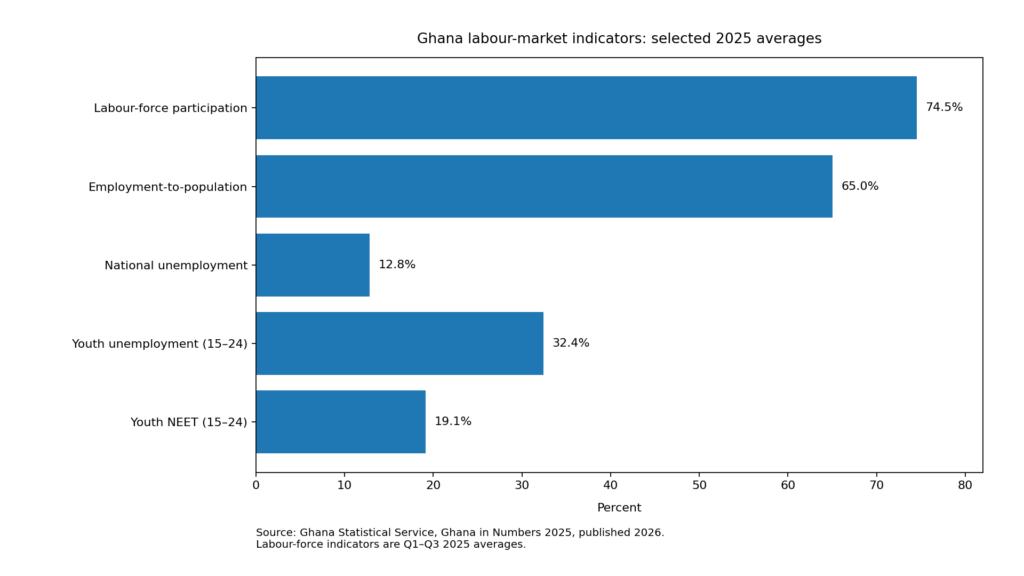
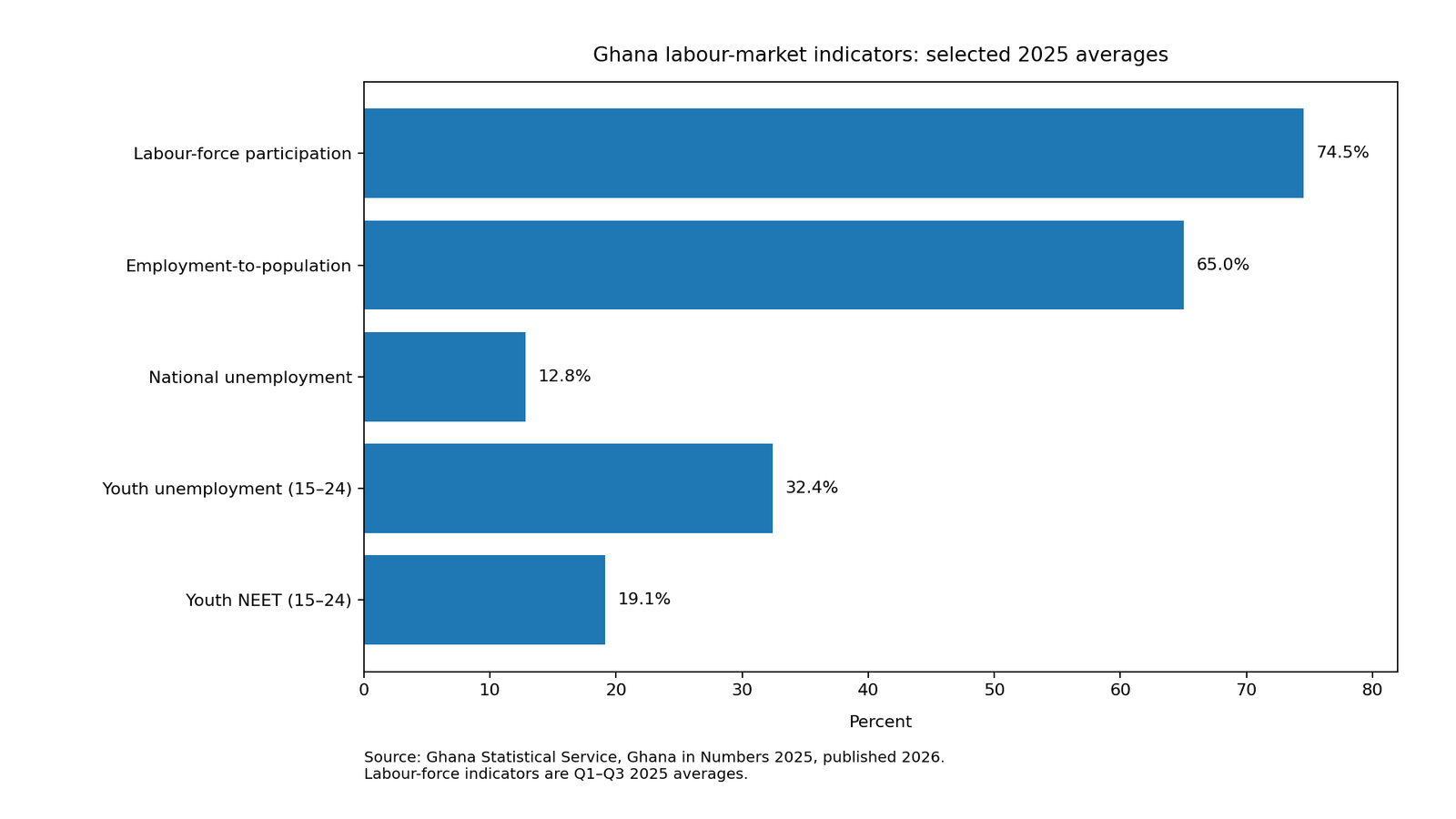
Ghana Statistical Service reports labour-force participation of 74.5% across the first three quarters of 2025, an employment-to-population ratio of 65.0%, national unemployment of 12.8%, youth unemployment of 32.4% for ages 15–24 and a youth NEET rate of 19.1%. The World Bank’s April 2026 Human Capital Country Brief gives Ghana an HCI+ score of 153, equal to the lower-middle-income-country average and above the Sub-Saharan Africa average of 126.
Data table: Ghana labour-market indicators
| Indicator | Reported value |
|---|---|
| Labour-force participation, Q1–Q3 2025 average | 74.5% |
| Employment-to-population ratio, Q1–Q3 2025 average | 65.0% |
| Employed people, Q1–Q3 2025 average | approximately 13.3 million |
| National unemployment, Q1–Q3 2025 average | 12.8% |
| Youth unemployment, ages 15–24 | 32.4% |
| Youth NEET, ages 15–24 | 19.1% |
Source: Ghana Statistical Service. This table restates the evidence discussed in the sections below; refer to the original publications for the full method.
1. Ghana’s labour-force participation rate averaged 74.5%
Ghana Statistical Service reports labour-force participation of 74.5% across Q1–Q3 2025. Participation measures people working or actively looking for work, so it is broader than the share actually employed.
2. The employment-to-population ratio averaged 65.0%
The same GSS source reports an employment-to-population ratio of 65.0%. The measure counts people in work as a share of the working-age population.
3. Ghana had about 13.3 million employed people
GSS reports an average of roughly 13.3 million employed people across Q1–Q3 2025.
4. National unemployment averaged 12.8%
Ghana’s national unemployment rate averaged 12.8% across the first three quarters of 2025, according to Ghana Statistical Service.
5. Youth unemployment reached 32.4%
For people aged 15–24, GSS reports an unemployment rate of 32.4%. This is materially above the national average and highlights the difficulty young people face moving into productive work.
6. The youth NEET rate was 19.1%
GSS reports that 19.1% of people aged 15–24 were not in employment, education or training. For ages 15–35, the reported NEET rate was 17.9%.
These are population-level measures. They do not tell an employer which professional course to purchase, but they are important context for workforce-development policy.
7. More than 70% of employment is informal
Ghana Statistical Service says more than 70% of employment was informal across the Q1–Q3 2025 averages. A separate 2026 World Bank poverty and equity brief describes informality as widespread and puts the share at roughly 80%.
Differences can reflect source, period and definition. The important conclusion is not the exact percentage but the structure: a large majority of Ghanaian employment sits outside formal wage employment.
8. Vulnerable employment involved about 9.7 million people
GSS reports approximately 9.7 million people in vulnerable employment across the Q2–Q3 2025 average.
9. Ghana’s HCI+ score is 153
The World Bank’s April 2026 Human Capital Country Brief gives Ghana an HCI+ score of 153 out of a maximum 325. The index extends the original Human Capital Index by incorporating tertiary education and work experience.
10. Ghana performs above the regional HCI+ average
Ghana’s HCI+ score of 153 is higher than the Sub-Saharan Africa average of 126 and equal to the lower-middle-income-country average of 153.
11. Ghana’s education-pillar score is 80
The World Bank reports an education pillar score of 80, above the regional average of 61. The health pillar score is 39 compared with a regional average of 36, while the employment pillar score is 33 compared with 29 regionally.
12. Tertiary completion is 15%
The Human Capital Country Brief reports tertiary completion of 15% for Ghana in its comparison with Nicaragua. The brief identifies tertiary completion, harmonized learning outcomes and survival to age 60 as major contributors to the HCI+ gap with the higher-performing comparator.
13. Youth wage employment remains limited
The World Bank comparison reports 46% of Ghanaian youth at work and 31% of youth in wage employment. For adults, the reported shares are 82% at work and 32% in wage employment.
These internationally comparable indicators reinforce the importance of distinguishing employment from formal wage employment.
14. Ghana’s HCI+ shows a gender gap
The World Bank reports an HCI+ score of 148 for women and 160 for men, a 12-point difference. The brief interprets this as a difference in expected earning potential associated with accumulated human capital.
15. Ghana’s economy grew 6.0% in 2025
The World Bank’s August 2026 Ghana update says real GDP growth reached 6.0% in 2025, supported by services and agriculture. The same update cautions that growth has not yet generated enough quality jobs to absorb the expanding working-age population.
16. Ghana’s jobs challenge is about quality as well as quantity
High informality, vulnerable employment and youth unemployment mean that job creation alone does not capture the whole workforce challenge. Productivity, enterprise capability, formalization, management quality and access to skills all matter.
17. What employers should not infer from national labour statistics
National statistics do not prove that every organization needs the same training. A country can have high youth unemployment while an individual company has a shortage of experienced procurement managers. Informality can be high while a bank needs stronger risk governance. HCI+ can improve while a project team still struggles with stakeholder management.
Training needs should therefore be diagnosed at role and organizational level.
18. Management capability matters in a growing, informal economy
Organizations operating in a market with high informality often manage complex supplier, customer, workforce and compliance relationships. Managers may need stronger planning, financial judgement, procurement, process, people and stakeholder capability even where those needs are not captured in national labour statistics.
19. Public-sector capability remains commercially relevant
Ghana’s public institutions and development programmes manage significant investment, service delivery and reform agendas. Relevant professional capabilities include public financial management, procurement, monitoring and evaluation, programme management, governance, stakeholder engagement and strategy execution.
These are capability areas, not claims that one particular Ghanaian institution has a training deficiency.
20. Procurement training should connect process with judgement
Procurement professionals may need market analysis, specifications, supplier evaluation, negotiation, contract management and governance. Where public rules apply, local legal and procedural requirements should be separated from transferable procurement-management capability.
Relevant programmes include Strategic Procurement Management, Strategic Sourcing and Supplier Market Analysis and Contract Management and Administration.
21. Monitoring and evaluation is especially relevant to programme environments
Development and public programmes need credible results frameworks, indicators, evidence and learning routines. TheSkillGrid’s Results-Based Management, Monitoring and Evaluation course addresses this management capability without claiming that training itself guarantees programme outcomes.
22. Finance and public-resource management are separate training needs
General finance training develops financial judgement for managers. Public financial management involves budget execution, expenditure control, accountability and institutional interfaces. Organizations should choose the programme based on role rather than assume one finance curriculum fits both.
23. Leadership training should follow responsibility
First-time managers may need delegation, feedback and team coordination. Senior leaders may need strategy, governance, risk and stakeholder judgement. Functional leaders in HR, finance, procurement or projects need leadership integrated with their discipline.
24. Women’s professional development should be tied to real career pathways
Ghana’s human-capital gender gap is a national indicator, not evidence that every employer has the same progression problem. Organizations considering women-in-leadership programmes should examine actual promotion pathways, role transitions, sponsorship, functional capability and management responsibilities.
25. What Ghanaian organizations should include in a training needs analysis
- Participant roles and decision authority
- The work product or process that needs to improve
- Whether the problem is knowledge, judgement, incentives, process design or resources
- Current performance evidence
- The manager or sponsor who will reinforce application
- Whether one course or a staged pathway is required
26. Practical capability areas for corporate organizations
- Leadership and management
- Finance and budgeting
- Procurement, contracts and supply chain
- Project and programme management
- Sales and customer experience
- HR and workforce planning
- Operations and process improvement
- Strategy and business analysis
27. Practical capability areas for public and development institutions
- Public-sector strategy execution
- Results-based management and monitoring and evaluation
- Public financial management
- Procurement and tender management
- Programme and PMO capability
- Governance and internal control
- Stakeholder engagement
- Policy design and implementation
28. How Ghanaian HR, L&D and institutional buyers can use these findings
National unemployment and informality indicators are not a substitute for an organizational skills assessment. A buyer preparing a training brief should identify the participant roles, the decisions or work products that need improvement, the operating environment and what supervisors will review after training. For a private organization, this might mean procurement, project governance, finance or workforce-planning capability. For a public or development institution, the priority might be budget controls, programme monitoring, procurement governance or donor documentation.
Use the Accra corporate training options, Ghana procurement and tender management pathway or public-sector performance and monitoring programme as relevant starting points. Compare potential courses against real tasks, approved policies and confirmed facilitator suitability rather than treating national statistics as a forecast of training outcomes.
29. Methodology and limitations
The Ghana Statistical Service labour-market figures cited here are Q1–Q3 2025 averages published through Ghana in Numbers in 2026. The World Bank HCI+ brief uses internationally comparable datasets with varying reference years. The World Bank 2026 economic commentary describes more recent macroeconomic and jobs conditions.
These sources do not provide a single current employer-vacancy skills ranking comparable with the World Bank bulletins available for Nigeria, Kenya and South Africa. This article therefore does not claim one.
National labour-market indicators are evidence for market context and workforce policy, not a direct estimate of demand for commercial training.
Primary sources
- Ghana Statistical Service, Ghana in Numbers 2025 labour-market indicators
- World Bank, Ghana Human Capital Country Brief, April 2026
- World Bank, Ghana economic update, August 2026
- World Bank, Ghana Poverty and Equity Brief, October 2026
Related Ghana training pathways
- Corporate Training in Accra, Ghana
- Results-Based Management, Monitoring and Evaluation
- Public Sector Strategy Execution and Performance Management
- Strategic Procurement Management
- Corporate Governance Essentials
- Financial Management for Non-Finance Managers
- Private in-house training
Related organizational training: For organizations in Ghana designing practical professional-development pathways, explore Procurement and tender management training in Ghana; Public-sector performance and monitoring training in Ghana. These programme links are options for scoping, not evidence that a particular course will change the cited labour-market statistics.
Related evidence and practical guidance
Informality, jobs and human-capital measures have different populations and denominators. Institutional training needs should be tested against actual decisions and delivery responsibilities, not inferred from headline workforce aggregates. For context, read Africa-wide workforce evidence and its scope and an African public-financial-management training brief.
Training options for organizations: See TheSkillGrid’s professional training pathways across Africa for relevant courses, country guides and private-cohort enquiries. The cited labour-market data provides background context rather than evidence of a specific training outcome.
Develop this capability in your organization