
A KPI is useful when it measures progress toward a specific business outcome and prompts a clear response. Selecting easy-to-count activities before defining the objective leads to dashboards that reward motion instead of results.
Start with the decision and intended outcome, then set measurement rules, data ownership, targets, thresholds and balancing measures. Test how teams might improve the number without improving the business.
Business Objective
Define the customer, operating or financial result that matters and the decisions managers can take to influence it. Separate the actual objective from a convenient proxy metric.
Metric Definition
Specify numerator, denominator, units, population, event rules, reporting period, exclusions and source. A metric must be reproducible and relevant to its purpose.
Leading And Lagging Measures
Use leading indicators for important controllable drivers and lagging indicators for outcomes. Treat relationships as hypotheses until supported by evidence, and include measures that reveal unintended harm.
Targets And Thresholds
Set targets using a transparent baseline, business capacity and genuine decision limits. Distinguish aspirations from action thresholds and explain when variation is noise rather than deterioration.
Dashboard Hierarchy
Organize dashboards around decisions at strategic, operational and team levels, without copying every number into every report. Show definitions, trends and relevant guardrails.
Review And Action Ownership
Assign each measure an owner with authority to act, specify response triggers and revisit definitions when work changes. Retire indicators that produce no useful action.
Practical KPI Design Checklist Working Template
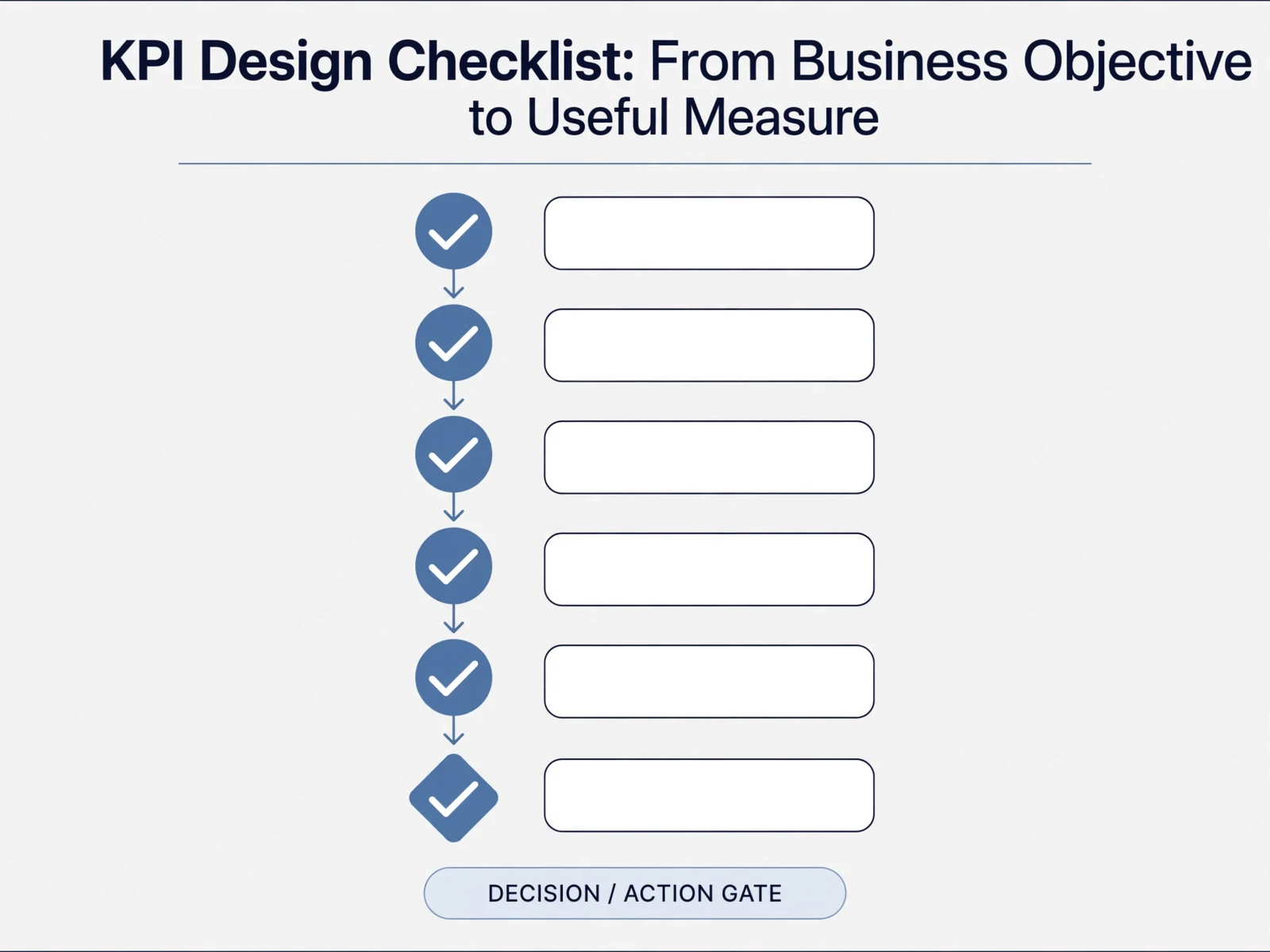
- 1. What business outcome is at stake?
- 2. What exact population and formula define the KPI?
- 3. Which sources can support that measure?
- 4. Which leading and lagging signals are needed?
- 5. What target or trigger is justified by evidence?
- 6. Who acts and how is the result reviewed?
- Next decision: Who owns the review and what evidence changes it?
Worked Example
A service team rewards handling calls quickly but repeat contact rises. The KPI design adds resolved cases and follow-up work, checks counting rules and assigns the service manager a clear action when quality declines.
Common Mistakes to Avoid
- Treating what is easy to count as the objective.
- Using an undefined denominator or changing scope.
- Turning arbitrary goals into red-amber-green ratings.
- Rewarding a metric that can be gamed at the customer’s expense.
- Retaining dashboards without an action owner.
Questions Managers Should Ask
- Would the business notice if this KPI improved but the outcome worsened?
- Could another analyst reproduce the metric?
- What evidence justifies the threshold?
- Who changes operations when it moves?
Management Review Checklist
Check the objective, data quality, measure definition, response thresholds and unintended incentives. Remove or redesign KPIs that fail to support a consequential decision.
Decision Quality Test
If people optimise this KPI, are they likely to improve the business outcome?
What to Review After Three Cycles
Compare actual cases over several cycles, test whether the original decision assumptions still hold, and improve the practice where evidence requires. Build KPI review into normal operating meetings, with clear triggers for corrections and definition changes.
Make the Method Part of Normal Work
Build KPI review into normal operating meetings, with clear triggers for corrections and definition changes.
A 30-Day Application Plan
- Week 1: Identify one real business outcome.
- Week 2: Define reliable metric and data rules.
- Week 3: Set justified target and guardrails.
- Week 4: Pilot a KPI review and refine the response.
Capability Maturity
Basic: KPIs are defined. Developing: source quality and ownership support action. Mature: KPIs adapt to outcomes and operational learning.
For HR, L&D and Corporate Sponsors
Participants should design an evidence-backed KPI for a fictional service problem, including formula, guardrail, owner and action threshold.
Implementation Boundary
For KPI design checklist, standardize only the definitions, evidence, ownership and escalation rules where inconsistency creates real risk or confusion. Leave professional judgement open where circumstances differ materially. The objective is reliable decisions without forcing every case through an identical script.
Evidence to Bring to the Next Review
At the next KPI design checklist review, bring the actual work product, the evidence that changed the team’s view, the decision that followed and the assumption that still matters most. This makes follow-up useful for learning and accountability instead of repeating a status summary.
Related Courses in This Capability Cluster
Applied example for management teams
An executive team wants a KPI for customer service improvement. Instead of choosing an available dashboard number, it defines the business outcome as resolving customer issues reliably. Managers agree the exact calculation for repeat contact, first resolution and complaint escalation, including exclusions and reporting delay. Leading process measures are linked to the outcome without being treated as proof of success. Thresholds trigger named actions, and the team checks for gaming or changes in case mix before interpreting improvements.
Connect KPI design to institutional performance decisions
An institution needs indicators that clarify responsibilities and choices, not just an attractive scorecard. The strategy execution rhythm guide relates a measurement system to practical review meetings. For public-sector management buyers, the Ghana public-sector performance pathway provides relevant programme context, with local reporting rules confirmed during scoping. A cohort can practise identifying the indicator owner, data limitations, review frequency and escalation triggers.
For an organizational cohort, request a private instructor-led training proposal with participant roles, approximate group size and capability objectives. Programme availability and commercial terms are confirmed during scoping.
Where to Go Next
The KPI Design and Performance Measurement course develops this capability through live instructor-led practice and workplace application. For broader pathways, see Training Bundles and Corporate Academies.
Design KPIs from the outcome and the decision, not from the reporting system’s available counters.
Develop this capability in your organization