Strategy fails operationally when priorities live in a presentation while weekly management continues as usual.
Execution requires a rhythm that keeps strategic priorities visible in decisions, resources, measures, and management conversations.
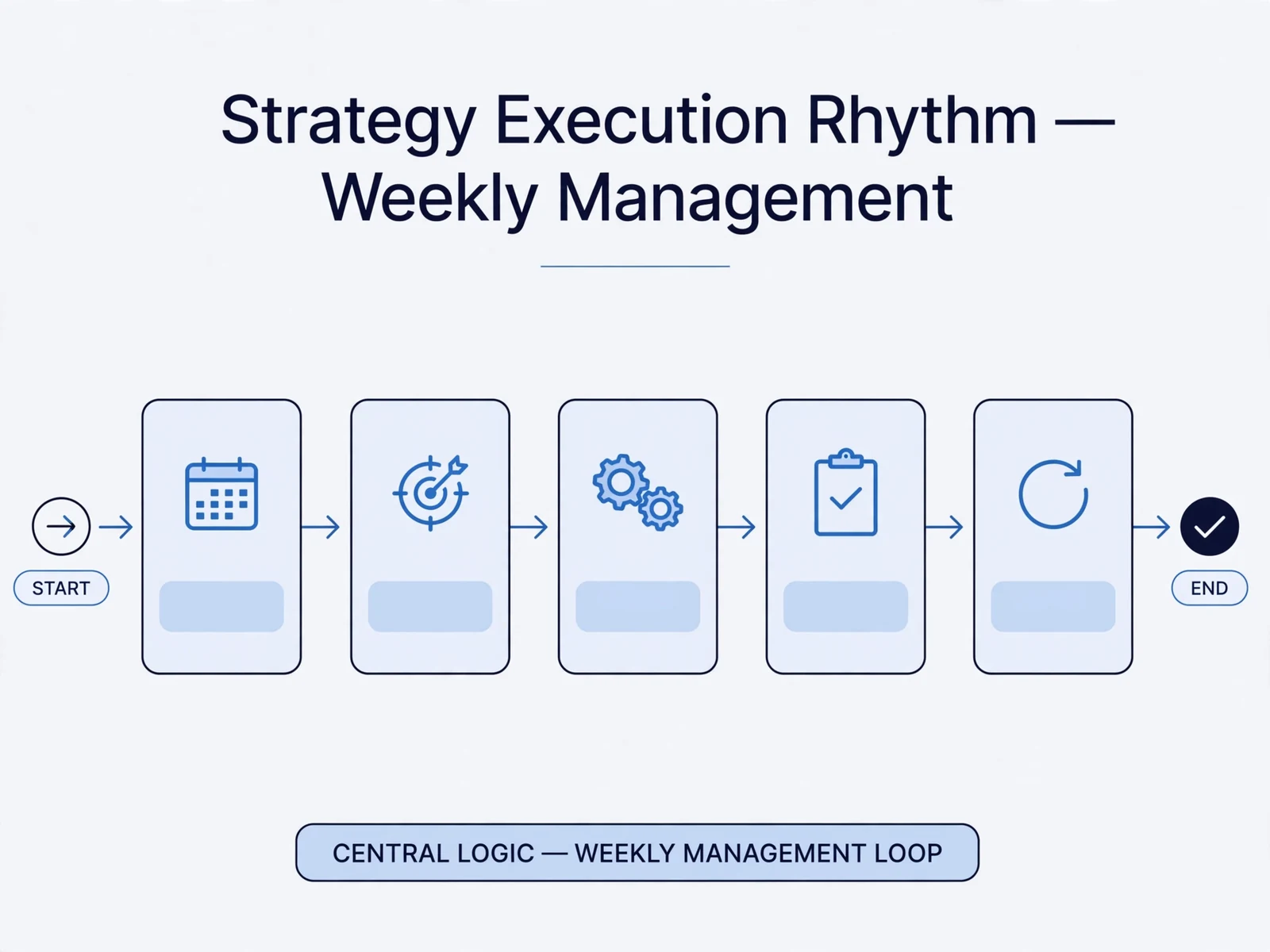
Reduce Strategy to a Manageable Set of Priorities
If everything is strategic, nothing is prioritized.
Leaders should be able to name the few priorities that require disproportionate attention over the current period.
Give Every Priority an Owner
Shared responsibility can become no responsibility.
Each strategic priority should have one accountable owner, even if delivery depends on many functions.
Translate Priorities Into Outcomes
A priority such as “improve customer experience” is too broad for execution.
Define:
- what outcome should change;
- what evidence will show progress;
- what initiatives contribute;
- what trade-offs may be required.
Create a Weekly Strategic Check
Not every strategic priority needs a long weekly meeting.
A short review can ask:
- What changed?
- What is off track?
- What decision is required?
- What dependency needs escalation?
- What action belongs this week?
Separate Measures From Management
A dashboard can show that a measure is off track. It cannot decide what to do.
Use data to focus the conversation, then ask what management action is required.
Connect Budget to Strategy
Strategic priorities without resources are statements of preference.
Review whether money, people, technology, and leadership attention align with the stated priorities.
Manage Dependencies Explicitly
Many priorities fail because success depends on another function.
Map critical dependencies and give them owners.
Use Decision Logs for Strategic Trade-Offs
Execution produces trade-offs.
Record important decisions so teams understand what was prioritized and why.
Run a Monthly Outcome Review
Weekly reviews focus on immediate movement. Monthly reviews should ask whether the overall direction is working.
- Are outcomes improving?
- Are assumptions still valid?
- Is the initiative portfolio still appropriate?
- Should resources move?
- What has become less important?
Stop Projects That No Longer Serve the Priority
Execution quality depends partly on the willingness to stop work.
Old initiatives can survive because they already have sponsors, budgets, and teams.
Ask whether they still support the current strategy.
Give Managers a Clear Line of Sight
Middle managers should know how their team’s work connects to the strategic priorities.
If they cannot explain that connection, execution will become a collection of local activities.
Use a Quarterly Reset
Every quarter review:
- priority relevance;
- progress;
- resources;
- dependencies;
- new risks;
- initiatives to stop or start.
A Simple Strategy Execution Rhythm
- Weekly: exceptions, decisions, blockers.
- Monthly: outcomes, trends, resource decisions.
- Quarterly: priority and portfolio reset.
Connect Strategic Priorities to Manager Goals
Managers should not be expected to translate strategy alone. Convert enterprise priorities into a small set of outcomes each function or team can influence.
Then make the relationship explicit. If a team target cannot be linked to a strategic priority, ask whether the target is still important enough to consume capacity.
Use Leading and Lagging Indicators
Lagging indicators show results after they happen. Leading indicators show whether the system is moving in the right direction early enough to act.
For example, revenue is a lagging result. Pipeline quality, conversion, delivery capacity or retention may provide earlier information depending on the business.
Do not create dozens of measures. Choose the few that improve decisions.
Escalate Trade-Offs, Not Only Problems
Execution often stalls because two good priorities compete for the same people or budget. Managers should escalate the trade-off explicitly.
Instead of saying, “We are overloaded,” say, “We can deliver A by October or A and B by December. Which outcome has priority?”
Make Strategy Visible in Operating Meetings
Add a short strategic section to existing management routines rather than creating another layer of meetings. Ask which current issue has the biggest effect on the strategic priorities and what decision is needed.
Review Assumptions
Strategies are built on assumptions about customers, competition, regulation, technology, cost and capability. Keep a short assumption register for the few assumptions that would materially change the plan.
Execution Review Questions
- Which priority is moving?
- Which is stalled?
- What decision is blocking progress?
- What resource needs to move?
- Which assumption changed?
- What work should stop?
Example: Turning a Strategic Priority Into Weekly Management
Suppose the strategic priority is to improve customer retention.
The operating translation might be:
- Outcome: reduce avoidable customer loss.
- Owner: Customer Director.
- Leading signals: service issues, renewal-risk accounts, unresolved complaints.
- Weekly question: which accounts require intervention now?
- Monthly question: what recurring cause is driving risk?
- Quarterly question: does the service model need redesign?
This is much stronger than a strategy slide that simply says “customer centricity.”
Protect the Rhythm From Becoming Reporting Theater
Execution reviews should not become presentations created to prove that work is happening. Keep them short, decision-oriented, and focused on exceptions.
If teams spend more time formatting updates than resolving the issues inside them, the rhythm is working against execution.
Example Questions for the Weekly Review
- Which priority needs a decision this week?
- What dependency is now critical?
- What outcome is moving slower than expected?
- Which resource conflict needs escalation?
- What initiative should stop to protect the priority?
These questions keep the review focused on management action rather than presentation quality.
Keep the Rhythm Lightweight
The rhythm should make execution easier, not create a reporting industry. Use existing meetings where possible, focus on exceptions, and remove measures that do not change decisions.
Where to Go Next
The Strategic Planning and Execution course develops strategy formulation, prioritization, alignment, measures, governance, and execution rhythms. Leaders managing transformation can also use Change Management and Organizational Transformation.
Strategy becomes real when it changes what managers discuss, decide, fund, and stop every week.
Develop this capability in your organization