
A profitable business can still face a cash shortfall when customer receipts arrive after supplier and payroll commitments. Liquidity risk is about the timing and reliability of available cash, not simply reported earnings.
Map short-horizon cash inflows and outflows, working-capital demands, committed funding and plausible adverse conditions. Assign clear thresholds and actions that managers can take before payment obligations become urgent.
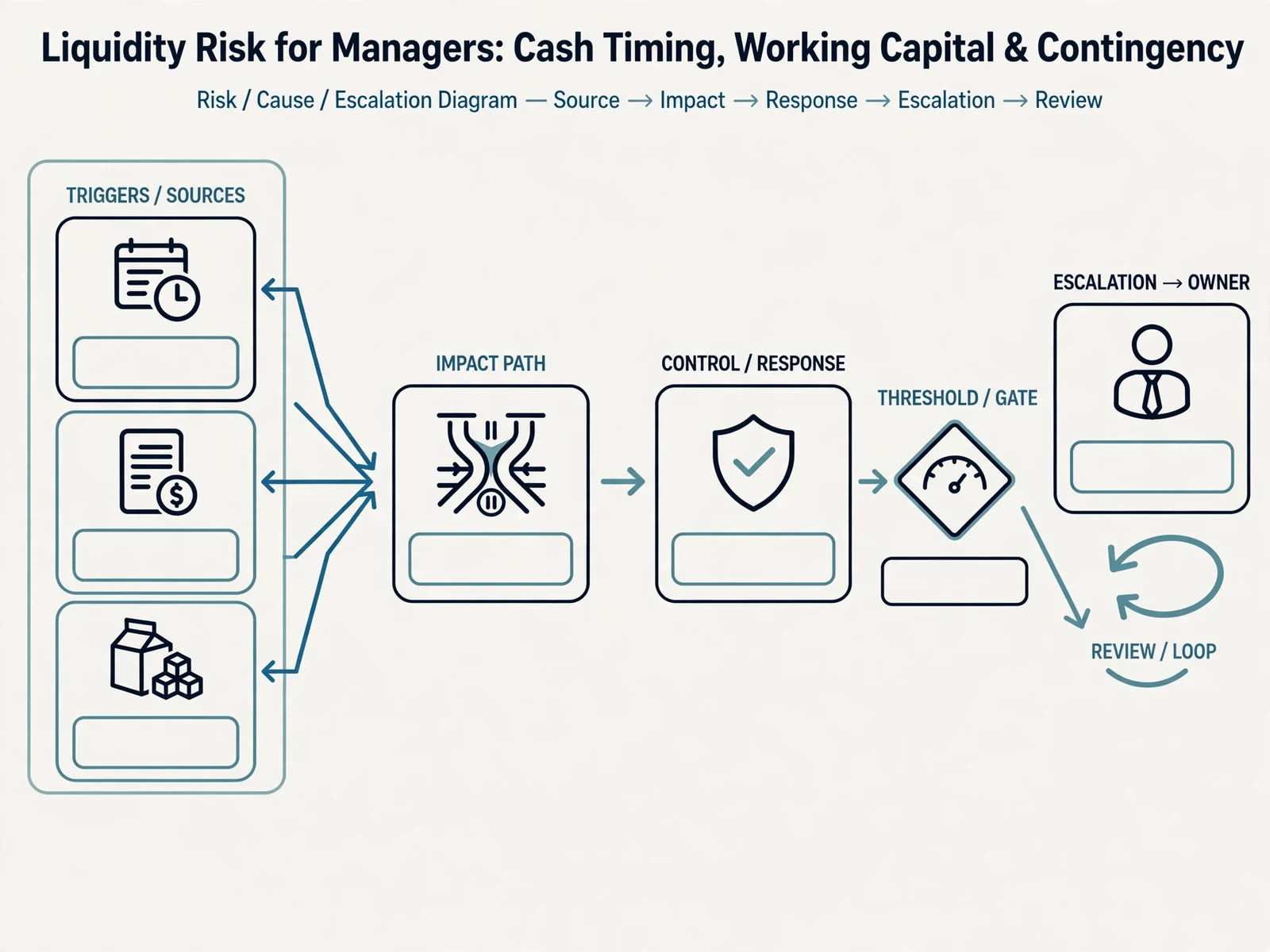
Liquidity And Cash Timing
Create a cash timeline showing actual available balances, expected collections, payroll, taxes, inventory purchases and debt obligations. Separate committed from uncertain receipts and reconcile the starting position to bank and treasury records.
Credit And Counterparty Exposure
Identify material customer concentration, late-paying accounts and credit facilities that may not remain available under stress. Use verified terms and collectability assumptions rather than treating invoiced revenue as cash.
Market Sensitivity
Where relevant, consider interest-rate, currency and input-cost movements that affect payments or access to funding. Distinguish known contractual exposure from scenarios, and avoid unsupported market forecasts.
Concentration
Check dependence on a few customers, funding banks, suppliers or inventory lines. Ask whether one delayed receipt or seasonal stock commitment could create a disproportionate funding gap.
Scenario Analysis
Test time-bound conditions such as slower collections, supplier prepayment or an unexpected capital purchase. Show resulting timing, earliest potential shortfall and options; label hypothetical cases and keep the model assumptions reviewable.
Controls And Escalation
Set forecast ownership, update frequency, funding contingency, spending authority and escalation when actual cash or expected headroom approaches a decision threshold. Treasury and operations should agree what action is feasible.
Practical Liquidity Risk Management Working Template
- Opening liquidity: What usable cash and committed funding exist now?
- Cash calendar: When will verified obligations and likely receipts occur?
- Uncertainty: Which collection or funding assumptions may fail?
- Stress: Which credible adverse condition exposes an early shortfall?
- Action: What can management defer, collect, finance or renegotiate?
- Trigger: Who acts when headroom deteriorates and when?
- Next review: Who owns the resulting decision and what evidence is needed next?
Worked Example
A seasonal wholesaler expects strong sales but has to purchase stock weeks before customer invoices settle. Finance builds a weekly cash view, separates confirmed receipts from optimistic collection assumptions and tests a delayed major payment. Management agrees an inventory and facility contingency before the lowest cash point.
Common Mistakes to Avoid
- Confusing profit with immediately available cash.
- Treating all invoiced receivables as certain on-time collections.
- Excluding taxes, supplier deposits or seasonal obligations from forecasts.
- Publishing a precise stress result without visible assumptions.
- Waiting until a payment is missed before activating a contingency.
Questions Managers Should Ask
- When is the tightest expected cash point and why?
- Which major receipts are genuinely uncertain?
- How would a realistic customer or funding delay alter headroom?
- What response could be implemented before the shortfall?
- Who owns daily cash evidence and threshold escalation?
Management Review Checklist
Review cash forecasts against actual statements, near-term commitments, sources of uncertainty, stress assumptions and actionable funding alternatives. Document material differences and owners.
What to Review After Three Cycles
Compare forecast timing with observed receipts and payments across periods. Improve assumptions where collections, inventory or funding repeatedly differ and update escalation conditions.
A 30-Day Application Plan
- Week 1: Reconcile current cash and obligations.
- Week 2: Build realistic short-term inflow and outflow scenarios.
- Week 3: Test concentrated and timing stresses.
- Week 4: Agree contingency actions, limits and decision owners.
Capability Maturity
Basic: near-term cash obligations are visible. Developing: scenario headroom guides funding decisions. Mature: liquidity governance anticipates stress and coordinates commercial responses.
For HR, L&D and Corporate Sponsors
Finance managers can work through a fictional seasonal cash-flow case and identify actions before a projected shortfall, with all values clearly hypothetical.
Decision Quality Test
Can managers identify the earliest plausible cash gap and authorize an effective response in time?
Make the Method Part of Normal Work
Update liquidity forecasts as part of routine treasury and finance reviews and coordinate material cash changes with operations and procurement.
Related Courses in This Capability Cluster
Detailed workplace application
A seasonal distributor appears profitable but runs short of cash before customer payments arrive. Finance maps expected receipts, inventory commitments, supplier terms and financing availability across several time windows. Managers model delayed collections and a large unexpected purchase without assuming every forecast will be accurate. They identify actions such as rephasing purchases, negotiating terms or using pre-agreed contingency facilities. Clear thresholds trigger escalation before the shortage becomes unavoidable. The plan distinguishes liquidity timing from accounting profit.
Build cash-risk capability around real management decisions
A useful finance cohort can practise a cash-forecast review, identify exposures that need management action and separate a temporary timing mismatch from a persistent working-capital problem. The rolling forecast versus annual budget guide helps connect those choices. For private finance teams, see the Middle East finance training pathway; the delivery brief should specify the participant roles, forecast horizon and decision limits, not presume access to actual financial records.
For an organizational cohort, request a private instructor-led training proposal with the participant roles, approximate group size and capability objective. Dates, trainers and programme terms are confirmed during scoping.
Where to Go Next
The Financial Risk Management for Managers course develops this capability through live instructor-led practice and workplace application. For broader pathways, see Training Bundles and Corporate Academies.
Manage cash timing through evidence, scenario choices and early action, not profit figures alone.
Develop this capability in your organization