A budget answers a commitment question. A forecast answers an expectation question.
Managers get into trouble when they treat the two as though they are the same.
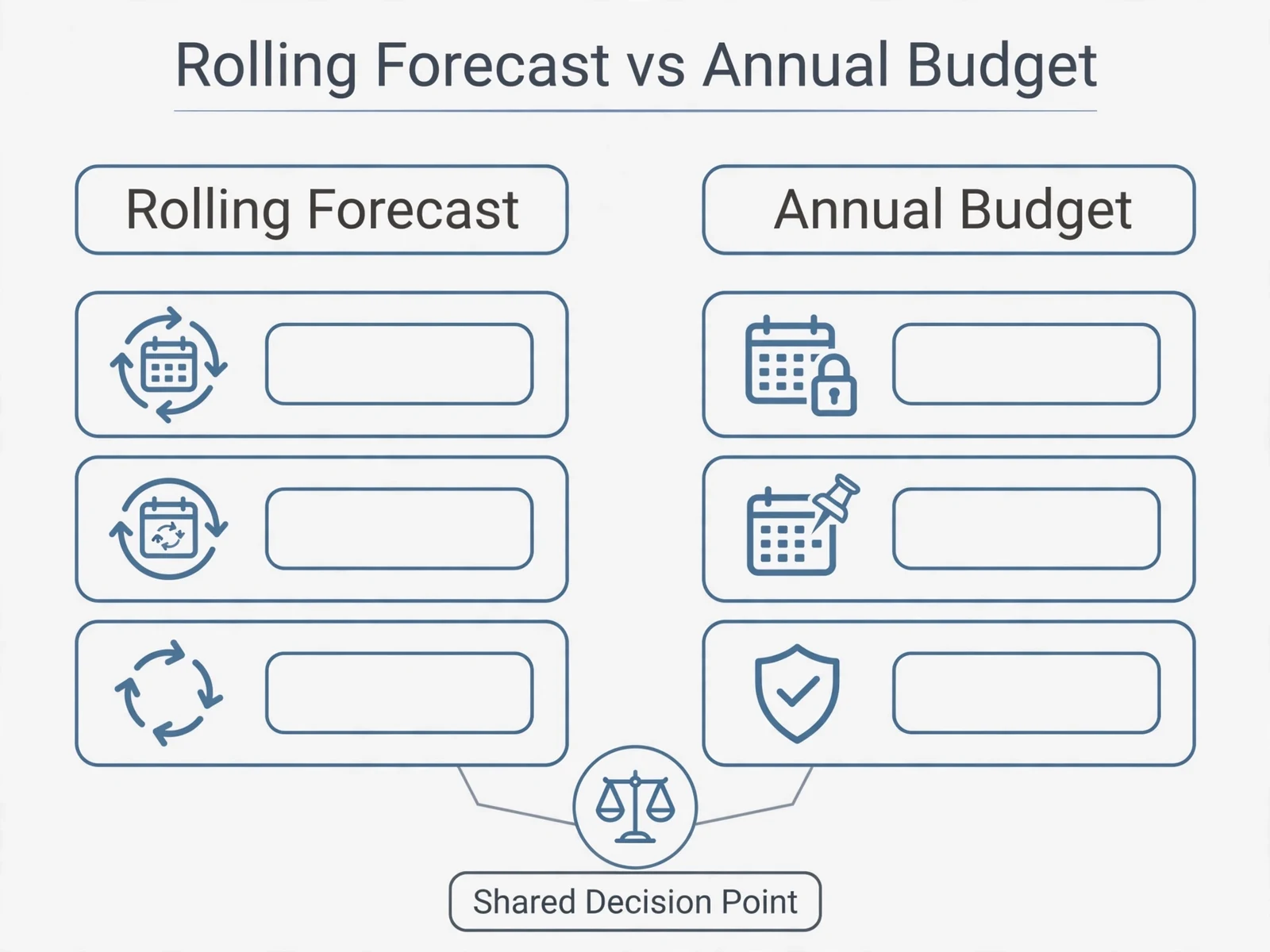
An annual budget typically sets a financial plan for a defined period. A rolling forecast updates the expected future as new information becomes available. One provides a baseline. The other keeps planning connected to reality.
What an Annual Budget Is For
An annual budget helps an organization:
- allocate resources;
- set financial targets;
- coordinate departments;
- approve spending;
- establish accountability;
- create a reference point for performance.
It is useful because the organization needs a plan before the year begins.
Where Annual Budgets Become Weak
The weakness is not that budgets exist. The weakness appears when managers continue using an old assumption after reality has changed.
Examples include:
- demand changes;
- supplier prices move;
- a major project is delayed;
- headcount takes longer to recruit;
- a customer contract is lost or won;
- exchange rates shift;
- regulation changes;
- a new product launches later than planned.
The original budget remains useful as a commitment baseline, but it may no longer be a realistic prediction.
What a Rolling Forecast Does
A rolling forecast updates the outlook using the latest available information and extends the forecast horizon as time moves forward.
For example, instead of forecasting only to the end of the current year, an organization might always maintain the next twelve months of expected performance.
Budget and Forecast Should Answer Different Questions
Budget question
“What did we agree to plan for and resource?”
Forecast question
“Given what we know now, what is likely to happen?”
That distinction allows managers to be honest.
If sales are likely to miss budget, the forecast should show the likely miss. Hiding it does not protect performance. It reduces the organization’s ability to respond.
Do Not Turn Forecasting Into Re-Budgeting
A forecast is not useful if managers simply change the forecast until it resembles the original target.
The forecast should be evidence-based.
Management can then decide what actions are required to close the gap.
Forecast the Drivers, Not Only the Financial Lines
Good forecasting begins with business drivers.
Examples include:
- sales pipeline;
- conversion rate;
- customer volume;
- price;
- utilization;
- headcount;
- salary rate;
- supplier cost;
- project milestones;
- production output.
Managers understand these drivers better than they understand abstract financial lines. That is why forecasting is not only a finance-team responsibility.
Use Scenarios When Uncertainty Is High
One forecast can create false precision.
For material uncertainty, use scenarios.
- Base case: most likely outcome.
- Downside case: what happens if major assumptions deteriorate?
- Upside case: what happens if key opportunities convert?
The purpose is not to produce three spreadsheets. It is to understand what decisions change under different conditions.
Questions Managers Should Ask in a Forecast Review
- What has changed since the last forecast?
- Which assumption moved?
- What is the financial effect?
- What is temporary and what is structural?
- What action can management take?
- What should trigger another forecast update?
Example: Hiring Delay
Suppose the annual budget assumed ten new hires would start in January.
By March, only four are in place.
The budget still records the original plan. The forecast should now reflect the actual hiring pace.
That affects:
- salary expense;
- recruitment cost;
- capacity;
- delivery timelines;
- possibly revenue.
A lower salary forecast is not automatically good news if the organization also loses the capacity required to deliver growth.
Example: Customer Demand
Suppose volume is running above plan.
A weak forecast simply increases revenue.
A stronger forecast also considers:
- additional delivery cost;
- inventory;
- overtime;
- customer service capacity;
- working capital;
- supplier constraints.
What Managers Own
Finance may own the process, but operating managers own many of the assumptions.
Managers should be able to explain:
- what changed;
- why it changed;
- how confident they are;
- what action is being taken;
- what the next risk is.
Choose a Forecast Horizon That Matches the Business
A twelve-month rolling forecast is common, but the right horizon depends on how far ahead management needs to make meaningful decisions.
A project business with long delivery cycles may need a longer view. A fast-moving consumer business may benefit from shorter operational reforecasting alongside a longer financial outlook.
The principle is to forecast far enough ahead that management still has time to act.
Separate Forecast Accuracy From Forecast Honesty
No forecast will be perfectly accurate. The objective is not to punish every miss.
If managers believe they will be blamed for changing a forecast, they may delay bad news or keep unrealistic numbers simply because those numbers were previously agreed.
A healthy forecasting process rewards early visibility. A forecast that changes for a clear business reason is more useful than a stable forecast everyone privately knows is wrong.
Track Assumptions Explicitly
For material forecast lines, record the assumptions.
Examples:
- expected sales volume;
- price;
- headcount start dates;
- supplier rates;
- project completion dates;
- customer retention;
- currency assumptions.
When the forecast moves, management can then identify which assumption changed instead of debating the spreadsheet output alone.
Use Forecast Reviews to Make Decisions
A forecast meeting should end with management action where action is needed.
That may include reducing discretionary spend, accelerating recruitment, changing capacity, revising a sales plan, renegotiating supplier terms, or protecting cash.
If every forecast meeting ends with “we will monitor it,” the process is probably reporting rather than managing.
Where to Go Next
The Budgeting, Forecasting and Cost Control course develops budgeting, forecasting, variance analysis, cost control, and manager decision-making in depth. Managers who need a broader grounding in financial statements and commercial thinking can start with Financial Management for Non-Finance Managers.
The budget tells you where you intended to go. The forecast tells you where current evidence says you are heading. Good managers need both.
Develop this capability in your organization