
Operational excellence is not a one-time improvement project. It is a management system that makes work visible, identifies problems early and creates a repeatable way to improve performance.
Define the Customer and Business Outcome
Start with what the process is supposed to achieve. A team can become very efficient at work that does not create enough value. Clarify the customer, expected output, quality, timing, cost and risk requirements before redesigning the process.
Map the Current Process
Map the work as it actually happens, not as policy says it should happen. Include steps, handoffs, queues, approvals, rework and waiting. A useful map reveals where information or work stops moving and who must make decisions.
Measure Flow, Not Just Activity
Teams often measure how busy people are instead of how well work moves. Depending on the process, useful measures may include cycle time, lead time, first-pass quality, rework, work in progress, backlog, on-time completion and failure demand.
Identify Constraints
A constraint is the point that limits overall throughput or service. Improving non-constraints can create local efficiency without improving the system. Look for recurring queues, overloaded specialists, limited equipment, approval bottlenecks or information dependencies.
Use Root Cause Before Countermeasure
Do not jump from symptom to solution. A late order might be caused by poor scheduling, inaccurate data, supplier failure, unclear priority or approval delay. The countermeasure should address the cause the team can influence.
Standardize the Best Known Method
Standard work does not mean removing judgement. It means documenting the current best method for repeatable work so variation is visible. When a better method is found, update the standard. Standards should support learning rather than freeze the process permanently.
Build Daily Management
Operational excellence becomes sustainable when teams have a routine for reviewing performance, abnormalities, risks and actions. A short daily or regular review should focus on exceptions and decisions, not lengthy status reporting.
Make Problems Visible
Teams cannot improve what they hide. Use visual management, clear escalation triggers and a culture where raising a problem is treated as useful information. The goal is to surface abnormal conditions early enough to respond.
Connect Improvement to Ownership
Every improvement action needs an owner, expected change, evidence and review date. Avoid long lists of ideas with no prioritization. Focus on the few changes that address material constraints or recurring failure.
Separate Local Optimization From System Improvement
Reducing cost in one department can increase delay or rework elsewhere. Evaluate the end-to-end consequence. Operational excellence requires cross-functional thinking where one team’s efficiency is not allowed to damage customer outcome or total cost.
Use a Structured Improvement Cycle
A practical cycle is: define the problem, understand current state, analyze causes, choose a countermeasure, test, measure, standardize and review. The exact methodology matters less than maintaining disciplined learning.
Review the Management System
If the same problems recur, inspect the management routines around the process. Are measures meaningful? Are escalation rules clear? Are decisions slow? Are standards outdated? Process improvement often fails because the operating system around the process remains unchanged.
Practical Working Template
- Customer outcome
- Current process
- Main delay or failure
- Constraint
- Key measure
- Root cause hypothesis
- Countermeasure
- Owner
- Expected evidence
- Review date
- Standard to update
- Escalation trigger
Worked Example
A service team has a growing backlog, so leaders ask employees to work faster. Mapping shows that cases wait two days for one specialist approval. Increasing frontline activity makes the queue larger. The real improvement is to change the approval rule, build more capability or redesign the handoff. Operational excellence focuses on the system constraint rather than pressuring the busiest visible part of the process.
Common Mistakes to Avoid
- Launching improvement events without a clear problem
- Measuring utilization instead of flow
- Standardizing a broken process
- Keeping too many improvement actions open
- Hiding abnormalities to protect performance metrics
- Improving one function while worsening the end-to-end process
Questions Managers Should Ask
- What outcome is the process meant to create?
- Where does work wait?
- What limits end-to-end flow?
- Which problem repeats despite previous fixes?
- What management routine should change after the process improves?
How to Apply This Over 30 Days
- Week 1: map the current process, exposure or decision and identify the biggest uncertainty.
- Week 2: apply the framework to one live case and capture the evidence.
- Week 3: review the result with the people who own related decisions or dependencies.
- Week 4: decide what should become a repeatable management standard, trigger or review routine.
Create a Problem-Solving Funnel
Not every issue deserves a full improvement project. Use daily management to solve small abnormalities quickly, assign recurring problems to structured root-cause work, and reserve larger cross-functional issues for formal improvement initiatives. This prevents the organization from over-engineering simple problems while still giving chronic issues enough attention.
Connect Daily Management to Strategy
Operational excellence is stronger when daily measures relate to the outcomes the organization cares about. A team may track quality, delivery, backlog, safety or customer issues because those measures show whether the strategic promise is being delivered. Avoid walls of metrics that do not change decisions.
Design Escalation Around Response Time
A useful escalation rule defines not only what must be raised but how quickly. A safety issue may require immediate escalation, while a moderate service deviation can wait for the daily review. Clear timing prevents both over-escalation and dangerous delay.
Build Leader Standard Work
Managers also need standard routines. That may include visiting the process, reviewing abnormalities, coaching problem solving, checking countermeasure follow-through and removing cross-functional blockers. Operational excellence weakens when leaders delegate the system entirely to an improvement team.
Worked Example: A Queue Hidden by Local Efficiency
A team reports high individual utilization, yet customers wait too long. Process mapping shows that work moves through three specialist approvals, each with its own queue. Local managers celebrate keeping specialists busy, but end-to-end lead time keeps rising. The improvement is not to make each person busier. It is to reduce handoffs, clarify approval criteria and manage the flow across the whole system.
Use Improvement Boards for Decisions, Not Decoration
A visual improvement board should show the problem, owner, current evidence, countermeasure, next test and review date. Remove completed or irrelevant actions. If the board contains dozens of stale items, the team loses the ability to see what matters. Keep the board small enough that managers can use it in a real review.
Final Management Checklist
- Is the business purpose clear?
- Are the assumptions and evidence visible?
- Does the process distinguish routine issues from material exceptions?
- Is there one accountable owner for the next action?
- Is there a trigger for escalation or review?
- Will the team know what changed at the next cycle?
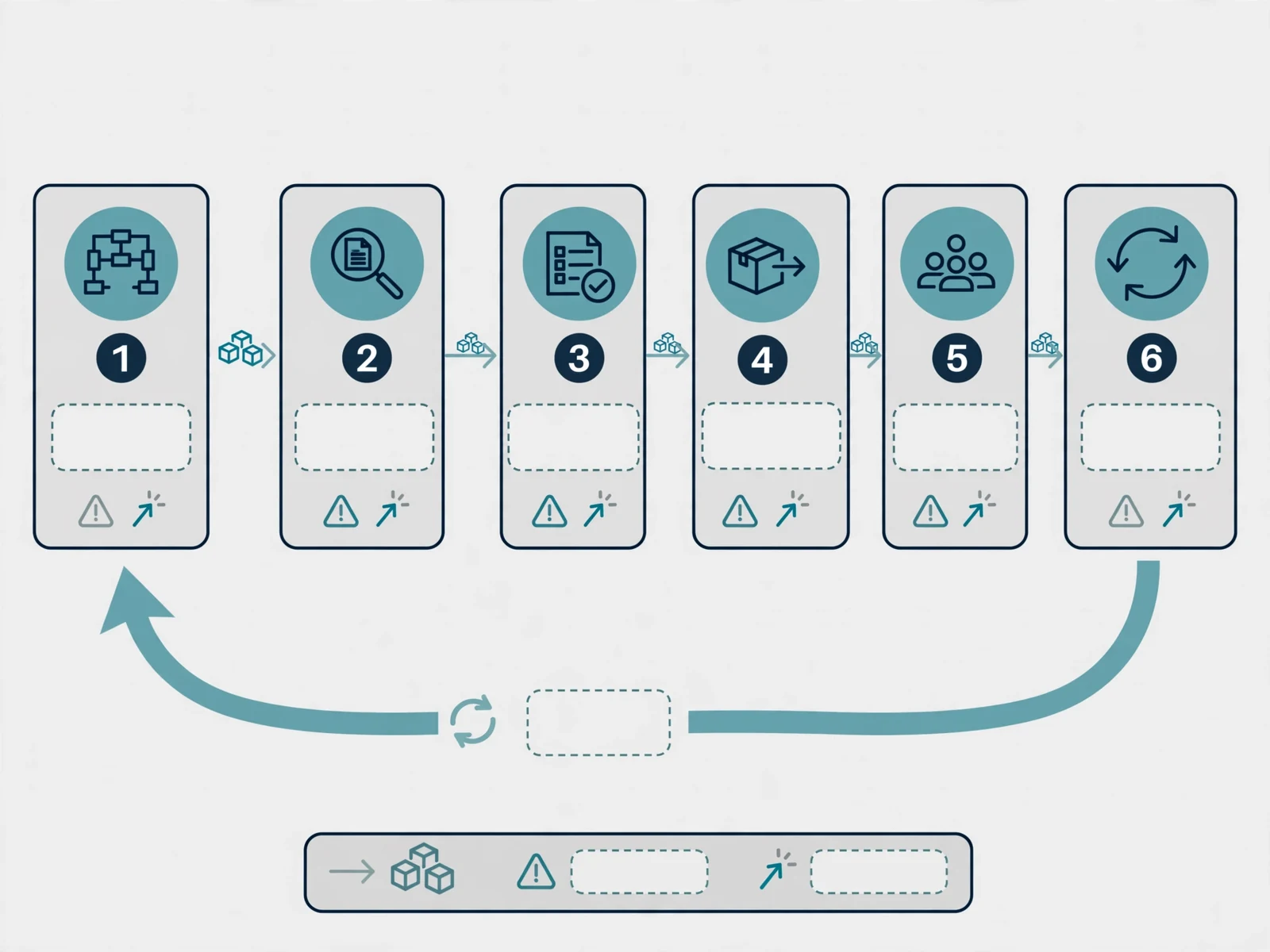
Observe customer flow and real exceptions
Locate waiting, rework and causes
Test a countermeasure under normal work
Use daily management and owner review
Observe the value stream instead of accepting the process chart
A neat process map often describes what should happen, not what people do when a customer submits incomplete information or a shared system is unavailable. Follow actual cases from customer request to completion. Separate active processing time from waiting, rework, handoffs and approval delays. Ask front-line staff why they use workarounds; those workarounds may reveal how formal controls conflict with real operations.
Choose a process outcome important to customers: a correct order, a resolved enquiry, a timely payment or a safe maintenance release. Establish a credible baseline that includes exceptions. Do not judge improvement from a single average if difficult cases were diverted out of scope. Operational excellence improves end-to-end reliability, not merely the efficiency of the department with the loudest dashboard.
Worked example: a faster team that creates more customer work
A support center is rewarded for shorter average handling time. Staff close tickets quickly, but clients call again because unresolved issues are transferred with incomplete notes. Locally, the team looks efficient; system-wide, the customer journey has slowed. The improvement lead examines a sample of repeated cases and finds ambiguous handoff ownership and missing information at the point of transfer.
Instead of telling agents to work faster, the team tests a concise exception record with a named owner, next action and customer update. They pilot it on one category of requests. The review compares first-contact resolution, repeat calls, unresolved cases and work transferred to downstream teams. If the intervention helps one group but creates new work elsewhere, it is revised before wider use.
Build a problem-solving funnel that staff can use
Not every issue needs an executive project. Define a practical route: immediate containment for customer or safety impact, team-level correction for simple recurrent problems, specialist investigation for uncertain causes and senior escalation when resources or decision rights cross departmental boundaries. Log the issue and responsible owner rather than leaving an anonymous red marker on the board.
At the daily review, focus on blockers requiring action now. Weekly review should revisit recurring causes and cross-functional changes. Monthly review can assess whether the process change achieved its intended outcome and whether the standard remains useful. This reduces the tendency to solve the same problem repeatedly without learning.
| Situation | Evidence or constraint | Management response |
|---|---|---|
| Repeated rework | Where does the same error enter? | Evidence-based cause investigation |
| Waiting for approval | Which decision right is missing? | Define boundary and escalation |
| Poor customer outcome | Is a local KPI hiding downstream work? | Review end-to-end cases |
| Short-lived improvement | Was the new method adopted in normal work? | Update standard, training and checks |
Make standard work a hypothesis that can improve
Document the best currently known safe method, including the intended result, normal sequence, decision points, exceptions and evidence of completion. Let employees test whether it works under realistic conditions. A rigid document that cannot accommodate legitimate exceptions encourages hidden workarounds. When a tested improvement works, update the standard, training examples and ownership before declaring the project complete.
Measure leading process signals together with customer outcomes. For instance, complete handoff records matter only if they reduce unresolved work or speed correct resolution. Avoid treating training attendance or the number of improvement events as proof of operational excellence. The system should make problems visible early and enable people with authority to resolve them.
Where to Go Next
The Operational Excellence and Process Improvement develops this capability through live instructor-led practice and work application. Related programs include Supply Chain Management and Resilience and Strategic Planning and Execution.
Use the framework on a live decision, learn from the result, and then build the repeatable standard.
Build Operational Improvement Capability Across Teams
Bring the processes, performance measures and management roles that require improvement. Training can be scoped around process mapping, root-cause investigation and the management routines needed to sustain results.
Further reading: daily management systems and root-cause analysis.
Develop this capability in your organization