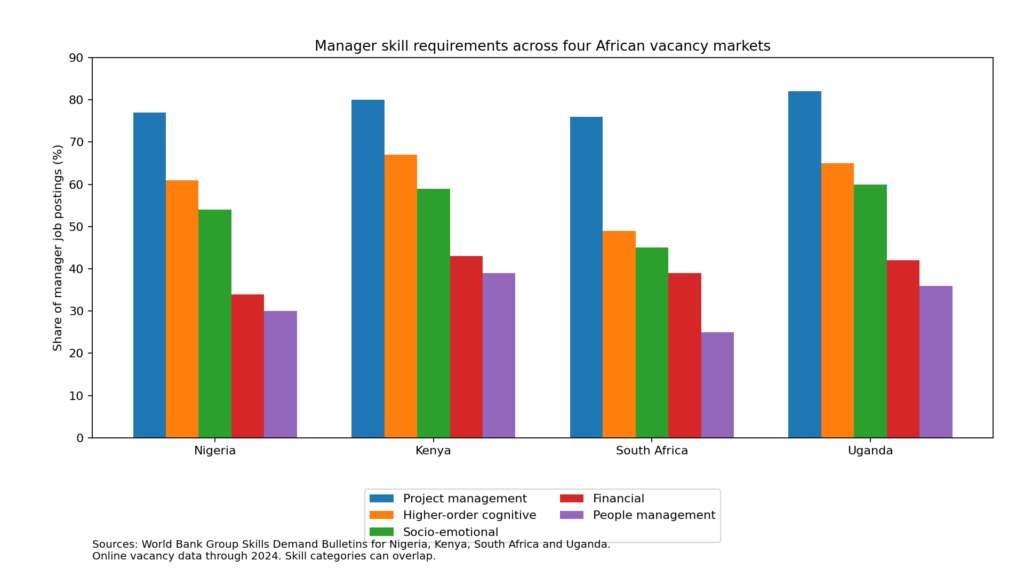
Leadership development in African organizations should not be designed as a stand-alone collection of motivational or interpersonal topics. World Bank vacancy data for manager roles in Nigeria, Kenya, South Africa and Uganda show a much broader capability profile: project and process management, higher-order thinking, digital capability, socio-emotional skills, customer orientation, finance and people management all appear in substantial shares of manager postings.
Across the four country bulletins, an unweighted average of the manager-vacancy category shares is approximately 78.8% for specialized project-management skills, 60.5% for higher-order cognitive skills, 54.5% for socio-emotional skills, 53.0% for specialized digital skills, 43.8% for cognitive skills, 42.0% for customer-service skills, 39.5% for financial skills and 32.5% for people-management skills.
Those averages are calculated from four separate World Bank country bulletins and are not population-weighted. They are useful as a directional comparison, not a continent-wide estimate of every African manager role.
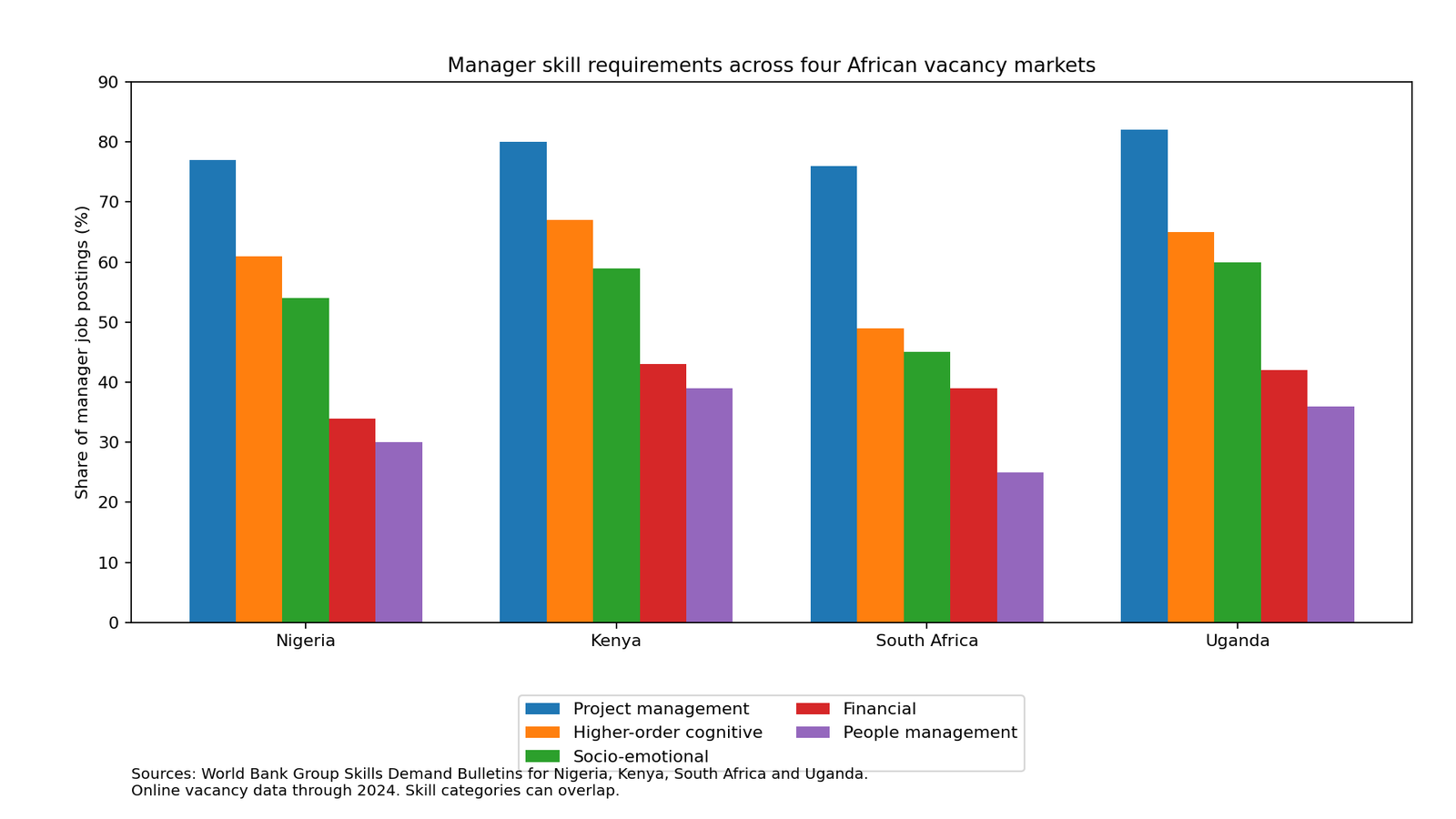
Data table: Manager-posting skill categories: four-country unweighted averages
| Skill category | Unweighted average |
|---|---|
| Project-management-related | 78.8% |
| Higher-order cognitive | 60.5% |
| Socio-emotional | 54.5% |
| Specialized digital | 53.0% |
| Cognitive | 43.8% |
| Customer-service | 42.0% |
| Financial | 39.5% |
| People-management | 32.5% |
Source: World Bank Skills Demand Bulletins for Nigeria, Kenya, South Africa and Uganda, linked in the original article. This table restates the evidence discussed in the sections below; refer to the original publications for the full method.
1. Project-management-related skills appear in 77% of Nigerian manager postings
The World Bank Nigeria Skills Demand Bulletin reports specialized project-management requirements in 77% of manager postings. The category includes management, planning, operations, project management, organizational skills and related execution capabilities.
2. The equivalent share is 80% in Kenya
Kenya’s bulletin reports specialized project-management skills in 80% of manager postings, the largest category in the manager profile.
3. South Africa reports 76% for manager postings
The South Africa bulletin reports project-management-related skills in 76% of manager postings.
4. Uganda reports 82% for manager postings
Uganda’s bulletin reports specialized project-management skills in 82% of manager postings, again the largest skill category shown for managers.
5. The unweighted four-country average is 78.8%
A simple average of the four manager-posting percentages is 78.8%. The calculation is not weighted by the number of postings in each country, so it should not be presented as a regional labour-market prevalence rate. Its value is comparative: execution and project/process capability consistently sits near the top of the manager skill profile in all four markets.
6. Higher-order cognitive skills appear in 61% of Nigerian manager postings
Nigeria’s bulletin places higher-order cognitive skills at 61% for managers. This category includes communication, problem solving, decision making, analytical skills, critical thinking, prioritization and strategic thinking.
7. Kenya reports 67% for higher-order cognitive skills
Kenya’s manager-vacancy profile reports a 67% share for higher-order cognitive skills.
8. South Africa reports 49%
The South African manager profile is lower on this category at 49%, while still showing a large requirement alongside project, digital, customer and financial capability.
9. Uganda reports 65%
Uganda’s manager postings show higher-order cognitive skills in 65% of the analysed vacancies.
10. The four-country unweighted average is 60.5%
Taken together, the country data support a leadership-development model that makes decision quality, analysis, communication and problem solving central to management work.
11. Socio-emotional skills are required in 54% of Nigerian manager postings
The Nigeria manager profile reports socio-emotional skills at 54%. The category includes leadership, detail orientation, time management, negotiation, teamwork, accountability and other professional behaviours.
12. Kenya reports 59%, South Africa 45% and Uganda 60%
The three other country bulletins put the manager-posting share at 59% in Kenya, 45% in South Africa and 60% in Uganda.
13. The four-country unweighted socio-emotional average is 54.5%
This is high enough to matter, but the training implication should not be “buy a soft-skills course.” Socio-emotional capability is more useful when embedded into real managerial decisions such as delegation, negotiation, stakeholder conflict, team accountability and change.
14. Digital skills appear in roughly half of manager postings
Specialized digital skills appear in 52% of Nigerian manager postings, 55% in Kenya, 47% in South Africa and 58% in Uganda. The unweighted average is 53%.
That evidence supports digital fluency for managers, but not a digital-only leadership strategy. Managers still need financial, customer, people, project and cognitive capability alongside tools and data.
15. Financial skills appear in 34–43% of manager postings
The manager profiles report financial skill shares of 34% in Nigeria, 43% in Kenya, 39% in South Africa and 42% in Uganda. The unweighted average is 39.5%.
For leadership development, that supports practical financial judgement: interpreting budgets, understanding commercial trade-offs, challenging investment assumptions and connecting financial information to operational choices.
16. Customer-service skills appear in 33–48% of manager postings
Nigeria reports 48%, Kenya 45%, South Africa 42% and Uganda 33% for the specialized customer-service category in manager postings. The four-country unweighted average is 42%.
Many managers therefore operate with customer, sales, commercial or service responsibilities even when their title is not “customer experience manager.”
17. People-management skills appear in 25–39% of manager postings
The people-management category appears in 30% of Nigerian manager postings, 39% in Kenya, 25% in South Africa and 36% in Uganda. The unweighted average is 32.5%.
The category includes capabilities such as coaching, mentorship, HR management, relationship management, supervision, employee relations and team leadership.
18. Uganda’s top individual skill requirements include management, communication, planning and leadership
Uganda’s World Bank bulletin ranks management first, communication second, planning third, operations fifth and leadership seventh among the top 50 skill requirements by frequency. Finance and project management also appear in the top group.
The mix illustrates the broader point: managerial work combines execution, communication, financial and people responsibilities.
19. Leadership is not the same as people management
A manager can require leadership and socio-emotional capability while also needing project, financial or customer skills. Conversely, a specialist moving into management may need to learn delegation, performance conversations and coaching even if they already have strong technical credibility.
That is why leadership curricula should be segmented by role and responsibility.
20. New managers need a different pathway from senior leaders
First-time managers typically need to learn how to set expectations, delegate, give feedback, manage performance, handle difficult conversations and coordinate team work. Senior leaders are more likely to need strategic judgement, cross-functional execution, governance, risk, financial challenge and stakeholder influence.
Using the same leadership programme for both groups wastes training time and can leave the most important role transitions unaddressed.
21. Functional leaders need leadership integrated with their discipline
A procurement director needs people and leadership capability, but also commercial judgement, supplier strategy and negotiation. A finance leader needs influence and communication plus financial decision-making. A PMO leader needs governance and stakeholder capability plus programme and portfolio management.
Leadership development is stronger when it reflects these functional realities.
22. Higher-paying jobs tend to require broader skill bundles
The ILO’s 2026 lifelong-learning analysis finds that higher-paying vacancies tend to require a greater number of cognitive, digital, financial, social and people-management skills. The report argues that employers increasingly seek combinations of skills rather than narrow technical expertise alone.
This supports development pathways that combine management judgement with technical or functional capability rather than treating them as separate learning worlds.
23. South African vacancy data show leadership as a major people-management keyword
In the ILO’s South Africa skill-keyword analysis, leadership represented 20.8% of keyword matches within the people-management skill subcategory, with coach at 11.5% and people management at 5.6%. Those percentages are shares of keyword matches within the subcategory, not shares of all vacancies.
24. Managerial roles have more complex skill bundles
The ILO notes that higher-level occupations generally require more diverse and complex skill combinations. Managerial occupations connect core cognitive, financial, writing and socio-emotional capabilities more strongly than lower-level roles.
25. Management development should begin with the work, not the competency label
“Strategic thinking,” “leadership” or “communication” can mean very different things in different roles. A useful needs analysis asks what the manager actually has to do:
- make resource trade-offs;
- set priorities across teams;
- coach underperformance;
- present recommendations to executives;
- manage project or operational risk;
- negotiate with suppliers or stakeholders;
- interpret financial and performance information;
- lead change across functions.
26. Leadership training cannot compensate for unclear authority
If managers are held accountable for outcomes but do not have authority, resources or reliable information, training alone will not solve the problem. Organizations should separate capability gaps from structural problems before commissioning development.
27. Manager follow-up matters
Leadership programmes are more likely to transfer when participants return to a manager or sponsor who expects a specific behaviour or work product. Examples include a stronger delegation plan, a clearer decision memo, improved stakeholder mapping, a more disciplined team review or a better performance conversation.
28. Women-in-leadership pathways should also be role-specific
Women’s leadership development should not assume all participants need the same confidence or communication intervention. Participants may be moving into project leadership, finance, HR, procurement, technology, sales or general management, and the curriculum should reflect those responsibilities.
29. Cross-border managers need additional stakeholder and cultural judgement
Regional and multi-country organizations add complexity through different regulatory environments, market conditions, stakeholder expectations and organizational cultures. Cross-border leaders need to coordinate those differences without reducing them to stereotypes.
Cross-Border Leadership and Stakeholder Management is designed around that challenge.
30. What organizations should measure before buying leadership training
- Which manager population is being developed?
- What decisions or conversations are currently weak?
- What changes when participants move from specialist to manager?
- Which financial, project, customer or governance responsibilities accompany the role?
- What should the participant do differently after training?
- Who will reinforce application?
31. Methodology and limitations
The manager percentages come from separate World Bank Skills Demand Bulletins for Nigeria, Kenya, South Africa and Uganda using Lightcast online vacancy data through June 2024. Online vacancies overrepresent formal, digitally advertised employment and are not a census of all managers in each country.
The four-country averages in this article are simple unweighted calculations from the published country percentages. They are not World Bank regional estimates and should not be cited as population-weighted Africa-wide prevalence.
The ILO evidence uses its own vacancy datasets and taxonomy. Its keyword percentages should not be mixed directly with the World Bank category shares.
Primary sources
- World Bank Group, Nigeria Skills Demand Bulletin
- World Bank Group, Kenya Skills Demand Bulletin
- World Bank Group, South Africa Skills Demand Bulletin
- World Bank Group, Uganda Skills Demand Bulletin
- ILO, Lifelong learning and skills for the future, 2026
Related leadership and management pathways
- Effective Leadership Skills for New Managers
- Advanced Leadership and Executive Presence
- Strategic Thinking and Decision Making
- Coaching Skills for Managers and Leaders
- Cross-Border Leadership and Stakeholder Management
- Finance for Senior Executives
- Program Management and PMO Leadership
- Private in-house leadership development
Related organizational training: For employers organizing leadership development by participant role and country, explore Leadership and management training in Nigeria; Leadership and management training in Kenya; Leadership and management training in South Africa. These programme links are options for scoping, not evidence that a particular course will change the cited labour-market statistics.
Related evidence and practical guidance
Job-posting and leadership surveys describe different groups; none by itself establishes that a specific employer’s managers need training. Start with observed leadership decisions and manager behaviours. For context, read Africa workforce and management-skills statistics and strategic workforce planning from capability gaps to action.
Training options for organizations: See TheSkillGrid’s professional training pathways across Africa for relevant courses, country guides and private-cohort enquiries. The cited labour-market data provides background context rather than evidence of a specific training outcome.
Develop this capability in your organization