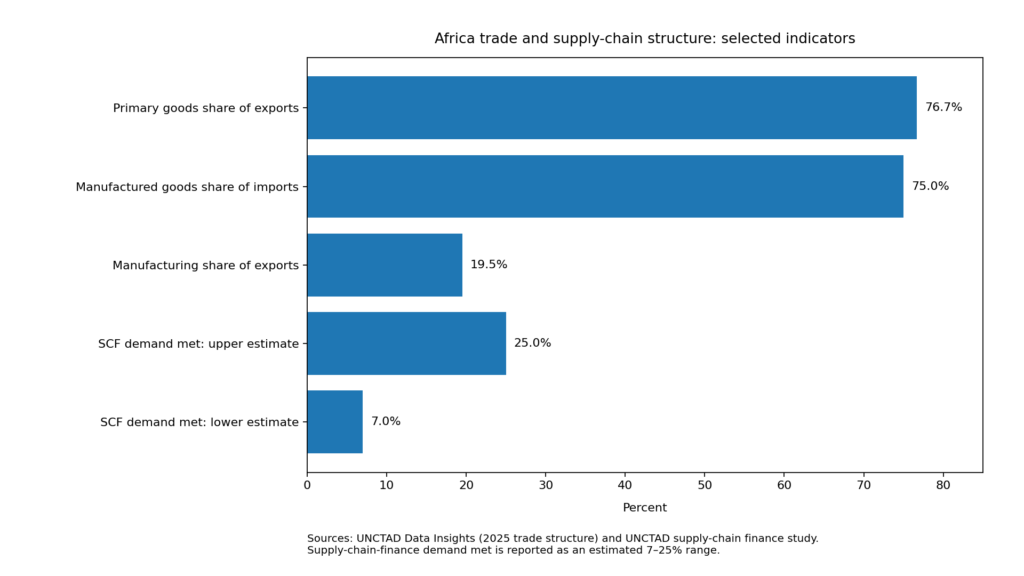
Africa’s procurement and supply-chain challenge is not simply about finding cheaper suppliers. Current trade, logistics and finance data point to a more complex operating environment: high dependence on primary exports, heavy manufactured-goods imports, weak logistics performance in many countries, expensive intra-African trade and a large financing gap for supply chains.
This 2026 reference uses current UN Trade and Development (UNCTAD), African Development Bank and World Bank-linked evidence. It does not claim that every African market has the same supply-chain structure. Country, sector and organization-level differences remain large.
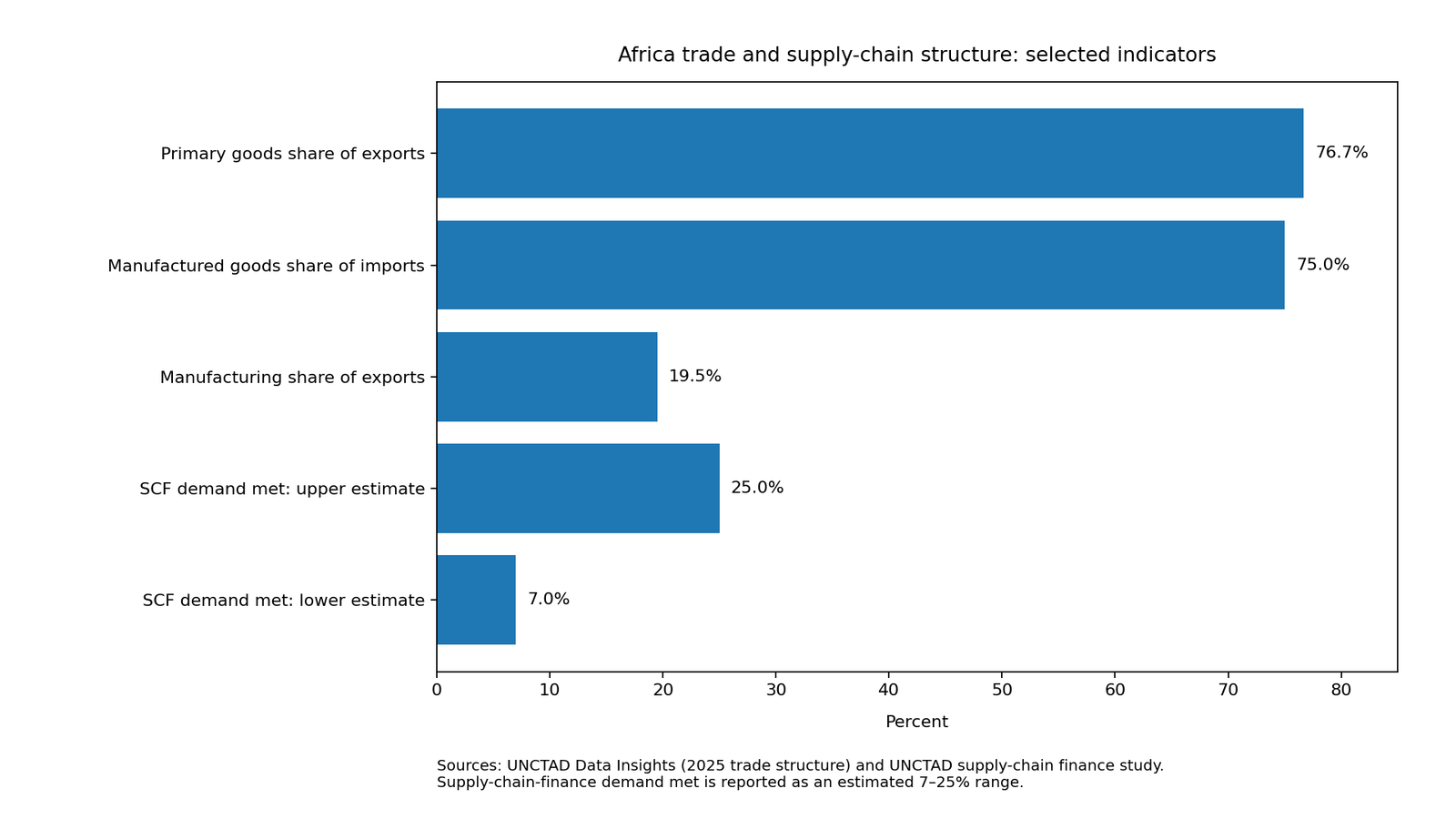
Data table: Africa trade and supply-chain evidence
| Indicator and unit | Reported value |
|---|---|
| Primary goods as a share of merchandise exports (2025) | 76.7% |
| Manufactured goods as a share of merchandise imports (2025) | 75% |
| Manufacturing as a share of merchandise exports (2025) | 19.5% |
| Merchandise trade deficit, as share of exports (2025) | 14.1% |
| Potential African supply-chain-finance market estimate | > US$60 billion |
| Estimated share of supply-chain-finance demand currently met | 7–25% |
Source: UNCTADstat international trade data insights (2025 trade composition, updated 30 October 2026) and UNCTAD supply-chain-finance study (potential market and estimated coverage). This table restates the evidence discussed in the sections below; refer to the original publications for the full method.
1. Primary goods accounted for 76.7% of Africa’s merchandise exports in 2025
UNCTAD’s Data Insights reports that primary goods represented 76.7% of Africa’s merchandise exports by value in 2025. Fuels alone contributed 29.5 percentage points.
That concentration matters for procurement and supply-chain leaders because commodity exposure can increase sensitivity to price, infrastructure, logistics and geopolitical shocks.
2. Manufactured goods made up 75% of Africa’s imports
UNCTAD reports that manufactured products represented 75% of Africa’s imports in 2025, while manufacturing accounted for only 19.5% of Africa’s exports.
For organizations dependent on imported machinery, components, technology or finished goods, supplier concentration, foreign exchange, shipping and lead-time risks can therefore become central procurement issues.
3. Africa’s merchandise trade deficit was equivalent to 14.1% of export value
UNCTAD’s 2025 trade-structure data show that surpluses in fuels, agricultural raw materials and ores were insufficient to offset deficits in manufactured products and food, leaving Africa with a merchandise trade deficit equal to 14.1% of export value.
4. Africa’s supply-chain-finance market exceeds $60 billion
UNCTAD’s 2025 report on supply-chain finance in African markets estimates a potential market exceeding US$60 billion.
5. Only 7–25% of African supply-chain-finance demand is currently met
The same UNCTAD study estimates that only 7% to 25% of demand is being met. The analysis uses World Bank enterprise-survey data across 31 African countries from 2020 to 2024 alongside firm-level South African data.
Working-capital constraints can affect suppliers’ ability to fulfil orders, invest in capacity or survive long payment cycles. Procurement teams therefore need to understand supplier financial resilience as well as price and technical performance.
6. Non-tariff barriers can be more restrictive than customs duties
UNCTAD’s AfCFTA support programme explains that non-tariff barriers can be at least three times more restrictive than ordinary customs duties. These costs may arise from customs delays, regulatory differences, transport bottlenecks and technical requirements; they are not a single import tax or an indicative 2026 shipping rate.
For sourcing decisions, buyers should examine the actual logistics corridor, applicable border requirements, supplier terms and realistic total landed costs instead of applying a continent-wide percentage to a specific purchase.
7. Only Egypt and South Africa exceeded the global average logistics-performance score in the cited African comparison
UNCTAD’s logistics analysis reports that only Egypt and South Africa exceeded the global average in the overall Logistics Performance Index comparison used in the report.
8. Botswana, South Africa and Uganda exceeded the global average on customs processes
For customs clearance and processes, UNCTAD identifies Botswana, South Africa and Uganda as exceeding the global average in the comparison.
9. Only Egypt and South Africa exceeded the global average on transport infrastructure and logistics quality
The report states that only Egypt and South Africa scored above the global average on trade-and-transport infrastructure and the competence and quality of logistics services.
10. Zimbabwe’s cited LPI score was 2.3 versus a global average of 2.9
UNCTAD uses Zimbabwe as an example of a country that is important in regional intermediate-input networks but still faces logistics constraints. Its overall score in the comparison was 2.3 against a global average of 2.9.
11. Only seven African countries were identified as having well-integrated road networks in the cited comparison
UNCTAD identifies Botswana, Cabo Verde, Egypt, Libya, Mauritius, Seychelles and South Africa as having well-integrated road networks in the report’s infrastructure comparison.
12. Transport costs in Africa have been estimated at three times US levels
The UNCTAD report cites WTO analysis indicating that transport costs in Africa are about three times higher than in the United States.
The comparison is an older benchmark referenced by the 2024 report, so it should be treated as structural context rather than a current 2026 price quotation.
13. Reducing transport and logistics costs materially changes the expected gains from AfCFTA
A 2023 CEPII/World Bank-linked trade-and-infrastructure modelling paper estimates an average 3.4% export increase under an AfCFTA-type trade integration scenario and a further 11.5% export increase when complementary transport improvements reduce time on roads, at ports and at border posts. These are modelled scenario effects, not additive forecasts guaranteed for every country or observed 2026 results.
These are modelled estimates from specific policy and infrastructure scenarios, not observed historical outcomes or projections for a particular supplier, country or training programme.
14. South Africa expanded its African service-input network from 17 to 46 countries
UNCTAD reports that South Africa sourced service value-added inputs from 46 African countries in 2022, up from 17 in 2012. The increase illustrates how service and input networks can deepen even while broader continental value-chain integration remains uneven.
15. Only 16 of 54 African countries met the report’s 0.5–6% threshold for intermediate inputs sourced from other African countries
UNCTAD’s value-added network analysis found that only 16 of 54 African countries received between 0.5% and 6% of total intermediate inputs from other African countries at the selected analytical threshold.
This is a network-analysis result, not a direct measure of total intra-African trade.
16. Africa remains weakly integrated in regional trade networks
UNCTAD’s Key Statistics and Trends in International Trade 2025, published in May 2026, observes relatively weak regional trade integration in Africa and Latin America. Extra-regional partners remain a major destination for trade outside the more deeply integrated East Asian networks.
17. South-South trade exceeded $6 trillion before reaching $7.2 trillion in 2025
UNCTAD’s Handbook of Statistics 2025 estimates South-South merchandise trade at roughly US$6.2 trillion in 2024. The WTO’s 2026 trade-resilience report reports US$7.2 trillion for 2025, representing 27.8% of world merchandise exports. These are global developing-economy trade figures, not intra-African trade totals.
The global rise creates opportunities for African suppliers and buyers, but the distribution of those gains remains uneven and is heavily concentrated in developing Asia.
18. Africa attracted about $70 billion in FDI in 2025
According to UNCTAD’s World Investment Report 2026 regional analysis, African FDI inflows reached approximately US$70 billion in 2025. That was below the unusually high US$94 billion recorded in 2024, but still the continent’s third-highest year since 1990 and roughly one-third above the long-run average. FDI flows are not training expenditure or a measure of procurement contract opportunities.
19. Investment is concentrated in supply-chain-intensive sectors
UNCTAD notes that energy, infrastructure and critical minerals are among the areas drawing significant investment. These sectors rely heavily on project procurement, contracts, logistics, supplier development and operational risk management.
20. African LDCs attracted about $33 billion of FDI in 2025
The UNCTAD World Investment Report 2026 reports approximately US$33 billion of 2025 FDI inflows into African least developed countries. Inflows were concentrated in relatively few economies, often linked to natural resources, energy, infrastructure and selected manufacturing projects. This is a subset of African FDI, not an additional amount to add to the continental total.
21. The African Development Bank maintains current contract-award procurement statistics
The African Development Bank’s procurement statistics page currently provides country and year summaries of contracts awarded through Bank-financed projects, including goods, works, consulting services and other expense categories. The October 2026 release includes awarded-contract listings from 2021 through 2026.
This is important for procurement professionals because development-financed purchasing is a distinct commercial environment with formal procurement and project-governance requirements. The presence of Bank data does not mean a supplier or training provider is eligible for any specific procurement.
22. Procurement capability is not the same as purchasing process knowledge
The external evidence points to problems that procurement teams cannot solve through tender administration alone: supplier finance, logistics constraints, market concentration, infrastructure risk, changing trade patterns and project execution.
Strategic procurement therefore needs market analysis, risk, contract strategy, supplier development, negotiation and cross-functional decision-making.
23. Supply-chain resilience starts with dependency visibility
Organizations need to know which suppliers, countries, transport routes, components and service providers can interrupt delivery. The UNCTAD value-chain analysis shows that Africa’s networks can be concentrated around a limited number of critical suppliers and users.
A resilience programme should therefore identify dependencies before selecting mitigation strategies such as dual sourcing, inventory changes, supplier development or alternative logistics.
24. Local supplier development must balance participation and delivery capability
Growing local participation can support industrial development and reduce some external dependencies, but procurement targets should still account for supplier capability, quality, financial resilience, scalability and commercial sustainability.
Local Content Strategy and Supplier Development focuses on making those trade-offs explicit.
25. Procurement and finance need a shared view of supplier risk
The supply-chain-finance gap is a reminder that a technically capable supplier can still fail because of working-capital pressure or payment-cycle mismatch. Procurement, finance and operations should therefore share supplier-risk information rather than evaluate commercial and delivery risk in isolation.
26. Major projects need a different procurement capability from routine spend
Infrastructure, energy and industrial projects can require contracting strategy, FIDIC knowledge, project finance, major-contract negotiation and long-horizon supplier governance. Those needs should not be collapsed into a generic procurement course.
Relevant programmes include Capital Project Procurement and Contracting Strategy, FIDIC Contracts, Claims and Dispute Avoidance and Advanced Commercial Negotiation for Major Contracts.
27. Procurement training should use real decision contexts
An organization deciding how to source routine office services does not face the same market, risk or governance problem as one buying industrial equipment, managing a strategic technology vendor or procuring a capital project.
Private cohorts should therefore use category, market and supplier scenarios that match the participant population.
28. Supply-chain capability also requires operational management
Procurement can select a supplier, but operations must manage forecasts, demand, inventory, service levels and disruption. TheSkillGrid’s Supply Chain Management and Resilience and Integrated Business Planning and S&OP address those downstream decisions.
29. What African organizations should measure before buying procurement training
- Where supplier or sourcing decisions currently fail
- Which categories or markets carry the greatest exposure
- Whether the problem is market intelligence, specifications, evaluation, negotiation, contracting or performance
- How procurement works with finance, projects and operations
- Which supplier risks are financially or operationally material
- What work product should improve after training
30. Methodology and limitations
The trade and product-mix figures use UNCTAD data for 2025. Logistics and value-chain comparisons derive from UNCTAD’s Economic Development in Africa Report 2024 and underlying historical datasets, including 2012–2022 network studies; they are not current freight quotations. The supply-chain-finance estimates come from a 2025 UNCTAD study using enterprise surveys from 31 African countries between 2020 and 2024. The AfCFTA and transport integration results are 2023 CEPII modelled scenarios. The 2025 investment amounts are from UNCTAD’s World Investment Report 2026; national and sectoral implications should not be inferred from continental totals.
Modelled AfCFTA export gains are scenarios, not realized outcomes. The LPI and transport-cost figures are comparative indicators and should not be treated as quotations for a current shipment. Procurement conditions vary materially by country, sector and organization.
Primary sources
- UNCTAD, World Investment Report 2026 (FDI in Africa)
- CEPII Working Paper 2023-14, Trade and Infrastructure Integration in Africa (modelled AfCFTA scenarios)
- UNCTAD, AfCFTA support programme (non-tariff barriers)
- UNCTAD, Handbook of Statistics 2025 (2024 South-South trade)
- UNCTAD Data Insights, merchandise trade structure, updated October 2026
- UNCTAD, Unlocking growth: Determinants of supply chain finance in African markets
- UNCTAD, Economic Development in Africa Report 2024, Chapter III
- UNCTAD, Key statistics and trends in international trade 2025
- African Development Bank procurement statistics
- WTO, Transformative Partnerships for Trade Resilience
Related procurement and supply-chain pathways
- Strategic Procurement Management
- Strategic Sourcing and Supplier Market Analysis
- Procurement Category Management
- Supply Chain Management and Resilience
- Local Content Strategy and Supplier Development
- Capital Project Procurement and Contracting Strategy
- Professional Training in Nigeria
- Professional Training in Kenya
- Private in-house training
Related organizational training: For buyers developing procurement teams across African markets, explore Procurement training in Nigeria; Procurement training in Kenya; Procurement and tender management training in Ghana. These programme links are options for scoping, not evidence that a particular course will change the cited labour-market statistics.
Related evidence and practical guidance
National trade and logistics indicators do not measure a specific procurement team’s competence. Translate evidence into supplier-market, risk and evaluation questions before selecting courses. For context, read public tender evaluation skills checklist for African teams and supplier market power and risk analysis.
Training options for organizations: See TheSkillGrid’s professional training pathways across Africa for relevant courses, country guides and private-cohort enquiries. The cited trade, investment and procurement evidence provides background context rather than evidence that any particular external training course will deliver a commercial or investment outcome.
Develop this capability in your organization