
Organization design fails when leadership redraws reporting lines without fixing who can decide, coordinate and deliver work. Adding or removing managerial layers is not the same as removing an operating bottleneck.
Begin with the work and recurring decisions the organization must support. Assess accountability, interfaces, management capacity, incentives and transition risks before choosing structural changes. Test whether employees can act more clearly after the redesign.
Organizational Diagnosis
Map the business outcomes at risk and observe how work currently crosses functions. Distinguish structural constraints from skill gaps, weak processes or incentives before prescribing a reorganization.
Roles And Accountability
Specify which role owns each material result, which authority accompanies it and who supplies expertise. Avoid multiple nominal owners when one person must decide under pressure.
Layers And Spans
Evaluate whether supervision and managerial layers match work complexity, geographic spread and needed coaching. Do not assume a universal optimal span of control or that fewer layers automatically improve performance.
Decision Rights And Interfaces
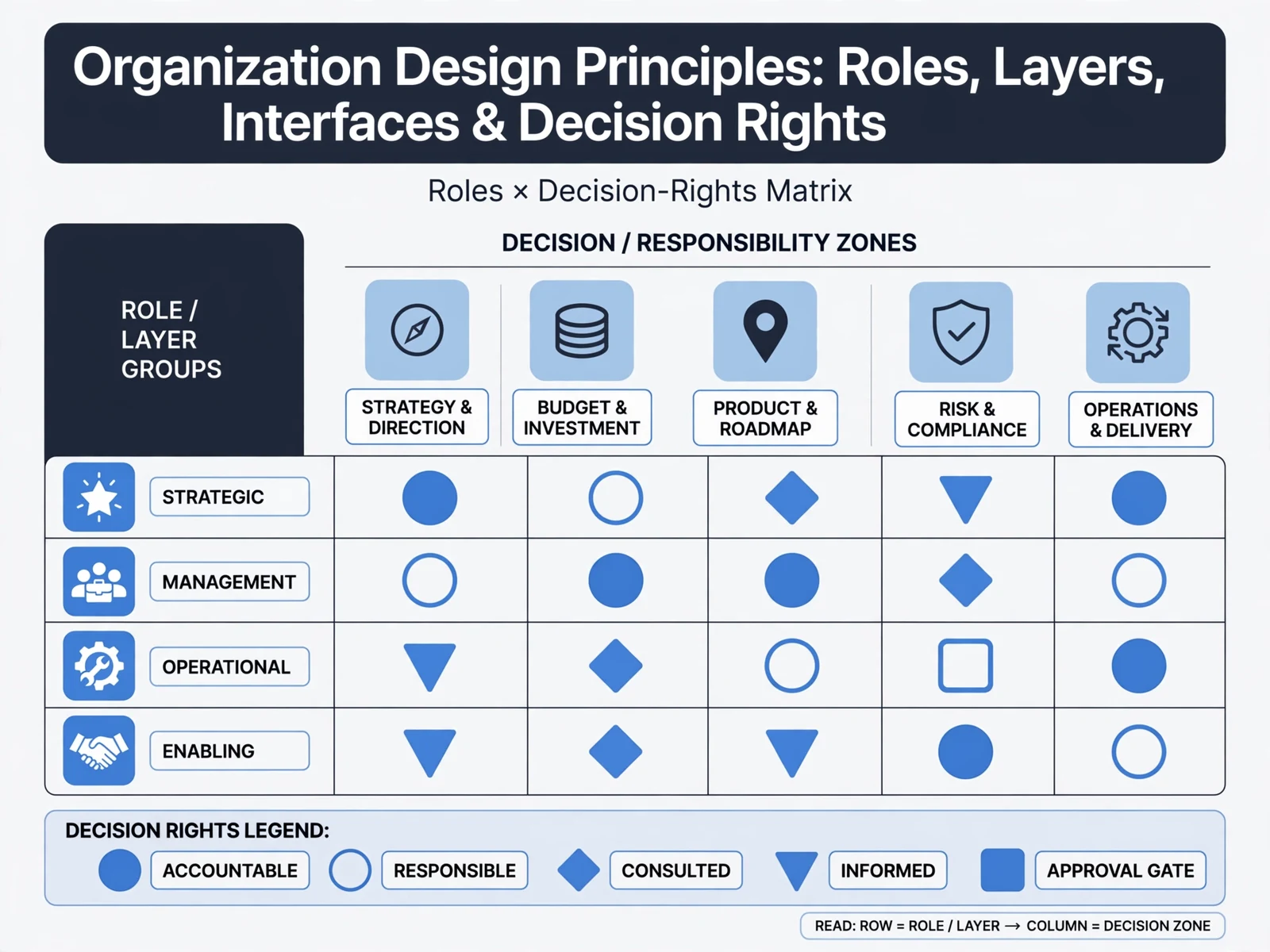
For common decisions, clarify who decides, who provides advice, who executes and who needs to be informed. Examine frequent cross-team handoffs and escalation loops as carefully as formal reporting lines.
Culture And Incentives
Test whether targets and rewards encourage collaboration or defensive handoffs. A redesigned role will not work if performance expectations still penalize the choices it is supposed to make.
Intervention And Transition
Pilot selected decision-rights or interface changes before a broad restructure when feasible. Communicate responsibilities, support managers and track unintended service or compliance effects during transition.
Practical Organization Design Principles Working Template
- Work: Which decisions and coordination tasks constrain the current results?
- Accountability: Who owns the outcome and has sufficient authority?
- Management capacity: What supervision and specialist support are actually required?
- Interface: Where do decisions cross teams or repeatedly escalate?
- Incentive: What target or reward encourages the existing dysfunction?
- Transition: How will a controlled change be tested and reviewed?
- Decision and next review: Who can authorize the next action and when will evidence be revisited?
Worked Example
A growing services company adds team leaders yet continues escalating every customer exception to the managing director. Mapping the actual decisions reveals unclear authority and inconsistent consultation rules. The company pilots clearer decision rights with a small account group before redesigning the entire reporting structure.
Common Mistakes to Avoid
- Changing the chart before analyzing work and decisions.
- Using an arbitrary span-of-control benchmark for very different roles.
- Separating accountability from the authority needed to act.
- Ignoring cross-functional handoffs and conflicting incentives.
- Announcing a restructure without transition and service safeguards.
Questions Managers Should Ask
- Which delayed decision proves the current design is not working?
- Who can legitimately make that decision and what expertise is required?
- Which interfaces need clearer rules rather than a new hierarchy?
- Would the current performance measures undermine the proposed roles?
- What pilot or operating evidence will show that the change helped?
Management Review Checklist
Evaluate the proposed design with a decision inventory, role outcomes, interfaces, supervisory burden and transition risks. Require a business owner to accept the consequences and set a review point.
What to Review After Three Cycles
Follow representative decisions through the revised structure. Inspect handoff time, rework, escalation and clarity of ownership, adjusting roles where work still stalls or controls are weakened.
A 30-Day Application Plan
- Week 1: Observe work flows and decision bottlenecks.
- Week 2: Clarify role accountability, interfaces and incentive conflicts.
- Week 3: Pilot changes to one significant decision or handoff.
- Week 4: Review operational evidence and set the transition plan.
Capability Maturity
Basic: roles and reporting relationships are visible. Developing: work, decision rights and interfaces are aligned. Mature: the organization adapts structure based on actual operating needs and tested evidence.
For HR, L&D and Corporate Sponsors
Use an anonymized organization-design scenario to map decisions, role boundaries and a small-scale operating pilot. Assess the logic of the design, not the visual polish of the chart.
Decision Quality Test
Can affected employees identify who decides, what authority they have and where a cross-team issue is resolved?
Make the Method Part of Normal Work
Revisit decision boundaries in ordinary operating reviews and management development, particularly after growth or changes in service complexity.
Related Courses in This Capability Cluster
Detailed workplace application
A growing services firm adds supervisors but still requires every client decision to pass through the managing director. An organization-design review maps decision flows and coordination work before changing reporting lines. It identifies decisions that can move to account leaders, where specialist advice is required and which incentives cause unnecessary escalation. A pilot tests new boundaries with actual clients. The design succeeds when accountability and coordination improve, not when a chart simply gains fewer boxes.
Decision Tool: Map Who Decides Before Redrawing the Organization Chart
Consider a hypothetical growing services company where client teams, operations, finance and risk all review the same decisions. Adding a management layer may appear to solve the bottleneck, but the real issue is that decision authority and consultation requirements have never been separated. Start by documenting a handful of frequent decisions and the consequence of delay.
| Decision | Accountable role | Required input | Escalation condition |
|---|---|---|---|
| Routine client service recovery | Service team lead | Customer impact and approved remedies | Outside agreed authority or material risk |
| Nonstandard contract commitment | Commercial owner | Legal, delivery capacity and margin review | Unacceptable contractual exposure |
| Shared specialist allocation | Portfolio or operations leader | Demand, priorities and dependency map | Conflict across business units cannot be resolved locally |
Test the operating model before changing reporting lines
Select a representative sample of recent delayed decisions. Trace each from request to approval: who received it, who could decide, whose advice was genuinely mandatory, who simply wanted visibility, and when the work restarted. Then test a revised rule for a bounded group. Record decision timeliness, quality, rework and unresolved handoffs. A faster approval is not a success if it transfers risk to a team that cannot manage it.
Distinguish roles, layers and interfaces
Role design clarifies outputs and authority. Management layers determine oversight, coaching and escalation. Interfaces specify how teams hand work to each other. They interact but are not substitutes: removing a layer without updating decision rights often shifts decisions upward informally. Likewise, a detailed RACI chart cannot fix conflicting objectives or insufficient specialist capacity.
Sponsor check: before approving a restructuring, ask for three concrete decisions that will be made differently, a named accountable owner for each, the operating risk of the proposed change, and how leaders will learn whether it worked. This turns organization design from a diagram exercise into an operating decision.
Where to Go Next
The Organizational Development and Organization Design course develops this capability through live instructor-led practice and workplace application. For broader pathways, see Training Bundles and Corporate Academies.
Design the organization around accountable work and usable decision rights, then test whether the structure delivers.
Organization Design and Decision Rights for Teams
If your organization is changing roles, reporting lines or cross-functional interfaces, private management training can support clearer decision rights and practical implementation.
Before changing reporting lines: Our organizational diagnosis framework helps distinguish structural problems from process and accountability gaps. The learning needs analysis guide explains when training can address the gap and when it cannot.
Develop this capability in your organization