Organizational development starts with diagnosis. Training, restructuring or culture campaigns are only useful when they address the system that is actually creating the performance problem.
Course Overview
This program is for HR, OD, People leaders and managers involved in organization design, culture, capability and effectiveness. It develops a structured approach to diagnosing organizational problems and selecting interventions.
Participants work with cases involving unclear roles, weak collaboration, duplicated work, culture gaps, leadership behavior, process friction and capability needs.
For organizations, the course can support OD teams, HR business partners, transformation programs and leaders responsible for operating-model change.
Where this program fits
OD professionals, HR business partners, People leaders and managers involved in organization effectiveness
Live classroom, live online or private in-house. Depth and schedule are tailored to the cohort.
Diagnosis, organization design, roles, decision rights, culture, capability and interventions
An organizational diagnosis and intervention plan for a live issue
Built for Corporate Cohorts
Private delivery can be aligned to participant roles, business priorities, internal terminology and real workplace scenarios. HR, L&D and functional sponsors can use the course alone or inside a broader academy.
What Participants Will Learn
Separate skill, structure, process, leadership and incentive problems.
Examine roles, interfaces and decision rights rather than boxes alone.
Translate culture language into observable behavior and systems.
Match the response to the diagnosed cause.
Identify where learning is genuinely part of the solution.
Plan stakeholders, adoption and reinforcement around interventions.
Business Problems This Program Is Designed to Address
Course Outline
Applied Practice and Scenario Work
Participants use realistic situations to practise analysis, decisions, stakeholder communication and application. Private cohorts can adapt scenarios to the organization’s context while protecting confidential information.
Participants diagnose interfaces, incentives, process and decision rights.
Participants test whether skill is the actual cause.
Participants redesign roles and decision rights rather than moving boxes again.
Participants examine the systems still rewarding the old behavior.
Practical Tools and Work Products
What Strong Practice Looks Like
OD practitioners need to resist solution bias. When the organization asks for a workshop, restructure or culture initiative, the first responsibility is to understand the performance problem and what maintains it.
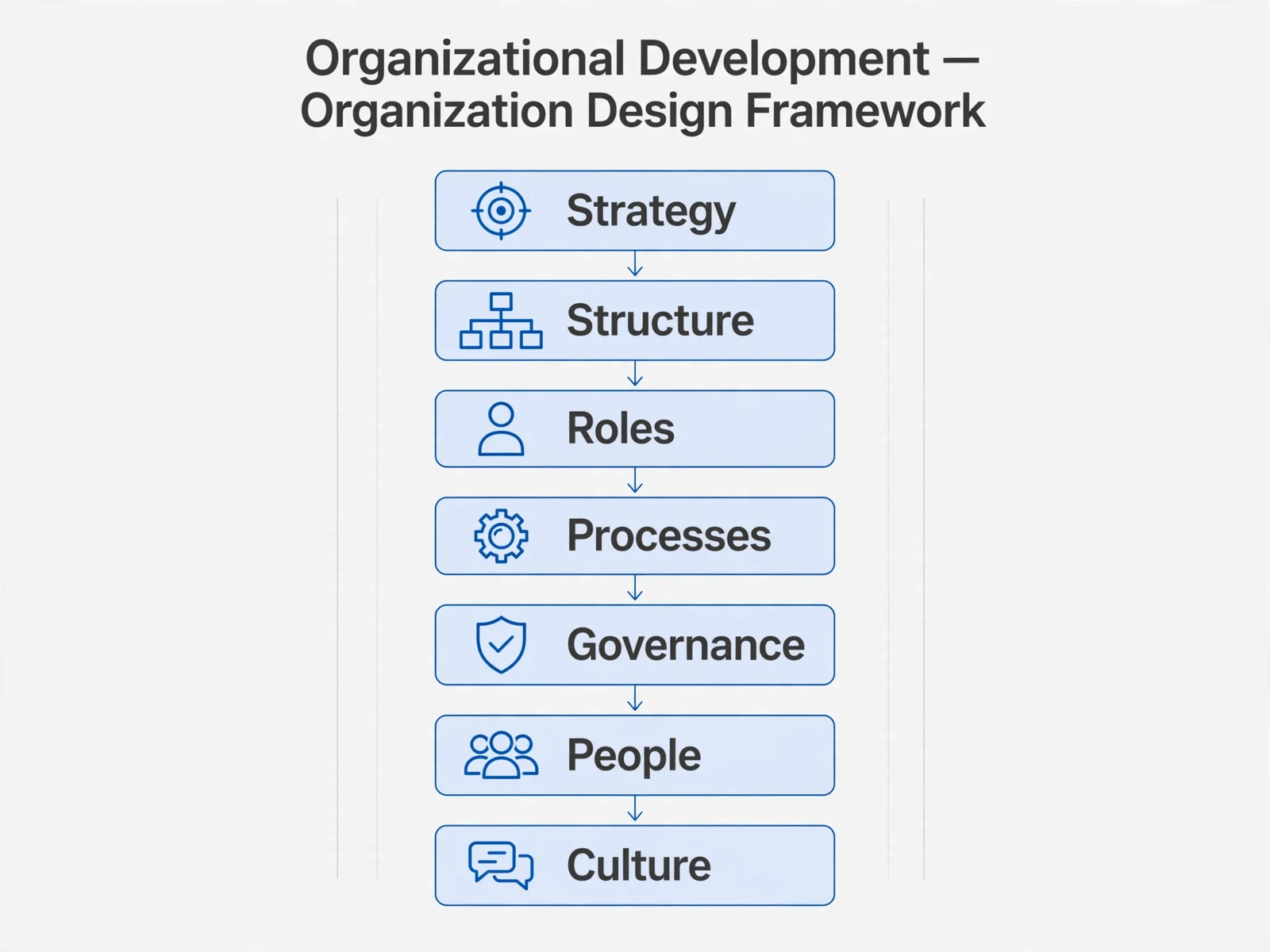
Organization design is about how work is coordinated. Reporting lines matter, but so do role clarity, decision rights, interfaces, management layers and the distribution of capability. A new chart can fail if these operating questions remain unresolved.
Culture becomes practical when leaders can identify which behaviors are expected, what signals reinforce them and which organizational systems currently reward something different. This moves culture work from messaging toward management design.
Interventions also need a theory of change. Leaders should be able to explain why the proposed action is expected to affect the diagnosed cause, what evidence would show movement and what other conditions must be present.
Questions Participants Learn to Ask
What evidence tells us the problem is structural, behavioral, process or capability-related?
Which decision or interface is currently unclear?
What system is reinforcing the behavior we say we want to change?
Why should this intervention change the diagnosed cause?
Implementation Pitfalls and Cross-Functional Interfaces
Capability in this topic depends on how decisions move across the organization. Private cohorts can map where ownership, information or incentives currently break down and use those interfaces as part of the learning design.
- Business leaders for operating priorities and accountability
- Finance for organization cost and resource decisions
- L&D and Talent where capability is part of the solution
- Change leaders for adoption and implementation
A common implementation mistake is to add a framework without changing the management routine around it. Participants therefore identify where the tool will be used, who needs to be involved, what evidence is required and what decision or behavior should become different after application.
Advanced Application Considerations
A common OD failure is using organization design to solve interpersonal or leadership problems. Changing structures can create new disruption without fixing the underlying behavior. Participants learn to identify when role clarity is the issue and when leadership intervention is more appropriate.
Another risk is designing an ideal future organization without understanding transition cost. Capability gaps, vacancies, systems and management bandwidth can make a theoretically attractive model difficult to implement. OD leaders need both target design and transition logic.
Measurement should also match the intervention. A culture change, organization redesign and capability program require different evidence. Participants define measures around the expected mechanism instead of using generic engagement or satisfaction scores for every initiative.
Before the Program Begins
For a private cohort, participants can identify one current case, decision or recurring problem related to the topic. Anonymized patterns can be used to weight practice without turning the program into a review of confidential internal matters.
After the Program
Participants can use one work product in the next relevant work cycle and discuss the result with a manager or peer. The goal is to reinforce application while the participant has a live opportunity to use the capability.
How Participants Work During the Program
The learning design moves through diagnosis, practice, challenge and application. Participants begin with a real problem or decision, test a framework, receive challenge, build a practical work product and identify the first workplace action after the course.
For employer-sponsored cohorts, managers can agree one current situation before delivery and review the participant’s application afterward. This creates a direct connection between learning and work without turning development into a heavy assessment exercise.
Manager Reinforcement and Evidence of Application
Sponsors can look for observable changes such as clearer decisions, stronger preparation, better use of a work product, improved ownership or better escalation. These are indicators that the capability is being applied, not automatic claims that attendance caused a business result.
Participants should select one or two applications first rather than trying to use every concept at once. Managers can ask what was tried, what response followed and what should be adjusted next time.
Designing a Private Cohort Around Real Work
Before private delivery, the sponsor can define participant roles, experience level, common workplace situations, internal terminology and one or two practical outputs that would be useful after the program.
- Participant roles and experience.
- Recurring decisions or problems the cohort needs to handle better.
- Relevant internal frameworks or governance.
- Practical work products participants can use afterward.
- How managers will reinforce application.
Capability Maturity and Leadership Decisions
OD maturity also requires deciding which problems should be solved locally and which need enterprise intervention. A team-level issue may not justify organization-wide redesign, while a recurring pattern across functions may signal a systemic problem. Participants learn to scale the intervention to the evidence.
Decision rights deserve particular attention because structural change often fails when formal accountability and practical authority do not match. The course helps leaders identify who recommends, decides, executes and escalates important choices across organizational boundaries.
For corporate cohorts, participants can compare current practice with a more mature operating model and identify the smallest change that would materially improve decision quality. That keeps the action plan practical while still showing what stronger capability looks like over time.
OD work also benefits from explicit transition planning. Even a strong target design can fail when leaders underestimate vacancies, skill gaps, communication, workload or the time required for new decision routines to stabilize. Participants include transition risks and temporary operating arrangements in the intervention plan rather than focusing only on the future-state design.
This is also a useful point for sponsors to decide which capability should be reinforced through management routines, which requires a specialist process, and which should become part of a broader academy or transformation roadmap.
Who Should Attend
- Organizational development professionals
- HR business partners
- People and culture leaders
- Managers involved in organization design or transformation
Organizational Benefits
- Improve organizational diagnosis
- Reduce weak or mismatched interventions
- Strengthen organization-design decisions
- Make culture change more practical
- Build strategic OD capability
Delivery and Pricing
The program is live and instructor-led. It can be delivered in the classroom, live online or in-house. Duration is flexible and should reflect participant level, selected depth, organizational objectives and the amount of applied practice required.
Public and private pricing: current public fees are confirmed with scheduled cohorts. Private and customized programs are quoted according to cohort size, location, scope and customization. Request a proposal.
Frequently Asked Questions
Can this be delivered privately for one organization?
Yes. Private cohorts can be calibrated to participant roles, business context and priority scenarios.
Is the duration fixed?
No. Delivery depth and schedule are adapted to the cohort and learning objective.
Can we use our own scenarios?
Yes. Organization-relevant situations can be used while protecting confidential information.
How should managers reinforce the learning?
Agree one or two work applications, then review what the participant tried, what happened and what should change next.
Can this sit inside a broader academy?
Yes. It can be combined with related programs into a role, function or leadership pathway.
Is this self-paced?
No. TheSkillGrid programs are live and instructor-led.
Related Programs
- HR Business Partner Certification
- Change Management and Organizational Transformation
- Performance Management and Employee Engagement
- Strategic Planning and Execution
Build a Cohort Around the Capability Need
TheSkillGrid can combine this course with adjacent programs into a coherent corporate pathway.
Upcoming Dates & Venues
Request course availability with your preferred date, location and group size. We will confirm available public-session and private-team options before any booking or payment.
Ready to Take the Next Step?
Register your interest for a public session or request private in-house delivery for your team.