
A talent review should not confuse excellent performance in today’s job with readiness for a different role. A strong succession decision separates documented results, growth potential, specific-role readiness and the risk created by an uncovered critical position.
Use consistent evidence standards and structured calibration to challenge unsupported impressions. Treat readiness as role- and time-specific, give people fair development opportunities and protect employee data throughout the review.
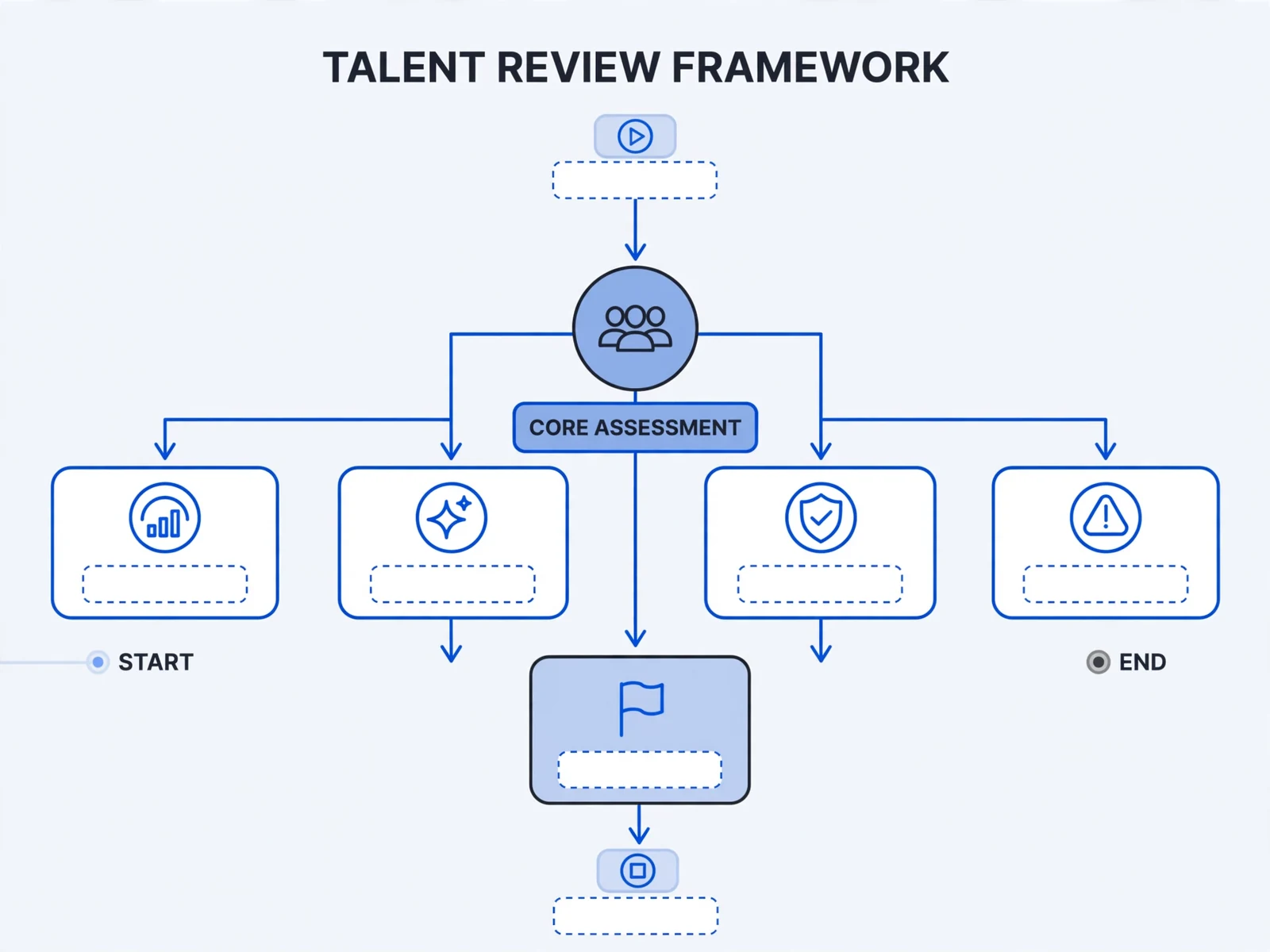
Performance Evidence
Evaluate demonstrated outcomes against the expectations and context of a person’s current role. Record the period, evidence sources and material constraints. Avoid turning manager confidence or a single recent success into an unsupported performance label.
Potential
Discuss evidence that someone may grow into more complex responsibilities, such as learning agility, judgement under uncertainty and willingness to pursue the path. Describe it as a development hypothesis to be tested, not an inherent trait or a guaranteed promotion.
Role Readiness
Define the actual demands of the target role: decision authority, stakeholder complexity, technical or commercial exposure and acceptable support. Assess whether the candidate has demonstrated these capabilities and what experiences would close the gap. Readiness can change as roles or circumstances change.
Critical Roles
Identify positions whose vacancy would materially affect service, risk control, delivery or strategic continuity. Document interim cover arrangements rather than assuming every senior title has equal succession criticality.
Succession Depth
Assess the availability and readiness windows of potential successors for each critical role, without presenting an unverified percentage as an organizational fact. Highlight concentrated dependencies and where external hiring or cross-training may be necessary.
Calibration And Development
Use a cross-functional panel to test whether managers apply the same evidence standards and distinguish observation from opinion. Record agreed development actions, sponsors, privacy controls and a date to reassess. Avoid covert ranking or decisions based on protected characteristics.
Practical Talent Review Framework Working Template
- Role demand: What responsibilities and decisions make this position critical?
- Performance evidence: Which current-role outcomes can be documented fairly?
- Potential hypothesis: What new experiences could test growth capacity?
- Readiness gap: Which target-role abilities are not yet demonstrated?
- Interim cover: Who can perform the essential functions during a vacancy?
- Development and review: Which experience, sponsor and date will test progress?
- Next action: Who owns the decision, and what evidence will be reviewed when?
Worked Example
For a regional operations succession discussion, the panel reviews delivery results in each candidate’s current job, then asks who has managed cross-country coordination, sensitive risk decisions and stakeholder conflict. The panel records missing experiences and interim coverage before attaching any readiness date. All judgments are provisional and should be reconsidered after relevant experience.
Common Mistakes to Avoid
- Equating current performance with future-role readiness.
- Turning a manager’s impression into a permanent potential label.
- Applying different evidence standards to different teams or employees.
- Treating a succession grid as proof of capability without development action.
- Publishing employee comparisons or invented talent-distribution statistics.
Questions Managers Should Ask
- Which evidence relates to the present role and which to the intended next role?
- Are panel members applying the same expectations and challenge standards?
- Which development opportunity would produce evidence that is currently missing?
- What operational exposure remains if the critical position becomes vacant?
- Who can access the records and when will the judgment be revisited?
Management Review Checklist
For each critical role, review the role demands, named interim cover, candidate evidence, uncertain readiness judgments and planned development experiences. Challenge unsupported labels and document dissent or missing evidence without discussing confidential information unnecessarily.
What to Review After Three Cycles
Across review periods, check whether development experiences improved observable readiness and whether panel standards remained consistent. Revisit the role requirements when the business changes rather than preserving stale succession labels.
A 30-Day Application Plan
- Week 1: Define role criticality, decision demands and privacy boundaries.
- Week 2: Gather documented evidence and separate performance from potential.
- Week 3: Calibrate readiness and specify development experiences and interim coverage.
- Week 4: Record accountable actions, feedback and review dates for each critical role.
Capability Maturity
Basic: critical positions and evidence sources are identified. Developing: panels calibrate role-specific readiness and development. Mature: succession decisions are fair, reviewed and connected to operational continuity.
For HR, L&D and Corporate Sponsors
Corporate talent-management learning should use fictional or anonymized cases with no identifiable employee records. Participants should practice evidence-based calibration, a role-readiness register, fair challenge and a realistic development plan.
Related Courses in This Capability Cluster
A worked application scenario
A leadership team reviews three potential successors for a regional operations role. Instead of equating current performance with future readiness, it separates results in the present job, evidence of learning, exposure to complex decisions and ability to operate at the next level. Each candidate receives documented development experiences, not an unsupported talent label. HR checks whether managers apply the same evidence standard across functions. The sponsor records the earliest plausible readiness window and an interim cover arrangement, then revisits the plan when responsibilities or business risks change.
Separate performance, potential and readiness with actual evidence
A talent review becomes unreliable when a manager treats strong performance in the current role as proof that an employee is ready for an entirely different role. Performance describes demonstrated outcomes within current responsibilities. Potential is a hypothesis about someone’s ability and motivation to develop for future demands. Readiness asks whether a person can perform a particular role, at a particular level of complexity, with reasonable support and risk. These are distinct judgments and need distinct evidence.
Begin with the business need and the future role’s actual demands. A supervisor who performs very well in a technical team may still need experience handling cross-functional disagreements, financial decisions or major customer risks before leading an entire region. Equally, a colleague who has had less opportunity to display those skills should not automatically receive a low potential label. Look at work examples, development opportunities, barriers and the evidence needed to make an assessment fair.
A worked review of a critical regional leadership role
An organization expects its regional operations director to leave in the coming years. Two internal managers are being considered for future responsibility. One has excellent operating results but limited experience with major customers and capital decisions. Another has strong cross-functional relationships but has not managed an incident involving a critical service. A traditional nine-box discussion might sort them into categories without explaining what either would need to develop.
Instead, HR and the business sponsor define the role’s required decisions and observe relevant evidence. The first manager receives a supervised customer-negotiation and investment-review assignment. The second takes part in a realistic continuity exercise with defined decision authority. Both receive feedback against the same role requirements and are offered appropriate support. The organization separately documents interim cover for an unexpected vacancy, because ‘able to cover routine approvals’ is not necessarily the same as ‘ready for permanent appointment’.
Map role criticality and coverage risk
Set an emergency interim arrangement, capture essential knowledge and prioritize supervised development.
Test handover and emergency authority; develop depth beyond one successor.
Standardize the work and offer role-relevant development without making a promotion promise.
Maintain knowledge transfer and review as organizational needs change.
This qualitative map is an initial continuity aid. It is not a scoring system for employee worth or a substitute for fair selection.
Build a role-readiness evidence register
For each critical position, document the specific decisions the incumbent makes, responsibilities that cannot be interrupted, important relationships and actual contingency options. Compare each potential successor against observed examples of relevant work, not vague attributes such as ‘executive presence’ without a definition. Identify which capabilities can be learned through a stretch assignment and which require qualifications, authorization or a longer development period.
| Capability | Evidence to seek | Development task |
|---|---|---|
| Commercial judgment | Quality of option and risk analysis | Lead a supervised supplier decision |
| Cross-functional leadership | Resolved competing team priorities | Run a multi-department improvement |
| Incident decision-making | Judgment under simulated uncertainty | Participate in a continuity exercise |
Protect fairness, confidentiality and development access
Talent reviews involve sensitive judgments about individuals. Restrict access to the people authorized to make legitimate employment and development decisions, and follow local employment and privacy requirements. Avoid unnecessary speculation about personality, health or personal circumstances. Use multiple perspectives and common role criteria where appropriate, but do not allow a group discussion to transform unsupported impressions into permanent labels.
Check whether people have been given a fair chance to demonstrate capability. A manager’s favored employee may have received more visible projects, while equally capable colleagues have not. That inequality should prompt better access to relevant experience, not simply a lower rating. Be transparent with employees about development opportunities and role requirements without promising appointments that have not been approved. A succession plan can identify preparation needs without replacing formal recruitment or selection.
Use quarterly reviews to test assumptions
At each appropriate review, ask whether strategic priorities or role demands changed, which development assignments were actually completed and what evidence emerged. Identify where an interim coverage plan is still weak and what would happen if two key people left simultaneously. Retire old readiness claims when the work or evidence changes. A development plan is successful when it produces demonstrable capabilities and genuine organizational resilience, not when a slide contains a reassuring number of names.
The value of talent review is measured by better preparation for real business requirements, more equitable access to relevant development and continuity under change. The labels are secondary to the actions they help leaders take.
Where to Go Next
The Talent Management and Succession Planning course develops this capability through live instructor-led practice, scenarios and workplace application. Organizations building a wider pathway can also review TheSkillGrid Training Bundles and Corporate Academies.
Use talent calibration to improve decisions and development, never to manufacture precise-looking talent outcomes or permanent labels.
Talent Review and Succession Planning for Teams
HR and leadership teams can use guided calibration exercises to improve succession discussions, evidence standards and development follow-through without treating potential ratings as objective fact.
Equip Managers to Run Better Talent Reviews
If your organization is refreshing its succession and performance processes, outline the participants, key decisions and talent criteria. A private development cohort can be scoped to those needs.
Related guides: workforce demand forecasting and strategic workforce planning.
Develop this capability in your organization