
A daily management system helps teams spot operational problems early, assign action and learn from recurring failures. The goal is not a wall of metrics or another meeting. It is a short, consistent review of the few service, quality, safety or flow signals that managers can influence.
Start with one operating area. Agree what requires escalation, who owns countermeasures and how the team will confirm whether the next work cycle actually improved.
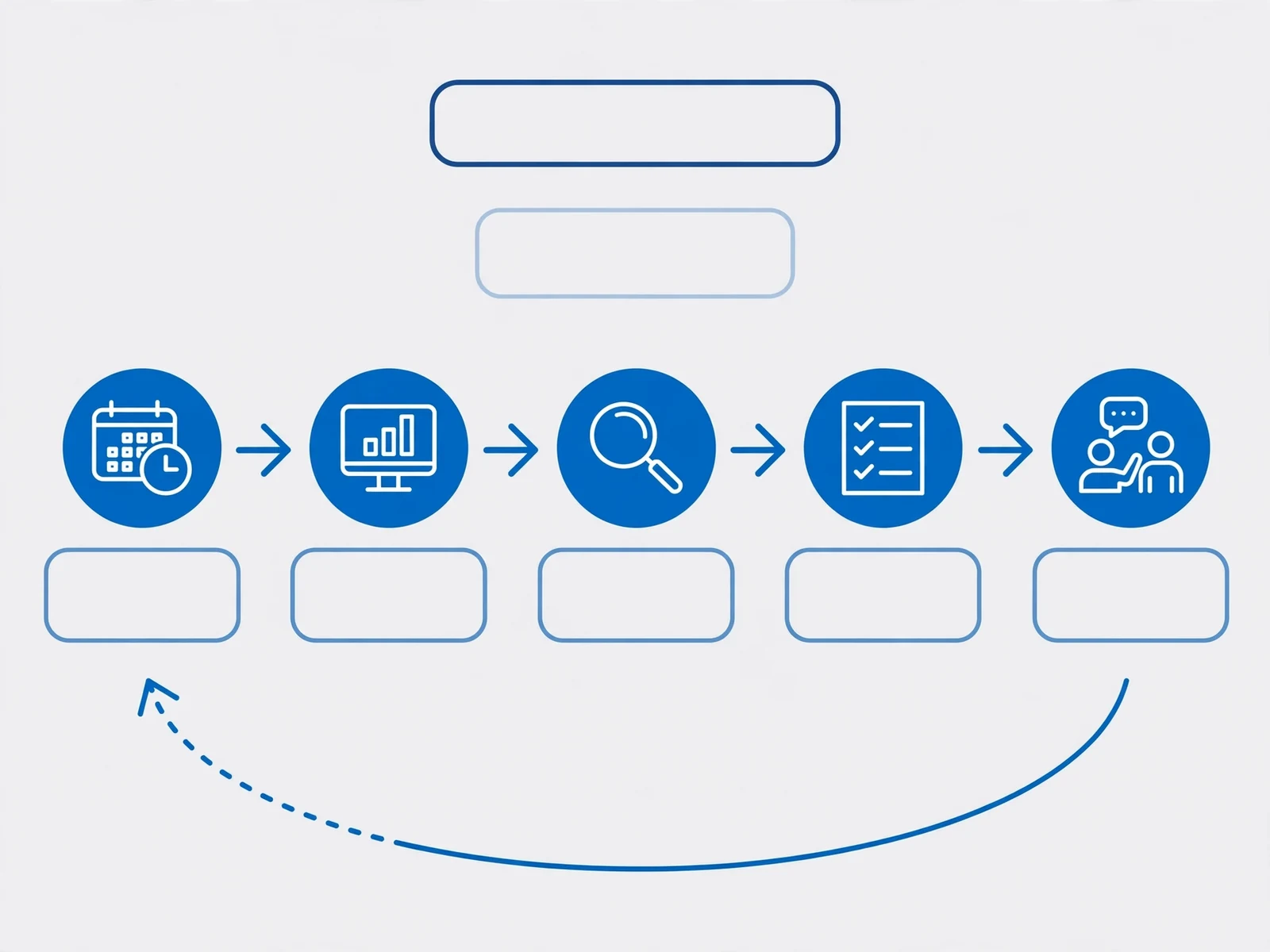
Define the few operating outcomes that matter
Daily management should focus on flow, quality, service, safety or cost signals that managers can influence rather than a wall of metrics. Choose a small set of measures with clear owners and thresholds.
Use a short visual review rhythm
A predictable review makes abnormalities visible before they become monthly surprises. Keep the review focused on exceptions, causes and actions.
Separate escalation from problem solving
Teams need to know what they can solve locally and what requires support from another function or level. Define escalation triggers so managers do not either hide or over-escalate issues.
Track countermeasures, not explanations
Repeated explanations without actions create a reporting ritual. Record the countermeasure, owner, due point and expected evidence.
Connect daily issues to improvement work
Recurring abnormalities should feed structured improvement rather than being reset every morning. Use recurrence and impact to decide which issues enter deeper analysis.
Protect standard work while allowing learning
A standard creates a baseline for improvement, but it should change when evidence supports a better method. Update the standard after the new method proves more reliable.
Practical Working Template
- Define the few operating outcomes that matter: Choose a small set of measures with clear owners and thresholds.
- Use a short visual review rhythm: Keep the review focused on exceptions, causes and actions.
- Separate escalation from problem solving: Define escalation triggers so managers do not either hide or over-escalate issues.
- Track countermeasures, not explanations: Record the countermeasure, owner, due point and expected evidence.
- Connect daily issues to improvement work: Use recurrence and impact to decide which issues enter deeper analysis.
- Protect standard work while allowing learning: Update the standard after the new method proves more reliable.
- Owner: Name one person accountable for the next action.
- Evidence: Record the evidence that supports the decision.
- Review point: Define when the team will revisit the result.
Worked Example
A service team repeatedly misses a customer turnaround target on Mondays. The board shows the miss each week, but no one owns the recurring cause. The manager uses the daily system to isolate demand, staffing and handoff patterns, assigns one countermeasure and reviews the result the following week. The value of the framework is that it turns a vague concern into a small number of explicit decisions, owners and review points. The team can then learn from the result instead of debating the same issue again at the next meeting.
Common Mistakes to Avoid
- Treating “define the few operating outcomes that matter” as a documentation task rather than a management decision.
- Treating “use a short visual review rhythm” as a documentation task rather than a management decision.
- Treating “separate escalation from problem solving” as a documentation task rather than a management decision.
- Treating “track countermeasures, not explanations” as a documentation task rather than a management decision.
- Treating “connect daily issues to improvement work” as a documentation task rather than a management decision.
- Adding measures or fields that no one uses to make a decision.
- Confusing a completed template with evidence that the underlying capability has improved.
Questions Managers Should Ask
- What evidence would tell us whether we are strong enough on define the few operating outcomes that matter?
- What evidence would tell us whether we are strong enough on use a short visual review rhythm?
- What evidence would tell us whether we are strong enough on separate escalation from problem solving?
- What evidence would tell us whether we are strong enough on track countermeasures, not explanations?
- What evidence would tell us whether we are strong enough on connect daily issues to improvement work?
- What evidence would tell us whether we are strong enough on protect standard work while allowing learning?
How to Apply This Over 30 Days
- Week 1: choose one live case and capture the current baseline, assumptions and owner.
- Week 2: apply the framework and record where judgement or evidence is weak.
- Week 3: review the result with the people who own adjacent decisions or dependencies.
- Week 4: decide which part should become a repeatable management standard and which should remain situational.
Capability Maturity
Basic: the team can describe the process and use the main tool. Developing: managers use consistent definitions, owners and review points. Mature: the capability changes decisions early, adapts when evidence changes and connects cleanly to adjacent functions. The right target depends on the consequence and complexity of the work.
For HR, L&D and Corporate Sponsors
This topic works well in employer-sponsored development because participants can apply the framework to live work between sessions. A private cohort can compare anonymized cases, identify recurring judgement gaps and agree a shared standard where consistency creates value.
Sponsors should look for stronger questions, clearer work products, more explicit trade-offs, better ownership and earlier escalation. Those are credible signs of application. Attendance alone should not be treated as proof of business impact.
How Daily Management Connects to Weekly and Monthly Reviews
Daily management should not become a parallel reporting system. The daily layer is for abnormal conditions, immediate ownership and short-cycle learning. Weekly or monthly reviews should handle larger trends, cross-functional issues and improvement priorities that cannot be solved in the local rhythm. The connection between the layers matters: recurring daily issues should move upward when they need resources or redesign, while resolved issues should not keep consuming senior attention.
What Managers Should Standardize
Standardize the review questions, definitions, escalation triggers and action ownership. Do not standardize every local countermeasure. Teams need enough consistency to compare performance and enough flexibility to solve problems close to the work. A useful standard might define what counts as an abnormality, how long an unresolved issue can remain local and what evidence is required before an action is closed.
Review the System After Several Cycles
After four to six weeks, ask which measures actually led to decisions, which issues repeated, which escalations arrived too late and which meeting elements added no value. Remove noise, strengthen weak evidence and clarify ownership. A daily management system should become simpler and more useful as the team learns, not heavier.
Management Review Checklist
Before turning the approach into a standard, review five things. First, is the business purpose clear enough that people know why the method exists? Second, are the assumptions and definitions explicit enough to avoid different interpretations? Third, does one person clearly own the next action? Fourth, is there a natural trigger for escalation or review? Fifth, will the next cycle produce evidence that tells the team whether the approach is working? If those questions cannot be answered quickly, simplify the process before adding more measures or documentation.
What to Review After Three Cycles
After the method has been used several times, look for patterns rather than isolated anecdotes. Which questions consistently improve judgement? Which fields are ignored? Where do decisions still stall? Which handoffs repeatedly create confusion? Remove anything that produces no action, strengthen evidence where managers still rely on opinion, and clarify ownership where issues bounce between functions. A useful management framework should become easier to use as the team learns.
A worked application scenario
At a service operation, the morning board shows six unresolved cases that missed their turnaround time. Rather than debating the average again, the team separates cases blocked by missing information from cases waiting for approval. The supervisor assigns an owner and a same-day next action to each issue, with one recurring handoff problem referred to the weekly improvement review. The next day the group checks whether the action removed the specific obstacle, not merely whether the reported number improved. This creates a daily connection between evidence, escalation, standard work and learning.
Surface problems at the point of work
Name the next action and decision authority
Choose and verify a countermeasure
Update standard work and review
Start from a real service outcome, not a board full of metrics
A daily management system should help a team recognize work that is not going according to the intended standard and make a timely decision. Begin with a small number of outcomes important to customers, safety, service quality or operational flow. Define how they are observed and which variation truly requires attention. An intimidating wall of red-and-green measures can distract teams when no one knows who can act on them. When the information is late, ambiguous or based on incompatible definitions, fix the measurement before setting more aggressive targets.
A visual board is useful because it gives the team a shared current picture, not because it decorates the workspace. Show blockers, accountable owners and next review points. Avoid forcing complicated cases into a single traffic-light state that hides what is actually happening.
Worked example: late service requests across shifts
A customer support team often misses its resolution commitment. Supervisors believe the problem is insufficient staffing and begin pressing people to clear cases more quickly. The daily review instead follows several delayed cases and finds that unresolved work is routinely transferred without a named receiving owner. Some cases are reopened and counted as new demand. The team changes its handoff method, identifying the action owner and next customer update for each exception.
The following day’s review checks whether the named action occurred and whether the client issue advanced. Over subsequent cycles, the team compares repeat contacts, unresolved cases and time to correct resolution. If the metric looks better only because difficult cases moved to a different queue, the improvement is not credible. An observed process failure has become a learning opportunity rather than an invitation to blame a shift.
Separate urgent containment from recurrent problem solving
A problem that threatens a customer, safety or a critical commitment may require immediate action before its underlying cause is fully known. Establish a route for urgent escalation that does not wait for a weekly improvement meeting. Routine defects can enter a different track for analysis, experimentation and changes to standard work. The team should know which choices lie within the supervisor’s authority and when another department must decide.
For recurring issues, write a precise problem statement, test plausible causes and document the change. A reminder or retraining session is not evidence that a process failure has been removed. Owners should check the countermeasure under normal operating conditions and reopen the investigation if the problem recurs.
| Situation | How to assess | Response |
|---|---|---|
| Immediate service risk | What must be contained today? | Responsible operator and escalation |
| Blocked work | Which decision or handoff is missing? | Named owner and next action |
| Recurring defect | What causal evidence is needed? | Improvement owner and test |
| Standard change | Did the tested method work reliably? | Updated procedure and review date |
Run a short meeting that produces a decision
A useful huddle asks what changed since the last review, which commitments are at risk, who owns the next action and what support is needed. Use a longer separate discussion for root-cause work that cannot responsibly be resolved in a few minutes. Managers should demonstrate their own accountability by closing outstanding decisions and barriers they promised to address.
Review whether the daily questions remain connected to customer outcomes. When a metric is repeatedly green and no longer prompts a useful decision, consider whether it needs less airtime. When staff hesitate to report bad news, investigate whether the management response punishes early escalation. A strong system makes problems visible before they become expensive.
Where to Go Next
The Operational Excellence and Process Improvement course develops this capability through live instructor-led practice, scenarios and work application. Organizations building a broader pathway can also review TheSkillGrid Training Bundles and Corporate Academies.
Use the framework on one real decision first, then build the repeatable standard from what you learn.
Daily Management and Operational Excellence for Teams
Operations managers can work with real performance routines, escalation rules and process-improvement examples to strengthen the daily management system.
Develop this capability in your organization