Coaching is not avoiding direction. Good managers know when to tell, when to ask, and how to help people think more clearly without taking responsibility away from them.
Course Overview
This program helps women managers build coaching into everyday management rather than treating it as a separate specialist activity. It develops practical skills for questioning, listening, feedback, accountability and development conversations.
Participants practise with realistic management scenarios such as underperformance, stretch assignments, repeated mistakes, confidence gaps, role transitions and employees who rely too heavily on the manager for answers.
For employers, the course fits manager academies, first-line leadership programs, women-in-management cohorts and performance-culture initiatives.
Where this program fits
Women managers, team leaders and emerging leaders responsible for developing others
Live classroom, live online, or private in-house delivery with flexible duration.
Coaching conversations, questions, listening, feedback, accountability and development
A repeatable coaching conversation model and plans for real team members
Built for Corporate Cohorts
Private delivery can be aligned to the sponsor’s capability goals, participant roles, internal frameworks, business priorities and real workplace scenarios. HR, L&D, Talent and functional leaders can use the program as a standalone cohort or as part of a wider academy, succession pathway or women-in-leadership portfolio.
What Female-Forward Means Here
The program develops managerial authority and developmental skill together. Coaching is positioned as a performance tool, not as an expectation that women managers should carry unlimited emotional labor.
What Participants Will Learn
Distinguish coaching from directing, teaching, mentoring and correcting.
Help employees think rather than waiting for the manager’s answer.
Identify assumptions, gaps and patterns behind the first response.
Be specific about behavior, impact and expectation.
Combine support with clear ownership and follow-through.
Use work assignments and reflection to build capability over time.
From insight to workplace application
Diagnose the need
Ask and listen
Create ownership
Follow through
Course Outline
Who Should Attend
- Women people managers
- First-time and established managers
- Team leaders and supervisors
- Organizations strengthening manager coaching capability
Organizational Benefits
- Improve manager-led development
- Reduce over-reliance on HR for routine coaching
- Strengthen feedback and accountability
- Support internal capability building
- Improve consistency across manager populations
Tools participants can use at work
B2B Deployment Options
Use the program as a private cohort, as one component of a structured Women at Work pathway, or inside a function-specific academy. Multi-location live-online delivery can support geographically distributed teams.
Delivery Format
The program is live and instructor-led. It can be delivered in a classroom, live online, or in-house. Duration is flexible and should reflect participant level, selected depth, organizational objective and the amount of applied practice required.
For HR, L&D and business leaders: Explore in-house training or request a customized cohort.
Business Problems This Program Is Designed to Address
This course is designed around workplace problems that organizations can observe in real roles. The aim is to give participants a structured way to diagnose situations, make stronger decisions, practise difficult conversations and return to work with tools that can be used immediately.
Applied Practice and Scenario Work
The learning design uses realistic management situations rather than abstract discussion alone. Private cohorts can calibrate the scenarios to the participant population, industry and operating context.
Application principle: participants should leave each major topic able to explain what they would do differently in a real role, which stakeholders they would involve, what evidence they would use and how they would know whether the action worked.
For HR, L&D and Program Sponsors
Coaching Skills for Women Managers and Leaders can be delivered as a standalone private cohort or embedded inside a broader capability pathway. The sponsor can define the target population, role level, business context, expected behaviours, priority scenarios and work products before delivery.
A stronger deployment does more than count attendance. Participants can apply one tool to live work, discuss the result with their manager and bring the learning into an existing talent, performance, project or functional review. This connects development to execution without making unsupported ROI promises.
- Before the cohort: define the capability gap and participant profile.
- During delivery: use role-relevant scenarios, practice and work products.
- After delivery: reinforce application through manager conversations, peer review or sponsor follow-up.
- At pathway level: combine this program with adjacent courses where participants need broader capability.
Pricing
The public-course fee below follows the current Women at Work offering structure for Saudi Arabia and the GCC. Program length and structure can vary by cohort and delivery context. Public fees exclude VAT or other applicable taxes.
Individual booking
3 delegates (15% off)
6 delegates (pay for 5)
How This Fits Into a Wider Development Pathway
For corporate cohorts, the tools and action plans from this program can feed into development plans, talent reviews, project reviews, functional academies or sponsor debriefs. The course can also be paired with adjacent programs so the learning journey reflects the capability the organization is actually trying to build.
Frequently Asked Questions
Can we use our own organizational scenarios?
Yes. Private cohorts can be calibrated around your operating context, role levels and common workplace situations while protecting sensitive information.
How should managers support participants after the course?
Agree one or two work applications, then review what the participant tried, what changed and what further support is needed.
Can this be combined with other Women at Work courses?
Yes. It can sit inside a multi-course pathway for managers, high-potential women, functional leaders or another defined population.
Can this be delivered only for our organization?
Yes. Private delivery can be calibrated to the participant population, business context, capability priorities and internal terminology.
Is the duration fixed?
No. Delivery depth and schedule are adapted to the cohort and organizational objective.
How Participants Work During the Program
Coaching Skills for Women Managers and Leaders is designed as an applied learning experience rather than a sequence of lectures. Participants move repeatedly between concept, diagnosis, practice and workplace application. The exact balance can be adjusted for the cohort, but the learning design should keep participants working with decisions and situations that resemble the responsibilities they actually hold.
Participants begin by defining the real problem, decision or capability gap rather than accepting the first description at face value.
They test language, analysis, tools or decision approaches in a low-risk setting and receive challenge from the facilitator and peers.
Participants create a work product linked to their role rather than leaving with notes alone. Relevant outputs can include Coach-or-direct decision guide, Feedback planner, Performance coaching template, Team coaching action plan.
Assumptions, blind spots and trade-offs are surfaced through peer review, facilitator questions and comparison with alternative approaches.
Each participant identifies where the learning will be used, who needs to be involved, what action happens first and what evidence will show progress.
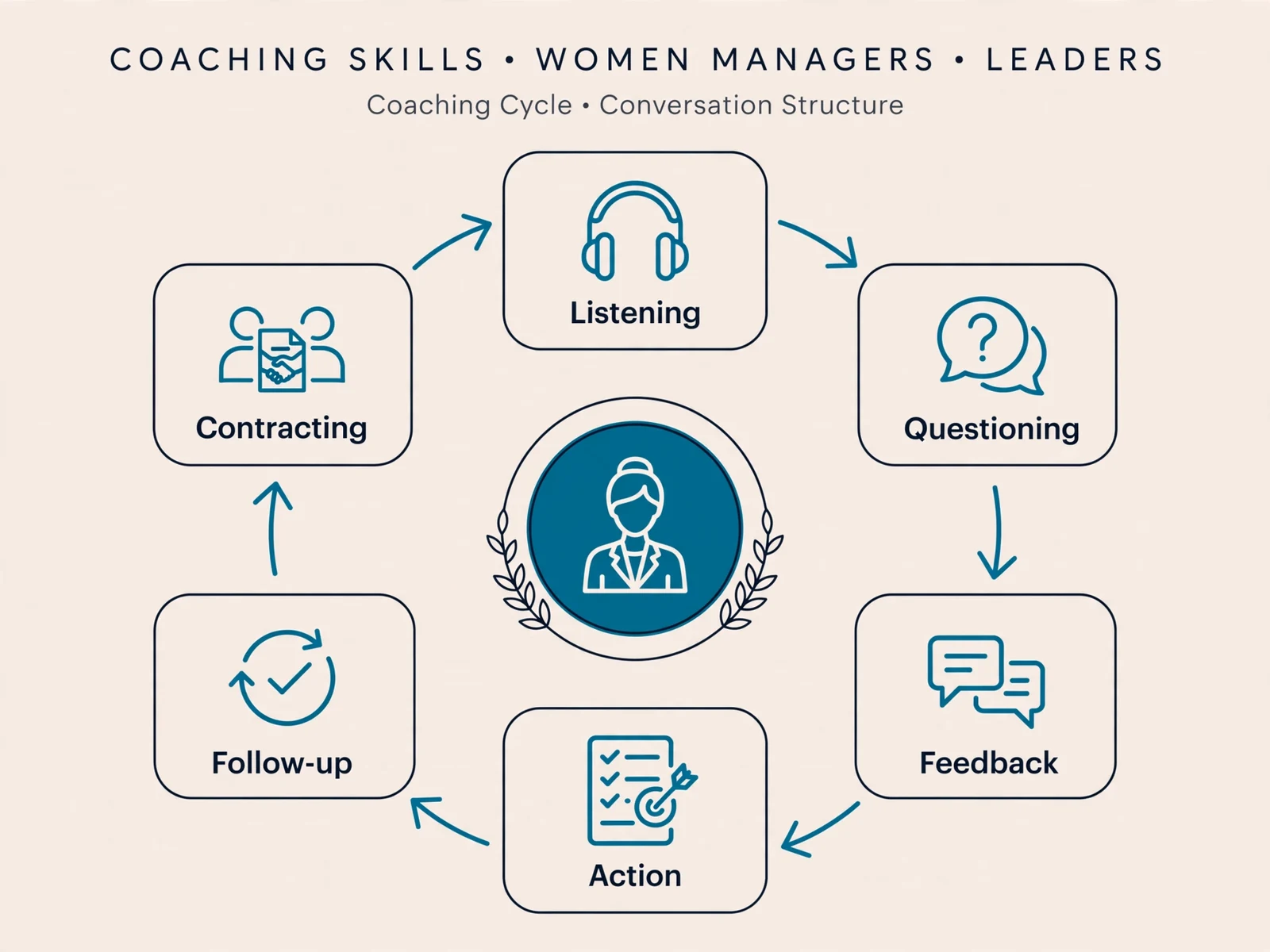
The core pathway covers The Manager as Coach, Questions That Improve Thinking, Listening and Feedback, Coaching Performance Problems, Coaching for Growth, Manager Coaching Plan. For private cohorts, examples and practice can be weighted toward the modules most relevant to the sponsor’s capability priorities without reducing the integrity of the wider program.
Manager Reinforcement and Evidence of Application
A course becomes more valuable when participants have a clear opportunity to use the learning after delivery. For employer-sponsored cohorts, TheSkillGrid can design the program so managers and sponsors know what participants are expected to practise without turning development into unnecessary administration.
- Before delivery: the participant and manager can identify one current situation where the course is likely to be useful. This gives the learning an immediate workplace anchor.
- Immediately after delivery: the participant selects one or two tools or behaviours to use first, rather than trying to apply every concept simultaneously.
- During the following work cycle: the manager can ask what was tried, what response it produced, what became clearer and what still needs adjustment.
- At sponsor level: patterns across the cohort can inform future learning priorities, manager support or pathway design without claiming that attendance alone caused a business result.
What Good Application Can Look Like
Evidence of application should be appropriate to the topic and role. Useful signs include clearer decisions, better-prepared stakeholder conversations, stronger use of a practical tool, improved escalation, more explicit trade-offs, better role clarity, or a work product that is being used in a real process. These are observable behaviours and outputs, not guaranteed performance claims.
Related Programs
Related programs in TheSkillGrid’s wider capability architecture include:
- Effective Leadership Skills for New Managers
- Performance Management and Employee Engagement
- Business Communication and Presentation Skills
- Advanced Leadership and Executive Presence
Build the Right Development Pathway
TheSkillGrid can combine this course with adjacent programs into a coherent private cohort or development pathway.
Upcoming Dates & Venues
Explore proposed 2027 dates and venues for this course. The city, trainer, venue, duration and fee are subject to confirmation. Use the proposed-date link to request availability, not a confirmed booking.
Request course availability with your preferred date, location and group size. We will confirm available public-session and private-team options before any booking or payment.
Ready to Take the Next Step?
Register your interest for a public session or request private in-house delivery for your team.