A high-performing team is not created by motivation speeches. It is created by clarity, standards, capable people, useful management routines, and a leader who knows when to intervene. This course helps women managers build the management system behind consistent team performance rather than carrying the team’s work on their own shoulders.
Course Overview
The Leading High-Performing Teams for Women Managers program is for managers who have moved beyond the basics and now need to create performance through a team. It focuses on the operating system of management: goals, roles, decision rights, delegation, one-to-ones, coaching, team meetings, performance evidence, conflict, culture, and cross-functional coordination.
The program is particularly useful for managers who are highly capable themselves but have become a bottleneck because too many decisions, tasks, or relationships still depend on them personally. Participants learn how to distribute ownership without losing accountability and how to create a team environment where standards are visible and problems surface early.
In-house cohorts can work with the organization’s performance framework, leadership behaviours, hybrid-work model, engagement priorities, and real team challenges.
Is this the right development fit?
Who Delivers This Program
Programs are delivered by subject-matter practitioners selected for relevance to the topic, audience level, and delivery context. For private and in-house cohorts, facilitator matching considers the organization’s industry, participant profile, and the situations the cohort needs to handle more effectively. A facilitator biography can be provided when a cohort is confirmed.
How We Make This Relevant to You Specifically
A short pre-course profile captures participant roles, industries, current challenges, and objectives. Facilitators use that information to calibrate examples, practice, discussion, and emphasis. For in-house programs, the sponsor’s objectives, organizational context, and existing people or leadership frameworks can also be incorporated before delivery.
What Female-Forward Means in This Program
The course focuses on strong management practice. The women-at-work cohort creates space to examine leadership load, visibility, boundaries, and authority where those factors matter to participants, without turning them into stereotypes.
What You Will Learn
By the end of this program, participants will be able to:
Define priorities, roles, decision rights, meetings, and management rhythms.
Move ownership to the team while preserving accountability.
Use questions and structured conversations instead of becoming the answer to every problem.
Use evidence, feedback, and follow-through before problems compound.
Translate standards and values into observable working behaviours.
Intervene before friction becomes entrenched.
Coordinate peers and stakeholders outside the formal team.
Build systems that make the team less dependent on the manager.
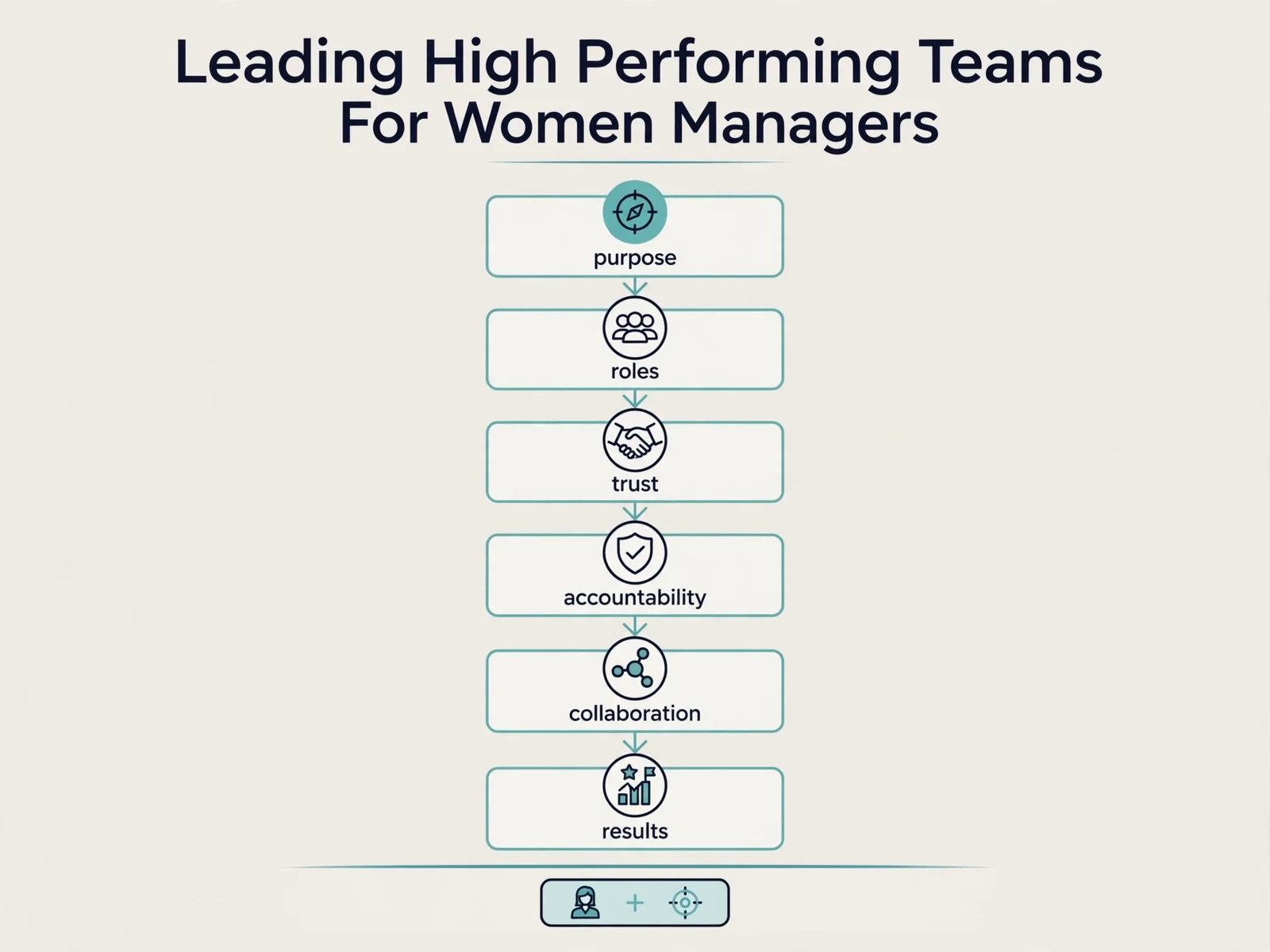
The high-performing team system
AlignSet clear outcomes, roles and decision rights.
OperateUse meetings, delegation and communication rhythms deliberately.
ImproveCoach performance, surface issues and strengthen accountability.
How the learning moves from insight to application
The sequence is adapted to the participant group and delivery context, while keeping the focus on practical application.
Set clear team outcomes
Clarify ownership and decisions
Run useful management rhythms
Coach performance and accountability
Course Outline
The program is structured across the following modules. Depth and sequencing are calibrated to the delivery format and any customization agreed during the pre-course needs assessment.
Who Should Attend
- Women managers responsible for established teams
- Managers moving from small-team supervision to broader responsibility
- Functional, project, operations, and service managers
- Women leaders managing across hybrid or cross-functional environments
- Organizations developing a stronger middle-management pipeline
Delivered in English. Arabic delivery can be discussed for private cohorts where facilitator availability and program requirements align.
Organizational Benefits
For organizations using this as a private cohort or development pathway, the program can help to:
- Create more consistent team-management systems
- Improve delegation and accountability
- Strengthen manager coaching capability
- Reduce dependence on individual heroic managers
- Improve cross-functional execution and team clarity
Private Cohorts and Customization
For in-house delivery, examples, scenarios, exercises, stakeholder situations, and action planning can be calibrated to your industry and organizational context. TheSkillGrid can also position the course within a wider women-leadership, manager-development, career-mobility, AI-literacy, or founder-capability pathway.
Turn the course into a private capability-building program
We can calibrate the examples, scenarios, emphasis and delivery structure around your participant group, organization and business priorities.
Same capability focus, different delivery context
Program depth, schedule and examples are calibrated to the cohort and delivery environment rather than forced into one universal duration.
Live ClassroomFacilitated face to face with discussion, practice, peer exchange and applied workshop time.
Live OnlineFully live and instructor-led, with interaction and practice rather than pre-recorded self-study.
Private / In-HouseAdapted to your organization, participant profile, scenarios, priorities and operational constraints.
Delivery Format
In-Person Classroom
- Public format calibrated to the scheduled cohort
- Small live cohorts
- Practice, discussion, and applied workshops
- Course materials and certificate included
Live Online
- Live instructor-led, not pre-recorded
- Interactive exercises and breakout work
- Flexible time-zone scheduling for private cohorts
- Same core learning outcomes as classroom delivery
In-House / Corporate: Delivered privately for your organization and calibrated to the participant group, industry, and development objective. Explore in-house training or discuss customization.
Pricing
The public-course fee shown below applies to the currently configured offering in Saudi Arabia and the GCC. Program length and structure may vary by cohort and delivery context; confirmed session details are shown when dates are scheduled. Public fees exclude VAT or other applicable taxes.
Individual booking
3 delegates (15% off)
6 delegates (pay for 5)
What you can take back to work
The emphasis is on usable work products, not notes alone. Exact outputs are adapted to the participant group and delivery context.
Team operating system canvas
Delegation matrix
Decision-rights map
Meeting rhythm planner
Practical Tools and Work Products
Participants do not leave with notes alone. The program is designed around practical work products that can be taken back into real roles and refined after the course.
- Team operating-system canvas
- Priority and role-clarity map
- Delegation portfolio
- One-to-one and coaching rhythm
- Team meeting redesign
- Performance and accountability cadence
- Thirty-day manager capacity reset
How This Fits Into a Wider Development Pathway
This program works particularly well as the second stage of a manager pathway: first build core management capability, then strengthen the systems that let managers create performance through an established team.
Frequently Asked Questions
Is this for first-time managers?
It can help newer managers, but it is best suited to managers who already understand the basics and now need to improve team performance at scale.
Does it cover remote and hybrid teams?
Yes, the operating-system principles apply across formats. Deeper remote-team design is covered in the Managing Remote and Hybrid Teams course.
Can we use our performance framework?
Yes. Private cohorts can work with your own goals, one-to-one process, performance cycle, and leadership expectations.
Does it include conflict management?
Yes. Team conflict, peer tension, avoidance, and manager intervention are included.
How practical is the course?
Participants build or redesign real team routines, delegation plans, meeting structures, stakeholder maps, and management rhythms.
Can this follow a first-time-manager program?
Yes. It is a natural second-stage program once managers have the fundamentals.
Related Programs
This course sits inside TheSkillGrid’s wider professional capability architecture. Related programs include:
- Effective Leadership Skills for New Managers
- Managing Remote and Hybrid Teams
- Performance Management and Employee Engagement
Build the Right Development Pathway
For a private women-at-work cohort, TheSkillGrid can combine this course with related leadership, communication, AI, HR, finance, project, or business programs into a coherent development pathway.
Upcoming Dates & Venues
Explore proposed 2027 dates and venues for this course. The city, trainer, venue, duration and fee are subject to confirmation. Use the proposed-date link to request availability, not a confirmed booking.
Request course availability with your preferred date, location and group size. We will confirm available public-session and private-team options before any booking or payment.
Ready to Take the Next Step?
Register your interest for a public session or request private in-house delivery for your team.