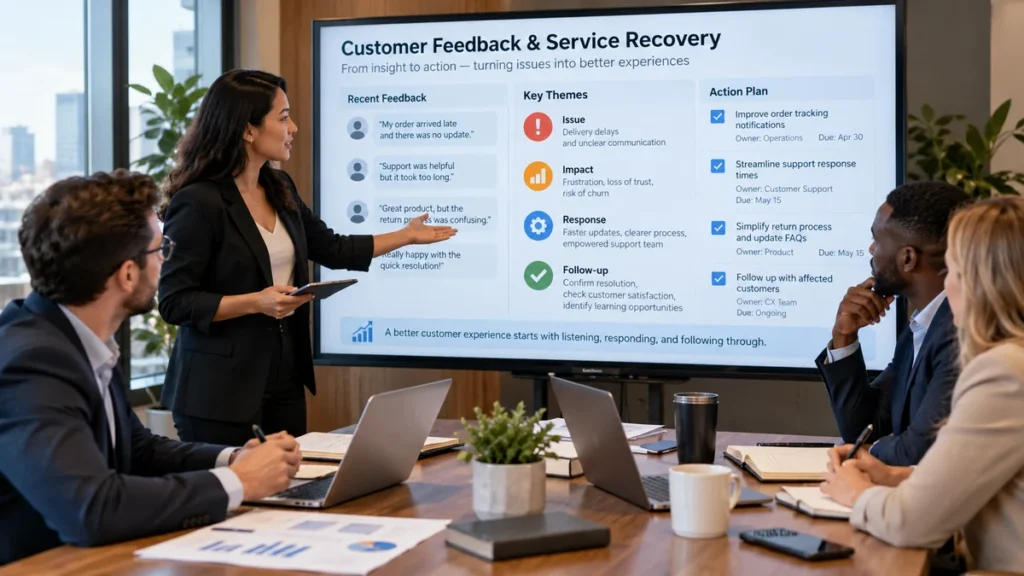
When a service failure happens, the customer needs an accountable next step—not a tour of your internal departments. A practical service recovery process acknowledges the failure, limits further harm, assigns ownership, communicates honestly, delivers an appropriate remedy and feeds the lesson back into operations. The objective is to restore a workable outcome and reduce recurrence, not merely close a complaint ticket.
This playbook is for customer-experience leaders, service managers, branch and contact-centre managers, operations teams, and people designing a consistent complaints process across locations or channels. Use it as an operational checklist and adapt remedies, escalations and retention rules to your sector and applicable requirements.
The eight-step service recovery playbook
From the customer’s problem to organizational learning
Confirm you understand the reported problem.
Identify urgency and customer consequences.
Appoint a named case owner.
Stop avoidable additional harm.
Agree the next contact and channel.
Deliver an appropriate documented remedy.
Check the remedy actually worked.
Fix and monitor the underlying weakness.
This sequence is a working aid, not a promise that every case can be resolved immediately. Safeguarding, legal, privacy and critical operational obligations may require immediate specialist escalation at any stage.
1. Acknowledge the experience before investigating blame
Start by checking that the customer and employee agree about the reported outcome: the wrong charge, missing service, delayed shipment, inaccessible account, mistaken information or unsafe experience. Reflect the problem back in clear language and ask what the customer needs immediately. An apology is appropriate when the organization has fallen short, but do not admit unverified legal facts or promise remedies outside your authority.
Useful opening: “I understand that you were charged twice and have already spent time contacting us. I am going to review the transaction, explain the options and make sure one person owns the next step.”
Avoid: “This is not our department,” “the system does that,” and generic phrases that never say what the organization will do. Customers should not have to know your reporting lines to obtain help.
2. Assess urgency based on impact, not the loudness of the complaint
Record what happened, when, the service affected, what is known, what remains uncertain, and the consequences. Consider safety, privacy, accessibility, financial loss, business interruption, repeated failures, contractual obligations and whether the customer is vulnerable. Two incidents involving the same process error can require different responses if one prevents essential service and the other is a minor inconvenience.
Use an internal triage system based on consequence and time sensitivity. Do not classify an important case as minor solely because the customer is calm, polite or unfamiliar with the company’s terminology.
3. Assign one accountable owner across internal handoffs
The case owner coordinates resolution even when another department must provide the technical fix. Record the primary owner, specialist contributors, decision authority and escalation route. Tell the customer who will contact them; the person communicating may differ from the specialist doing the work, but that difference should not become the customer’s burden.
Set a clear handoff rule: receiving teams acknowledge ownership, pass relevant context and confirm the next action before the previous owner closes their task. Avoid forcing customers to explain the full case again. Where identity verification is required, request only what is necessary through an approved channel.
4. Contain immediate harm while investigating
Early actions may include pausing an erroneous charge, restoring essential access, stopping a duplicate order, isolating a faulty product, offering a temporary route to service or escalating a potential safety issue. Containment is not the same as final resolution: an emergency workaround may be useful while the underlying defect remains.
Before promising a refund, free service or replacement, confirm authorization and applicable rules. In sectors with regulated complaints, record retention and escalation duties, follow those requirements rather than relying only on this general workflow.
5. Communicate a next step customers can rely on
Explain the current facts, unresolved questions, proposed action, owner, expected next checkpoint and preferred communication channel. Where a completion time cannot be known, promise a status update at an agreed time rather than inventing a resolution deadline. If the situation changes, inform the customer before the original update commitment is missed.
Example update: “The duplicate payment is confirmed, and finance is checking the reversal route. I will update you by tomorrow afternoon even if the bank has not completed the process. You can reach me through this reference if anything changes before then.”
For complicated cases, distinguish a status update from a decision, and distinguish a partial remedy from full resolution. A friendly tone cannot compensate for vague accountability.
6. Choose a remedy proportionate to the real consequence
Possible remedies include correcting the service, replacing a product, restoring access, waiving an inappropriate fee, arranging a refund, offering suitable alternative delivery or carrying out a formal review. The correct choice depends on the failure and relevant consumer, contract and sector obligations; do not apply a universal credit amount or compensation formula.
Service teams should have written authority limits for routine remedies and a fast route to a decision-maker for unusual cases. Empowerment without controls creates inconsistency. Controls without meaningful authority create delay and unnecessary customer effort.
7. Verify that the customer can use the remedy
A ticket marked closed is not proof the customer’s problem is fixed. Check the promised outcome: was access restored, the revised invoice issued, the new delivery received, or the alternative service usable? Ask whether another handoff or unanswered question remains. If the customer disagrees with the disposition, provide the appropriate reconsideration or escalation route rather than relabeling the case “resolved.”
8. Identify what should change in the operating system
Record the problem, its source, contributing conditions, missed controls and corrective action. Ask why the process failed and why the failure was not detected sooner. A staff reminder is rarely sufficient when the actual cause is a broken rule, unclear ownership, confusing interface or missing exception mechanism.
Use the same standard of evidence that you would apply in a root-cause analysis and corrective-action program. Assign an owner and an effectiveness check, not merely an action-completion date.
Recovery escalation matrix: who decides what?
The matrix below is an illustrative design; each organization must set its own decision thresholds, legal escalation criteria and response commitments.
| Case pattern | First response | Decision owner | Essential record |
|---|---|---|---|
| Simple fulfillment or communication error | Correct information and arrange practical next step | Authorized frontline agent | Customer impact, remedy, confirmation |
| Repeat complaint or cross-team failure | Assign owner and review history and dependencies | Service manager and process owner | Recurring pattern, handoffs, corrective action |
| Potential safety, privacy or regulatory issue | Contain, protect evidence and follow incident procedure | Relevant compliance, privacy, safety or legal specialist | Timeline, affected scope, approvals, required notifications |
| Major contractual or commercial dispute | Preserve terms, clarify interim service and responsible contacts | Authorized commercial and account leadership | Contract basis, customer impact, decision trail |
Worked example: a business customer receives duplicate invoices
Consider a fictional training provider whose corporate client is invoiced twice for one private workshop. Accounts receives the first message but asks the customer to contact sales. Sales explains that finance creates invoices, while finance asks for proof already included in the original email. The payment is not yet collected, but the client has delayed approving the contract renewal because no one can confirm the correct amount.
Weak recovery: send a generic apology, route the customer to yet another inbox and mark the initial ticket as answered. The immediate customer journey remains unresolved even if each employee technically responded.
Stronger recovery: the account owner acknowledges the duplicate, records the invoice references, asks billing to pause collection of the disputed item, requests a corrected document from finance, confirms approval ownership and provides a specific update commitment. The client receives a written correction, and the account owner checks that the reconciliation is complete before closing the case.
Prevention: the business compares the sales order, booking and invoice triggers, establishes which record is authoritative and tests whether duplicate invoice generation is blocked or flagged. The process owner later verifies a sample of similar cases. This turns an isolated fix into a better control.
The example illustrates a workflow, not a verified customer case or a numerical performance claim. In real situations, teams must confirm invoice status and applicable financial obligations before choosing a remedy.
A practical service recovery case record
A useful case log is short enough for frontline teams but complete enough for the next handoff and a later improvement review. Include:
- Case reference and intake: unique identifier, channel, date and relevant customer contact details collected appropriately.
- Problem and customer impact: the customer’s description, service affected and time sensitivity.
- Facts and unknowns: evidence reviewed, systems checked and questions still open.
- Owner and escalation: accountable individual, specialist contributors, approvals and next checkpoint.
- Containment and remedy: immediate safeguard, proposed action, actual action and confirmation.
- Communication log: what was promised, who contacted the customer and whether the update was delivered.
- Root cause and prevention: confirmed contributing conditions, corrective-action owner and effectiveness check.
- Closure evidence: how the outcome was verified and whether a dispute or additional follow-up remains.
Restrict access and retention to what is appropriate for the business, and avoid storing sensitive incident information in ordinary spreadsheets or public-facing forms without proper controls.
What managers should measure—and what each measure can miss
Use a small balanced set of measures rather than a single headline score. Time to first meaningful response shows how quickly a customer receives ownership, but an automated acknowledgement alone is not meaningful progress. Time to resolution helps identify bottlenecks, but averages can conceal serious outliers or artificially quick closure. Repeat-contact rate exposes customers who have to chase, but needs reliable case matching. Reopened cases reveal premature closure, but some legitimate follow-ups are unrelated. Customer confirmation and qualitative feedback show whether the remedy worked, but customers who do not respond should not automatically be treated as satisfied.
Combine these with recurring-cause themes, delayed approvals, cross-functional transfers and corrective-action effectiveness. Segment by channel, severity and customer journey stage before drawing conclusions. A complex safety case should not be evaluated as though it were a simple password reset.
Run a practical weekly service-recovery review
The review should be short and decision-oriented. Start with unresolved high-impact cases and broken update commitments. Then examine repeat complaints and cases bounced between teams. Select one or two systemic issues for action rather than asking every agent to try harder. Record the control change, owner, evidence of improvement and review date. In the next meeting, check whether the intervention worked before adding another project.
When senior leaders are involved, give them a decision brief: customer consequence, likely system cause, trade-offs, proposed fix, resource requirement and who is accountable. Avoid a long slide deck of activity counts without choices.
Common mistakes that make recovery worse
- Apologizing without ownership: the customer still has to coordinate the solution.
- Promising deadlines before assessing dependencies: an invented promise becomes another failure.
- Closing on agent action: the internal step is done but the customer result is not.
- Confusing friendliness with fairness: a pleasant response does not resolve actual harm.
- Overusing compensation: automatic concessions may mask defects and create inconsistent outcomes.
- Blaming an individual too early: process design, training, capacity or controls may be more important causes.
- Ignoring silent failures: customers who leave without complaining can still point to a broken journey.
- Tracking only speed: pressure to close quickly can increase repeat contact and unresolved cases.
How this fits into customer experience strategy
Complaint handling is one part of the end-to-end experience. Mapping the customer journey helps reveal where failures originate before reaching the complaints team. A service blueprint can connect customer-visible steps to internal processes and handoffs. For organizations redesigning multiple touchpoints, the Customer Experience Strategy and Journey Management course supports journey diagnosis and cross-functional ownership.
Teams needing a wider operational capability—service standards, complaint handling, leadership and continuous improvement—can explore Customer Experience and Service Excellence. Both programs can be delivered in private organizational cohorts using suitable anonymized scenarios from the client’s own service environment.
For HR, L&D and service leaders: bring one recurring complaint type, a typical customer journey and an outline of the current escalation rules when requesting in-house service recovery training. This provides a useful starting point for designing practical exercises, role authority and workplace follow-up.
The test of a recovery playbook is simple: when something goes wrong, does the customer receive a clear owner and a workable remedy—and does the organization become less likely to repeat the failure?
Develop this capability in your organization