
A programme can contain projects that each report on-time milestones while the combined business outcome remains at risk. A finance-system rollout that depends on data cleanup and workforce adoption needs decisions about shared resources, cross-project sequencing and benefits that no single project manager can make alone.
Start with the intended programme outcome and the dependencies required to achieve it. Set decision rights for project leads, the programme board, executive sponsors and benefits owners; define which issues they can resolve, which require escalation, and how decisions are recorded and followed up.
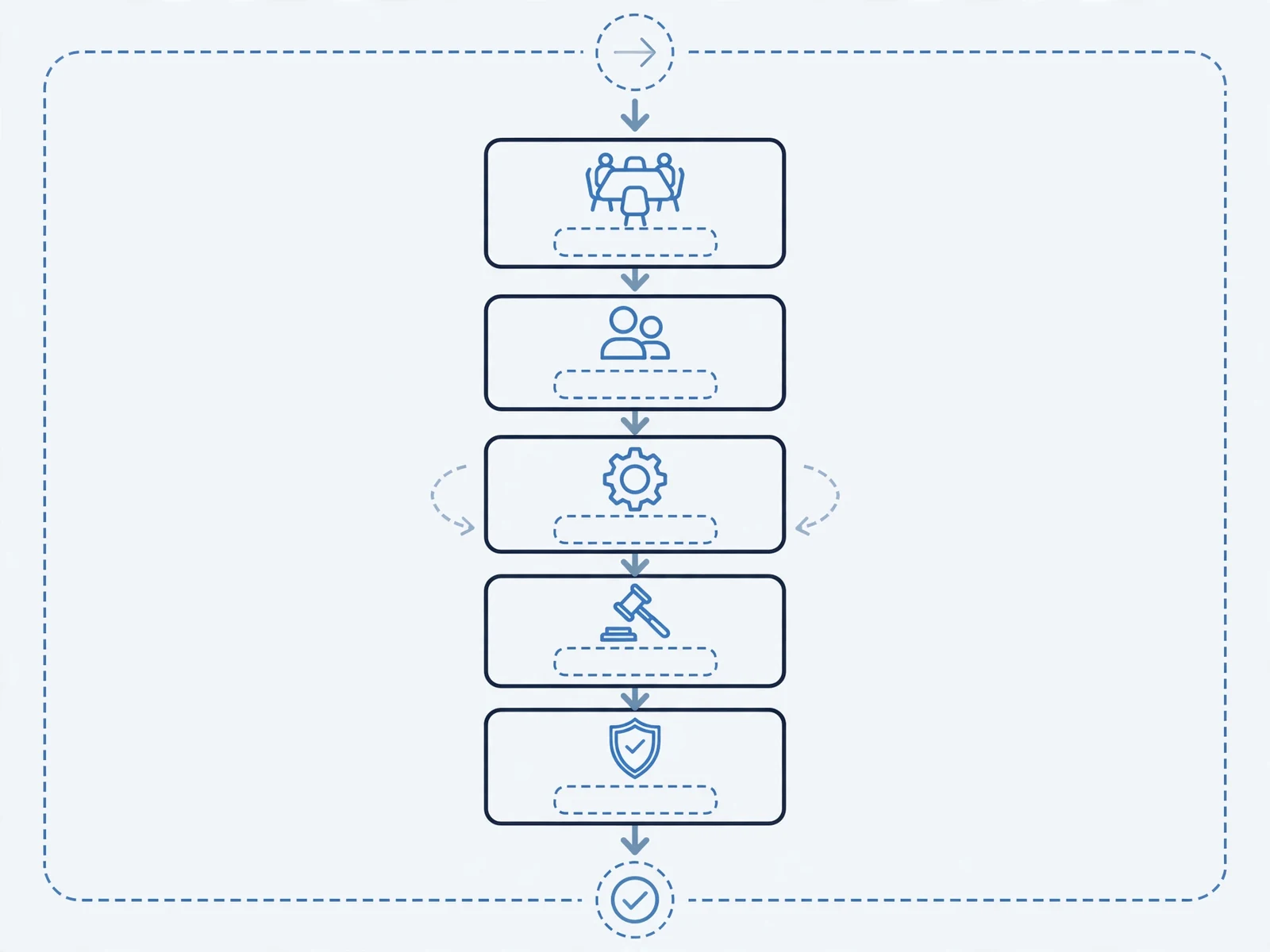
Define the Programme Outcome
Describe the business outcome that depends on several projects working together. Completing finance, data and training milestones is not enough if the intended operating benefit cannot be realized. Assign an owner for each material benefit and its baseline.
Assign Governance and Decision Rights
Separate decisions for project leads, the programme board, benefits owners and executive sponsor. The board should address programme-wide trade-offs, while the sponsor resolves issues beyond delegated authority. A PMO can organize evidence without becoming an unaccountable approver.
Map Cross-Project Dependencies
Make visible where one workstream relies on another’s data, people, approvals or deliverables. Record the dependency owner, needed date and consequence of delay. Review the few dependencies that can change programme outcomes rather than every minor task.
Track Benefits Beyond Milestones
For each expected benefit, state the operating definition, evidence source, baseline, realization owner and time to review. Do not mistake an installed system for an adopted process or a planned saving for a verified financial result.
Resolve Shared Resource Conflicts
Identify specialist capacity, funding and critical equipment or system constraints shared across workstreams. Show alternative sequencing choices, affected projects and who can authorize reallocations. Escalate conflicts while options remain available.
Make PMO Support Decision-Oriented
A useful programme office maintains decision logs, dependency maps, benefit evidence and open escalations. Each board meeting should close or assign decisions instead of repeating green/amber/red dashboards with no consequences.
Programme Governance: Minimum Decision Record
- Outcome and owner: Which benefit requires coordinated delivery and who owns realization?
- Dependency: Which project or team needs an input from another, and by when?
- Decision boundary: What can project leads decide, what belongs to the board, and what requires the sponsor?
- Shared constraint: Which resource or budget conflict requires programme-level choice?
- Options and consequence: What feasible trade-offs exist, including the cost of waiting?
- Action owner: Who implements the decision and confirms closure?
- Review and escalation: What evidence and date will trigger further board or sponsor action?
Worked Example
A programme has a finance-system project, a data-quality initiative and workforce training workstream. Each reports green status, but a shared subject-matter expert and a late data migration threaten the same go-live date. Ordinary project status meetings cannot resolve the priority conflict.
The programme board compares the available sequencing choices, asks benefits owners which outcomes depend on the contested milestone, and assigns an authorized decision maker. The PMO records dependencies and decisions, not merely dates, while the sponsor resolves issues outside the board’s authority.
Common Mistakes to Avoid
- Equating a consolidated milestone dashboard with programme-level decision making.
- Giving the PMO responsibility for decisions that belong to the sponsor or programme board.
- Tracking benefits as percentages without named owners, baselines or operational definitions.
- Allowing project teams to optimize their own delivery while shifting unresolved costs or risks to another project.
- Escalating every minor issue or, conversely, leaving cross-project conflicts unresolved until the deadline.
Questions Managers Should Ask
- Which business outcome would fail even if each project completed its tasks?
- What dependencies or shared resources put more than one workstream at risk?
- Who can approve a change to sequencing, scope, funding or benefit priorities?
- Which unresolved issue is above a project manager’s delegated authority?
- Who owns each measurable benefit after delivery, and what is the baseline?
- How will the board confirm its previous decision was implemented before accepting another status report?
Management Review Checklist
A functioning programme review shows the intended benefit, workstream dependencies, shared capacity constraints, material risks and decisions awaiting authorization. Project managers retain operational delivery decisions; the board resolves programme-wide trade-offs; the executive sponsor handles conflicts beyond the board’s mandate. Each decision records rationale, action owner and deadline.
What to Review After Three Cycles
After three governance cycles, examine decisions delayed by unclear authority, dependency issues discovered too late, benefits without owners and issues that returned repeatedly because actions were not closed. Reduce unnecessary board reporting and improve the escalation criteria instead of adding meetings.
A 30-Day Application Plan
- Week 1: Map the programme outcome, constituent projects, benefits owners and the dependencies most likely to block delivery.
- Week 2: Publish a simple decision-rights and escalation matrix covering project leads, the programme board, PMO and sponsor.
- Week 3: Run a dependency review on real resource and sequencing conflicts; document decisions and owners in one accessible log.
- Week 4: Review decision closure, benefit ownership and unresolved cross-project risks, then adjust meeting agendas and delegation rules.
Capability Maturity
Basic: programme roles and decision rights are documented. Developing: cross-project dependencies and benefits are reviewed with named owners and explicit escalation thresholds. Advanced: leaders resolve shared constraints promptly and track business outcomes beyond the completion of project deliverables.
For HR, L&D and Corporate Sponsors
For employer-sponsored development, program governance framework becomes useful when participants bring a real case from their role, apply the method between sessions and return with evidence about what changed. Cohort discussion can then focus on where program management and pmo leadership decisions require consistency and where professional judgement should remain flexible.
Sponsors can review program governance framework through the quality of the participant’s reasoning, the usefulness of the resulting work product, and whether managers see stronger ownership or decision clarity in the next cycle. That is more credible than measuring the program only through attendance or satisfaction.
Related Courses in This Capability Cluster
A worked application scenario
A program contains overlapping finance-system, data-quality and workforce projects. When one stream slips, different managers present incompatible explanations to the sponsor. Program governance defines which decisions belong to project leads, the program board and the executive sponsor; the PMO maintains a dependency log rather than only a milestone dashboard. Benefits owners identify which business outcomes require multiple projects to finish together. A monthly review focuses on cross-project trade-offs, resource constraints and decisions that no individual project can resolve alone.
Where to Go Next
The Program Management and PMO Leadership course develops this capability through live instructor-led practice, scenarios and workplace application. Organizations building a wider pathway can also review TheSkillGrid Training Bundles and Corporate Academies.
Test program governance framework on a live decision, examine what changed, and standardize only the parts that improve the next cycle.
Develop this capability in your organization