Managers do not need to become accountants, but they do need to understand how decisions affect cost, value, margin, investment, risk and business performance.
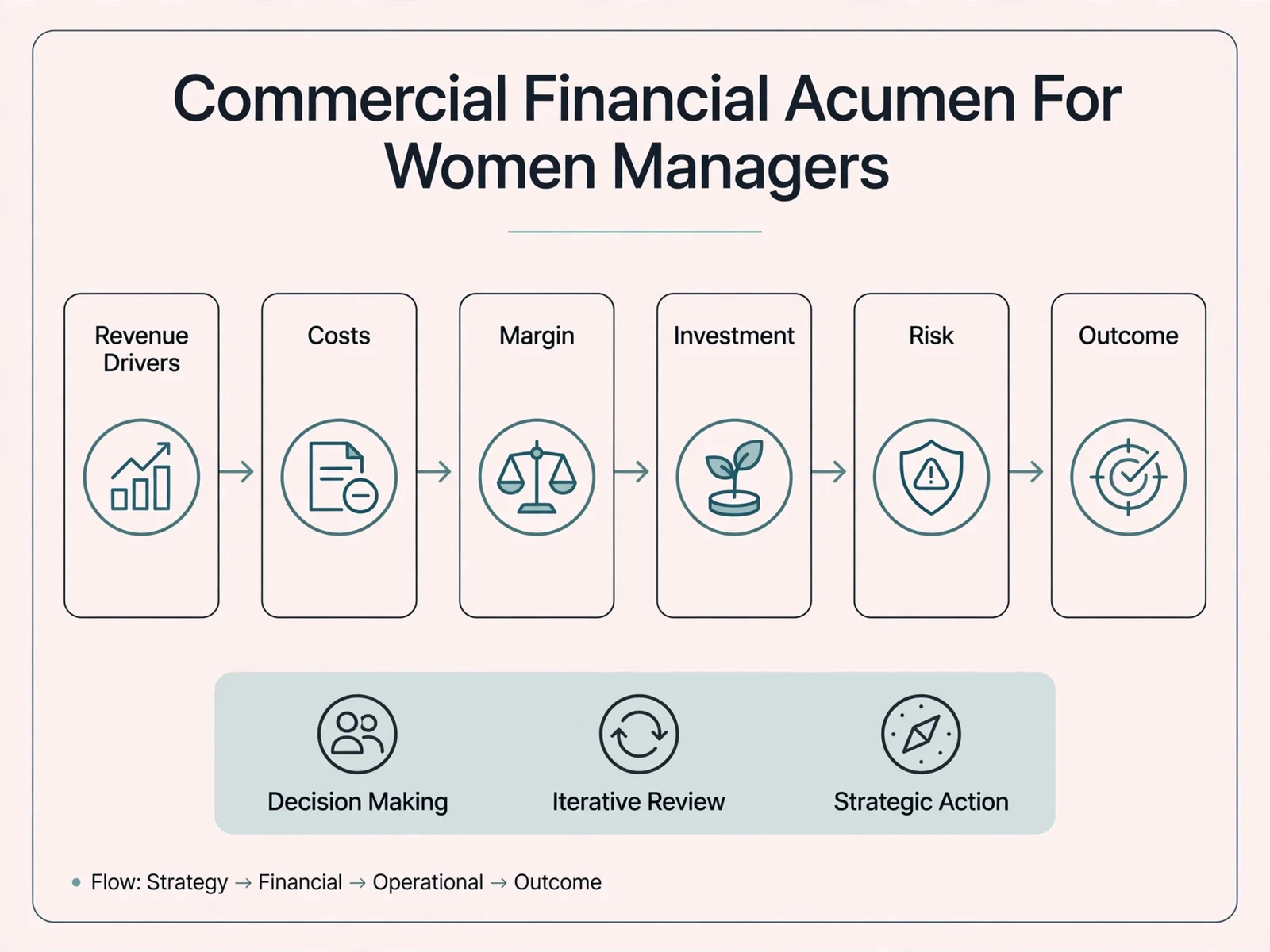
Course Overview
This program helps women managers and emerging leaders build the commercial and financial fluency required to participate confidently in business decisions. It translates finance into the practical questions managers face when planning, budgeting, evaluating options, requesting resources, or explaining business impact.
Participants work through management scenarios involving budgets, cost drivers, business cases, investment choices, pricing logic, variance, resource allocation and performance measures. The emphasis is on decision quality, not technical accounting depth.
Organizations can use the program within women-in-leadership pathways, manager development academies, succession pools, functional leadership programs, or cross-functional capability initiatives.
Where this program fits
Built for Corporate Cohorts, Not Just Individual Attendance
For private delivery, the program can be aligned to the sponsor’s capability goals, participant roles, internal frameworks, business priorities, and real workplace scenarios. HR, L&D, Talent, functional leaders, and transformation teams can use the course as a standalone intervention or as one component of a wider women-in-leadership, manager-development, succession, or functional-capability pathway.
How We Make This Relevant to Your Organization
Before a private cohort, the sponsor can define the target population, business context, capability gaps, priority scenarios, internal language, and desired work products. Examples, exercises, discussion and action planning can then be calibrated around that context without inventing outcomes or forcing a generic program structure.
What Female-Forward Means in This Program
The program removes the assumption that financial confidence should already exist before a manager enters the room. It gives participants a practical language for asking better questions, challenging assumptions and making commercially grounded recommendations.
What Participants Will Learn
Interpret core management information without getting lost in accounting detail.
Connect costs, benefits, assumptions, risks and alternatives.
Use variance and forecasts as management tools rather than reporting exercises.
Compare options based on value, risk, capacity and business consequences.
Frame recommendations in language senior decision-makers can act on.
Ask sharper questions about cost, value, demand, pricing and resource use.
From insight to workplace application
The sequence is adapted to the cohort and delivery context while keeping the emphasis on real organizational work.
Understand the economics
Question the assumptions
Compare the options
Recommend with confidence
Course Outline
The modules below provide the core pathway. The sequence, depth and examples can be adjusted for public, private, live-online or in-house delivery.
Who Should Attend
- Women managers with budget or resource responsibility
- High-potential women preparing for broader business leadership
- Functional leaders who need stronger commercial fluency
- Organizations developing non-finance managers
Organizational Benefits
For employers using this as a private cohort or capability pathway, the program is designed to help the organization:
- Increase financial confidence across management cohorts
- Improve the quality of business cases and resource discussions
- Strengthen budget ownership outside the finance function
- Support women preparing for P&L or broader leadership responsibility
- Create better cross-functional conversations between finance and operations
Participants leave with tools that can be used at work
B2B Deployment Options
A dedicated cohort aligned to one organization, function or population.
Combine with other Women at Work programs to build a structured development journey.
Use the course within a role-specific or function-specific capability academy.
Live-online or blended scheduling can support geographically distributed teams.
Delivery Format
The program is live and instructor-led. It can be delivered in a classroom, live online, or in-house. Duration is not fixed: the schedule and depth should reflect the participant level, organizational objective, chosen modules, and amount of applied practice required.
For HR, L&D and business leaders: Explore in-house training or request a customized cohort.
Business Problems This Program Is Designed to Address
This course is designed around workplace problems that organizations can observe in real roles. The aim is not to add another generic development event. It is to give participants a structured way to diagnose situations, make stronger decisions, practise difficult conversations and return to work with tools that can be used immediately.
Applied Practice and Scenario Work
The learning design uses realistic management situations rather than abstract discussion alone. For a private cohort, scenarios can be calibrated to the participant population, industry and operating context while keeping confidential organizational material appropriately protected.
Application principle: participants should leave each major topic able to explain what they would do differently in a real role, which stakeholders they would involve, what evidence they would use, and how they would know whether the action worked.
For HR, L&D and Program Sponsors
Commercial and Financial Acumen for Women Managers can be delivered as a standalone private cohort or embedded inside a broader capability pathway. Before delivery, the sponsor can define the target population, role level, business context, expected manager behaviours, priority scenarios and the work products participants should complete.
A stronger deployment does more than count attendance. Sponsors can ask participants to apply one tool to a live piece of work, discuss the result with their manager, and bring the learning into an existing talent, performance, project or functional review. This makes the intervention easier to connect to day-to-day execution without inventing a guaranteed ROI claim.
- Before the cohort: define the capability gap and participant profile.
- During delivery: use role-relevant scenarios, practice and work products.
- After delivery: reinforce application through manager conversations, peer review or sponsor follow-up.
- At pathway level: combine this program with adjacent courses where participants need a broader capability journey.
Pricing
The public-course fee below follows the current Women at Work offering structure for Saudi Arabia and the GCC. Program length and structure can vary by cohort and delivery context, and public dates are confirmed only when they appear in the current training schedule. Public fees exclude VAT or other applicable taxes.
Individual booking
3 delegates (15% off)
6 delegates (pay for 5)
How This Fits Into a Wider Development Pathway
For corporate cohorts, the tools and action plans from this program can feed into development plans, talent reviews, project reviews, functional academies or sponsor debriefs. The course can also be paired with adjacent programs so the learning journey reflects the capability the organization is actually trying to build.
Frequently Asked Questions
Can we use our own organizational scenarios?
Yes. Private cohorts can be calibrated around your operating context, role levels and common workplace situations. Sensitive information does not need to be exposed for scenarios to feel relevant.
How should managers support participants after the course?
A practical approach is to agree one or two work applications before or immediately after the program, then review what the participant tried, what changed and what further support is needed.
Can this be combined with other Women at Work courses?
Yes. It can sit inside a multi-course pathway for managers, high-potential women, functional leaders or another defined population.
Can this be delivered only for our organization?
Yes. Private and in-house cohorts can be tailored around your participant profile, business context, capability priorities and internal terminology.
Is the duration fixed?
No. The delivery schedule is adapted to the cohort, selected depth, practice requirements and organizational objective.
Can this sit inside a wider women development pathway?
Yes. The program can be combined with leadership, management, communication, AI, commercial, project or functional capability courses from the Women at Work collection.
Related Programs
This course sits inside TheSkillGrid’s wider professional capability architecture. Depending on the participant population and development objective, related programs include:
- Financial Management for Non-Finance Managers
- Budgeting, Forecasting and Cost Control
- Finance for Senior Executives
- Strategic Planning and Execution
Build the Right Development Pathway
For a private cohort, TheSkillGrid can combine this course with related leadership, communication, AI, HR, finance, project or commercial programs into a coherent pathway.
Upcoming Dates & Venues
Explore proposed 2027 dates and venues for this course. The city, trainer, venue, duration and fee are subject to confirmation. Use the proposed-date link to request availability, not a confirmed booking.
Request course availability with your preferred date, location and group size. We will confirm available public-session and private-team options before any booking or payment.
Ready to Take the Next Step?
Register your interest for a public session or request private in-house delivery for your team.