Build an integrated delivery pathway from core project management through business analysis, program leadership and risk.
Who This Academy Is For
Project managers, PMO teams, business analysts, transformation professionals and functional managers leading complex change.
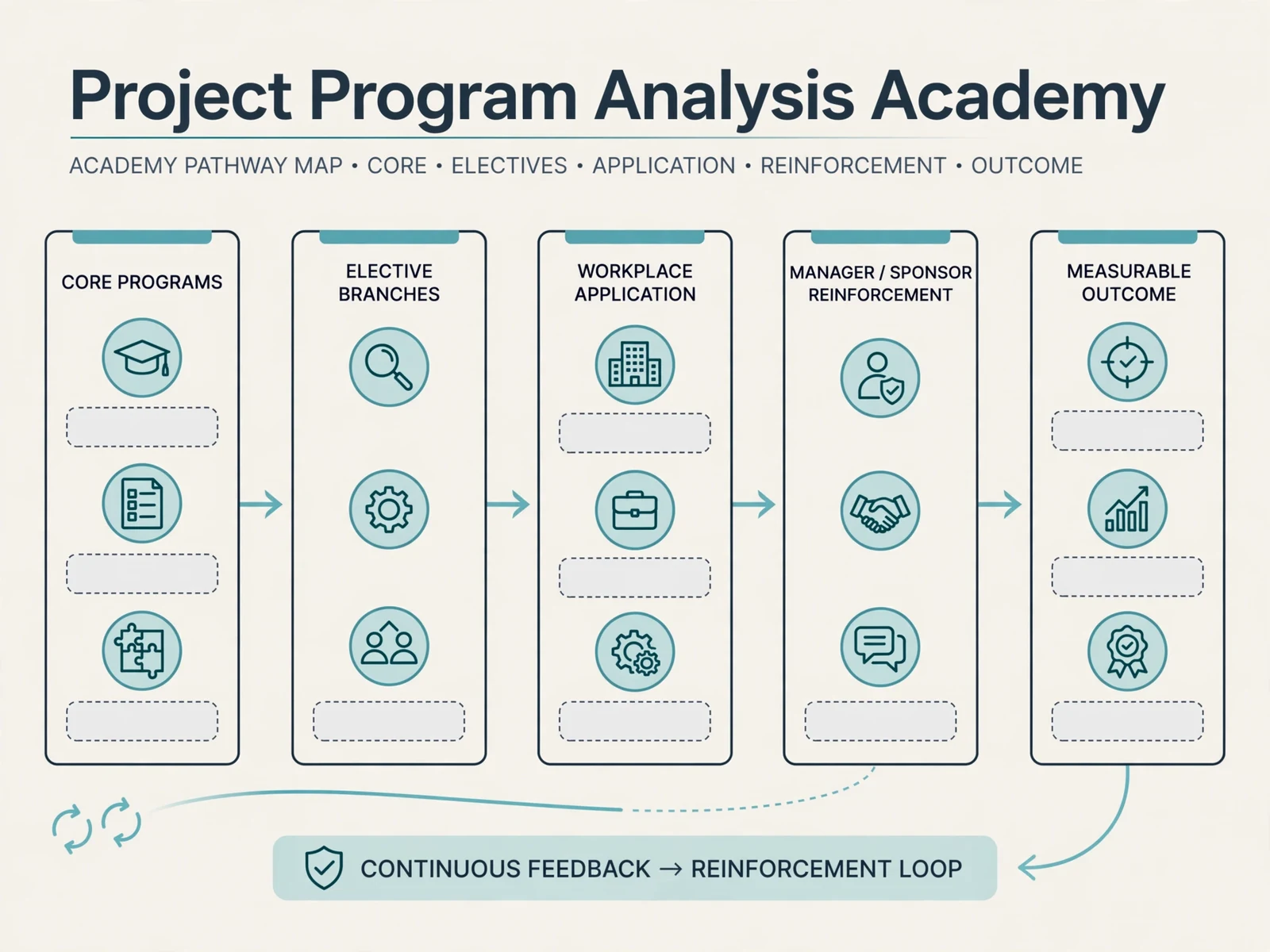
Built as a Corporate Capability Pathway
The academy is configurable. Programs can be sequenced around role level and business need, with a common core for the cohort and selected electives where participant responsibilities differ. Delivery remains live and instructor-led, with flexible timing rather than a fixed-duration package.
Programs in the Pathway
Project Management Fundamentals
Build project initiation, planning, stakeholder, execution and control foundations.
Business Analysis and Requirements Management
Improve problem definition, process analysis, requirements and solution choices.
Program Management and PMO Leadership
Lead related initiatives through governance, benefits, dependencies and resource trade-offs.
Risk Management in Projects
Strengthen project and program risk identification, ownership and response.
Change Management and Organizational Transformation
Connect delivery to stakeholder adoption and operating change.
Organizational Outcomes
- Create stronger project-to-program progression
- Improve requirements and scope quality
- Build more capable PMO and transformation teams
- Connect delivery to adoption and benefits
- Strengthen decision-making across complex initiatives
Business Problems This Academy Can Address
A Live Work Application Thread
Participants can use a live transformation or major project as the application thread, moving from problem framing and requirements through project control, program governance, risk and adoption.
This application thread means later programs build on earlier work rather than treating each course as a fresh start. It also gives managers and sponsors a practical way to reinforce capability between modules without creating an overly academic assessment system.
How to Structure the Cohort
The cohort should be defined by the work participants are expected to perform, not only by grade or job title. A strong design conversation looks at current responsibility, next-level responsibility, recurring decisions, stakeholder complexity and the practical outputs participants should be able to produce more consistently.
Shared programs for the whole population.
Role-specific depth where responsibilities differ.
Live work used between programs.
Manager and sponsor follow-up around observed application.
Between-Program Application
Programs can be spaced so participants have time to use relevant tools before the next module. A participant might apply a decision framework, stakeholder map, risk assessment, account plan, process map or governance tool and return with evidence about what worked and what needs adjustment.
The sequence should remain flexible. A more experienced cohort may skip a foundation program, while a developing population may benefit from a longer application cycle between modules. The academy should be only as broad as the capability goal requires.
What Sponsors Can Measure
Useful evidence includes application of course tools, clearer decision quality, stronger stakeholder preparation, manager observations and work products being used in normal business processes. TheSkillGrid does not treat attendance as automatic proof of ROI. Evaluation should match the business context and the decisions the sponsor needs to make about future development.
- Use of practical tools on live work.
- Clarity of decisions, recommendations and escalation.
- Manager observation of target behaviors.
- Quality and reuse of work products.
- Readiness for broader responsibility where the academy supports talent progression.
Capability Progression Across the Academy
The value of a multi-course academy comes from progression, not simply volume. Early programs establish the common concepts and operating language the cohort needs. Later programs can then add complexity, broader stakeholder responsibility and more difficult decisions. The academy should therefore be sequenced around the maturity of the participant population rather than around the order in which courses happen to appear in the catalogue.
For a developing population, the pathway may begin with foundational management or technical judgement and gradually increase the scope of work participants are asked to handle. For a more experienced cohort, the sponsor may begin with an advanced module and use selected earlier programs only for participants who need reinforcement. This keeps development relevant and avoids unnecessary repetition.
Sponsor Decisions Before Launch
Before the academy begins, the sponsor should decide what population is being developed and why. A useful starting point is to identify the roles participants hold today, the responsibilities they are expected to take on next, and the recurring business situations where current capability is not yet strong enough. Those decisions determine which programs belong in the pathway and which should remain optional.
- Define the participant population and expected progression.
- Identify two or three recurring decisions, conversations or work products that need to improve.
- Separate shared capability needs from role-specific needs.
- Choose which programs are core and which are electives.
- Decide how managers will reinforce application between modules.
- Agree what evidence will be sufficient to review whether the pathway should continue, expand or change.
How to Avoid an Overbuilt Academy
A larger academy is not automatically a better academy. Adding every adjacent course can dilute the capability goal and create unnecessary time away from work. The pathway should contain only the programs that materially contribute to the target role or business outcome. Where several participant groups need different depth, electives are usually better than extending the core for everyone.
The academy can also evolve. A first cohort may reveal that one capability needs more practice while another is already strong. Later cohorts can be adjusted using that evidence rather than treating the original pathway design as permanent. This makes the academy a managed capability system rather than a fixed training package.
Manager and Sponsor Reinforcement
Participants are more likely to apply development when their managers know what the program is trying to change. Managers do not need to reteach the course. They can reinforce the pathway by asking participants where a tool was used, what evidence informed a decision, which stakeholder response changed, and what the participant would do differently next time.
Sponsors can review patterns across the cohort rather than judging isolated anecdotes. If several participants struggle with the same interface, decision or capability, that may signal a need for an elective, a manager intervention, a process change or a different sequence in the next academy cycle.
Private Delivery and Investment
This academy is quoted as a private organizational pathway. Pricing depends on the selected programs, cohort size, delivery model, locations and level of customization. Programs can be delivered in-house, live online, in the classroom or through an appropriate combination. VAT and location-specific expenses are excluded unless explicitly stated.
Frequently Asked Questions
Do we need every course?
No. The pathway is configurable and can use a core plus electives.
Is the academy a fixed duration?
No. Sequence, spacing and depth are designed around the cohort and capability objective.
Can we use organizational scenarios?
Yes. Private delivery can use relevant terminology, scenarios and frameworks while protecting confidential information.
Can the pathway sit inside a talent or functional academy?
Yes. It can be integrated into existing development, succession or capability programs.
Can participants apply the learning between modules?
Yes. That is a core design feature of the academy approach.
Design the Right Cohort
Contact TheSkillGrid with the participant population, approximate cohort size and capability priorities to shape the pathway.
View all Training Bundles and Corporate Academies.
Request a Proposal for This Pathway
Tell us about your team, delivery preferences and development goals. We will discuss a tailored proposal; this is not a booking or a confirmed fee.