Not every difficult assignment is a development opportunity. Some are simply more work.
A genuine stretch assignment increases capability, scope, judgement, visibility, or career capital. Extra work may consume significant effort without changing what you can do or how the organization sees your readiness.
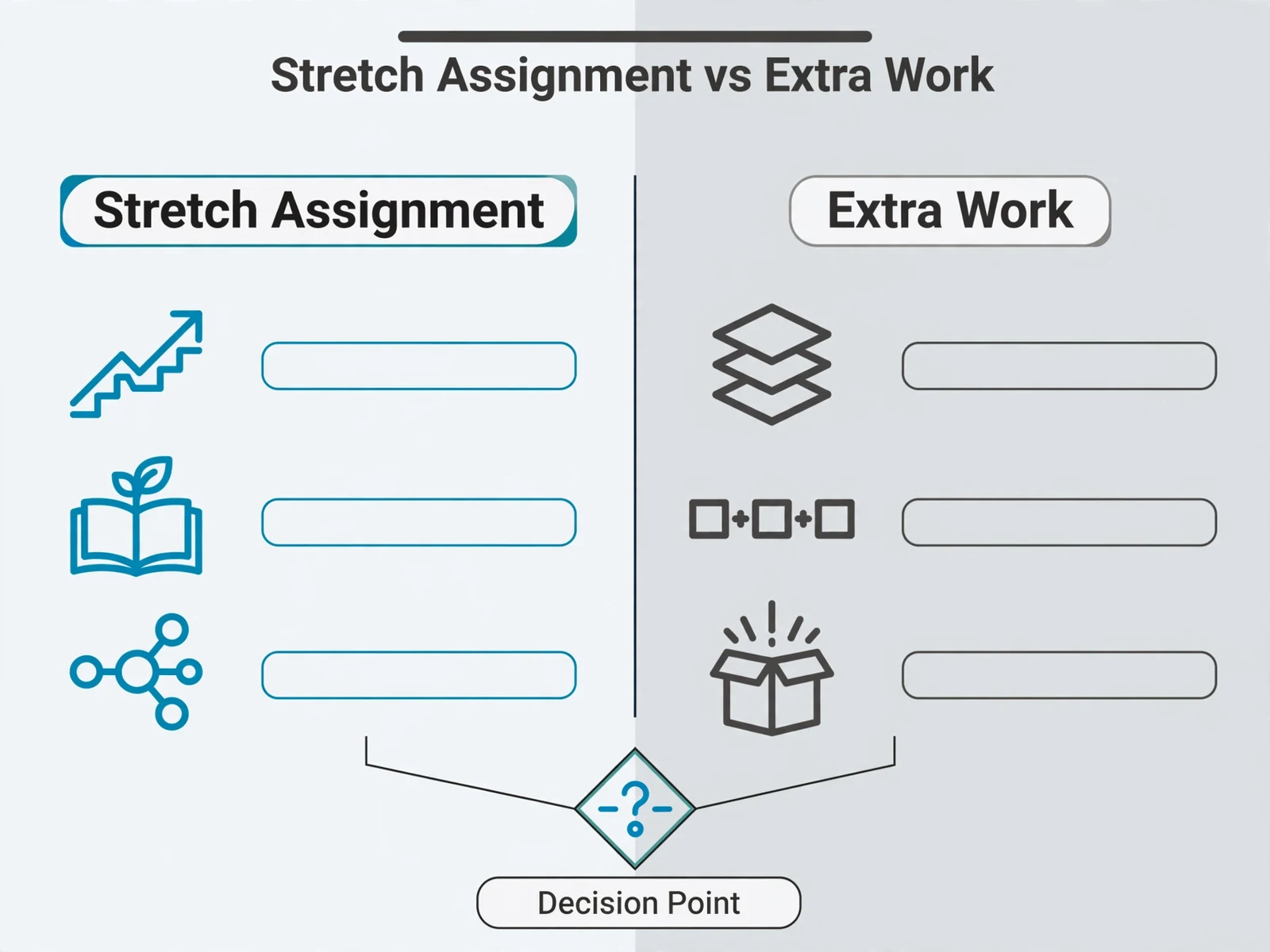
Start With the Capability Question
Ask:
“What will I be able to do after this assignment that I cannot demonstrate today?”
A stretch assignment should build something meaningful such as:
- cross-functional leadership;
- budget responsibility;
- client ownership;
- strategic decision-making;
- team leadership;
- executive communication;
- commercial judgement;
- change leadership.
Look at Scope, Not Only Difficulty
A task can be difficult because there is too much of it, the deadline is unrealistic, or the process is broken. That does not automatically make it developmental.
Stretch usually involves a different level or type of responsibility.
Check Whether Decision Rights Increase
Development accelerates when you own meaningful decisions rather than simply execute more activity.
Ask:
- What can I decide?
- What judgement am I expected to exercise?
- What still requires approval?
- Who is accountable for the outcome?
Check Who Will See the Work
Visibility should not be the only reason to take an assignment, but it matters if the work is intended to build readiness for greater scope.
Will the work expose you to:
- senior stakeholders;
- another function;
- customers;
- new markets;
- enterprise-level problems?
Check the Learning Support
Stretch should not mean abandonment.
Useful support may include:
- a clear sponsor;
- decision access;
- feedback;
- coaching;
- subject-matter support;
- permission to learn.
Check What Comes Off Your Plate
If a stretch assignment is added on top of a full workload with no reprioritization, it can become a burnout assignment.
Ask what will move, stop, or be delegated.
Check Whether Success Is Defined
You should know:
- what outcome is expected;
- what success looks like;
- what authority you have;
- what deadline applies;
- who will evaluate the result.
Use a Five-Part Test
Score the opportunity on:
- Capability: will it build something new?
- Scope: does responsibility increase?
- Visibility: will relevant people see the contribution?
- Support: is there sponsorship or access?
- Capacity: can you do it without simply carrying two jobs?
Red Flags That It Is Mostly Extra Work
- You are given responsibility but no authority.
- The work is invisible and administrative.
- The assignment repeats capability you already have.
- No one can explain how success will be evaluated.
- Your existing workload remains unchanged.
- The work is urgent because someone else failed to plan.
- You are repeatedly asked because you are reliable, not because the work develops you.
Questions to Ask Before Saying Yes
- What capability is this expected to build?
- Who sponsors the work?
- What decisions will I own?
- What will I stop doing?
- How will success be assessed?
- What exposure or stakeholder responsibility is included?
- What support will be available?
When Extra Work Can Still Be Worth It
Not every useful contribution needs to be a career accelerator. Sometimes the team genuinely needs help, and you may choose to contribute.
The point is to know what you are choosing.
Do not repeatedly label overload as development.
For Women Professionals
Women-focused career development can create useful space to examine whether reliable performers are receiving developmental scope or simply accumulating invisible work. The answer should still be evidence-based and specific to the situation rather than built on assumptions about gender.
Compare the Assignment With Your Current Role
A useful stretch assignment should change at least one dimension of your work:
- scope;
- complexity;
- stakeholder level;
- decision authority;
- commercial responsibility;
- leadership responsibility;
- visibility.
If every dimension is identical and only the volume is higher, the assignment is probably extra work rather than meaningful stretch.
Ask What Evidence You Will Be Able to Show
Career capital becomes stronger when an assignment leaves behind evidence.
Examples include:
- a decision you owned;
- a cross-functional outcome;
- a client or market you led;
- a process you redesigned;
- a team you developed;
- a recommendation accepted by senior stakeholders.
This matters because future promotion or role decisions need more than the memory that you worked hard.
Use a Stretch Assignment Scorecard
- New capability: 1-5
- New scope: 1-5
- Decision authority: 1-5
- Relevant visibility: 1-5
- Sponsor access: 1-5
- Capacity realism: 1-5
The score is not scientific. It forces a more disciplined conversation about whether the opportunity actually develops you.
Negotiate the Conditions of the Assignment
You can accept the opportunity and still negotiate how it works.
Ask for:
- clear scope;
- a named sponsor;
- decision authority;
- removal of lower-value work;
- feedback checkpoints;
- access to the right stakeholders.
This is especially important when the assignment is being added because you are known as reliable. Reliability should create opportunity, not permanent overload.
Review the Assignment Halfway Through
Ask whether the promised scope, visibility and learning are actually happening. If the assignment has turned into invisible execution work, reset expectations while there is still time to recover the development value.
Example: A Good Stretch Assignment
A finance manager is asked to lead a cross-functional cost-reduction program across three departments. The work adds complexity, but it also creates broader stakeholder exposure, decision responsibility, executive visibility and evidence of enterprise leadership.
That is materially different from being asked to prepare three extra monthly reports because the team is short-staffed.
Use a Decision Rule Before Accepting
Say yes when the assignment meaningfully improves capability or scope and the conditions are workable. Negotiate when the opportunity is strong but capacity, authority or support is weak. Decline or redesign when the work is mainly extra volume with little development value.
Where to Go Next
The Strategic Career Advancement for Women Professionals program covers stretch assignments, career capital, promotion readiness, sponsorship, visibility and role-transition decisions. The Women in Leadership course develops broader strategic scope and organizational influence.
A stretch assignment should expand what you can credibly own next, not simply prove that you can survive more work.
Develop this capability in your organization