A stakeholder list tells you who exists. A stakeholder map tells you how the project should work with them.
Complex projects fail when stakeholder management is reduced to communication frequency instead of understanding power, interests, decisions and dependencies.
Step 1: Identify Stakeholders
Include people or groups who:
- approve;
- fund;
- use;
- deliver;
- regulate;
- supply;
- are affected;
- can block progress.
Step 2: Map Influence
Ask how much power the stakeholder has over:
- budget;
- scope;
- resources;
- approval;
- adoption;
- reputation.
Step 3: Map Interest
High influence does not always mean high day-to-day interest.
Understand how closely the stakeholder is likely to follow the project.
Step 4: Identify Their Real Concern
Do not assume resistance means someone is “negative.”
Concerns may include:
- workload;
- risk;
- cost;
- loss of control;
- customer impact;
- timing;
- career or team consequences.
Step 5: Define the Decision You Need From Them
Stakeholder engagement improves when the project knows why the relationship matters.
Examples:
- funding approval;
- technical input;
- resource release;
- policy decision;
- adoption leadership;
- supplier commitment.
Step 6: Choose the Engagement Approach
Options include:
- inform;
- consult;
- involve;
- co-design;
- seek approval;
- manage closely.
Step 7: Assign Relationship Ownership
Not every stakeholder relationship belongs to the project manager.
A sponsor may need to engage an executive peer. A technical lead may own a regulator relationship. A business lead may own key users.
A Practical Stakeholder Map
- Stakeholder:
- Role:
- Influence:
- Interest:
- Primary concern:
- Decision/input needed:
- Engagement approach:
- Relationship owner:
- Next action:
Update the Map
Stakeholder positions change.
Review after:
- major decisions;
- scope change;
- leadership change;
- project delay;
- new risk;
- resistance.
Go Beyond the Power-Interest Grid
A basic power-interest grid is useful, but complex projects need more detail.
Two stakeholders with the same influence and interest may require completely different approaches because one controls funding and the other controls adoption.
Add the type of influence:
- formal authority;
- technical expertise;
- resource control;
- social influence;
- customer access;
- regulatory authority.
Map Current and Desired Position
For important stakeholders, record:
- current position;
- desired position;
- evidence for your assessment;
- what would move the relationship.
A stakeholder does not need to become an enthusiastic supporter. Sometimes the realistic goal is moving from active resistance to workable neutrality.
Map Dependencies
Ask what the project needs from the stakeholder and what the stakeholder needs from the project.
This reveals where engagement should be reciprocal rather than one-way communication.
Use a Stakeholder Conversation Plan
Before a high-value conversation, define:
- objective;
- message;
- evidence;
- likely concern;
- question to ask;
- decision or action required.
Watch for Hidden Stakeholders
Projects often miss:
- informal influencers;
- frontline users;
- support teams;
- unions or employee representatives where relevant;
- customers affected indirectly;
- teams inheriting the process after implementation.
Do Not Confuse Communication Frequency With Engagement Quality
A stakeholder can receive ten updates and still feel ignored if none address their actual concern.
Measure engagement by decisions, alignment, support, feedback quality and reduced uncertainty.
Example Stakeholder Entry
- Stakeholder: Regional Operations Director
- Influence: high
- Concern: implementation capacity
- Needed: release of local managers for pilot
- Approach: involve in pilot design
- Owner: project sponsor
- Next action: agree capacity plan before steering committee
Segment Stakeholders by Engagement Need
A practical map can group stakeholders into:
- Manage closely: high influence and material involvement.
- Keep aligned: important decision-makers who do not need daily detail.
- Involve: people whose knowledge or adoption is essential.
- Inform: people affected but not responsible for decisions.
Use this as a starting point, not a rigid formula.
Map Stakeholder Risk
For each critical stakeholder, ask what happens if the relationship fails.
Risks may include delayed approval, resource loss, resistance, customer impact, rework, regulatory concern or reputational damage.
Plan the Sequence of Engagement
Order matters. A project may need technical validation before executive approval, or sponsor alignment before communicating to users.
Map which conversations should happen first and what each one should produce.
Use Stakeholder Evidence, Not Guesswork
Do not label someone resistant because they asked hard questions. Record evidence of their position and update the map as new information appears.
Review at Each Major Project Gate
Revisit the map when the project moves from design to build, pilot to rollout, or implementation to handover. Different stakeholders become more or less important at each stage.
Stakeholder Map Workshop Questions
- Who can approve or stop the work?
- Who knows something we do not?
- Who must change behaviour?
- Who owns a critical dependency?
- Who is affected but underrepresented?
- Who should own each relationship?
Use the Map to Prepare the Sponsor
The project sponsor should not discover stakeholder resistance for the first time in a steering meeting. Use the map to brief the sponsor on where executive engagement is needed, what decision is blocked, and which relationship they should own personally.
Connect the Map to the Communication Plan
Stakeholder mapping and communication planning should not be separate exercises. The map tells you who matters, why they matter, and what they need. The communication plan turns that into timing, channel, message and ownership.
Do Not Over-Communicate Everyone
Sending every update to every stakeholder creates noise. Tailor communication to the decision, concern and level of involvement.
Use the Map to Detect Adoption Risk
For projects that change behaviour, identify people with strong informal influence over users. They may not have formal authority but can significantly affect whether the new process is accepted.
Stakeholder Review Cadence
For high-change projects, review critical stakeholders at least at major decision gates. Update position, concern, owner and next action based on evidence rather than old assumptions.
A stakeholder map that separates formal power from actual influence
Formal role, informal influence and personal interest are different variables. A project sponsor may approve funding without following every operational decision. A respected frontline supervisor may have little signing authority but strongly influence whether a new process is used. A regulator may have little interest in the project’s business case but absolute authority over particular compliance conditions. Mapping only job titles or drawing everyone into a power-interest box can miss those differences.
Begin by listing the decisions each stakeholder can make or block. Record who influences the decision-maker, who must implement the result, who bears disruption and who might be overlooked. Use interviews, decisions from previous projects and real interactions as evidence. Avoid treating a subjective assessment of someone as a fixed personality trait; stakeholder priorities shift when circumstances change.
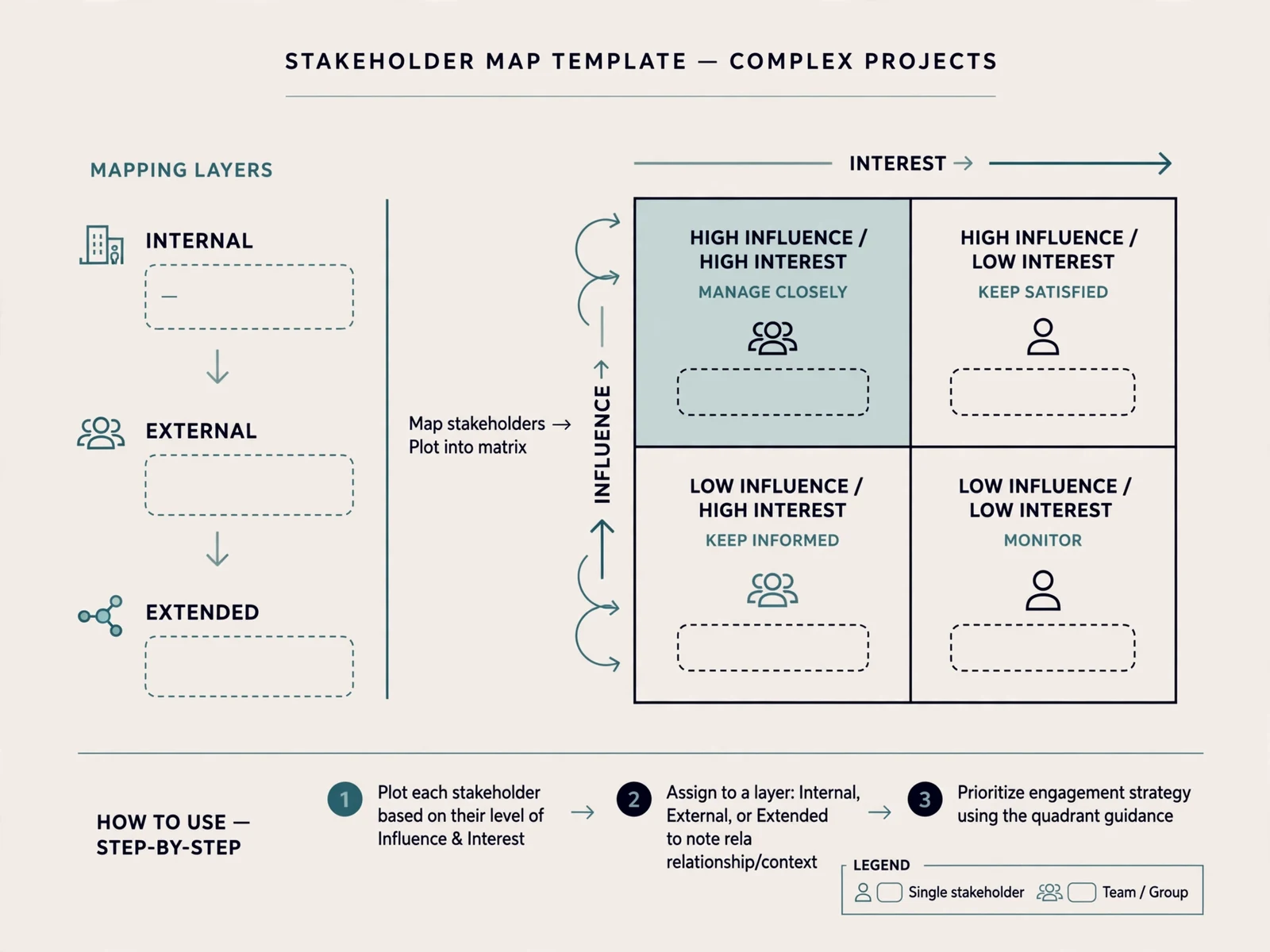
Infographic: choose engagement by power and interest
Engage in decisions, resolve concerns early and secure explicit commitments.
Example: accountable executive sponsor.
Focus on decisions and exception thresholds; avoid unnecessary status detail.
Example: an approving board member.
Co-design practical changes, listen to lived experience and surface adoption risk.
Example: affected operations team.
Make relevant information accessible and monitor changes in impact.
Example: an adjacent unaffected unit.
Use as an initial discussion aid, not a label that overrides legal consultation, ethical obligations or affected people’s rights.
Work a real dependency chain, not merely a contact list
Consider a project introducing a single customer-service process across several regional branches. The program director sponsors the change; operations managers control staffing and local workflows; IT controls system access; a privacy specialist interprets data requirements; employees will use the process; customers experience the result. A simple list with names and communication frequencies would tell the project manager very little about why implementation could stall.
The map becomes useful when it shows that the IT team cannot approve a new data field until the privacy review is complete, that the operations leads must agree an exception route before training starts and that the customer-facing team can reveal usability problems before the pilot. These are dependencies between decisions, not interpersonal niceties. Sequence conversations accordingly: clarify requirements, secure the necessary control decisions, test with users, then ask the sponsor to authorize scale-up.
If the sponsor wants to announce a launch before these decisions are made, the project manager can use the map to explain which unresolved approvals affect the date and which stakeholder is accountable. The map should expose a blocked decision rather than just reporting that the relationship is ‘amber’.
Use a decision-oriented stakeholder register
One practical register row includes the stakeholder or group, why they matter, which decision or work product they influence, their current concern, evidence of their present position, the desired commitment, the relationship owner, the next conversation and the date for review. When support is uncertain, describe it as uncertain; avoid turning an untested inference into a resistance score.
| Stakeholder | Decision or concern | Evidence to seek | Next engagement |
|---|---|---|---|
| Operations lead | Shift impact and handoff ownership | Current exceptions and capacity | Agree pilot cover and escalation |
| Privacy specialist | Permitted information and access | Actual data flow and controls | Review workflow before configuration |
| Frontline users | Adoption and exception handling | Observed workarounds and test cases | Run a practical pilot walkthrough |
Hold better conversations with skeptical stakeholders
Do not open with “How can we get you to support the project?” Instead ask what outcome the person is accountable for, which risks they see, what information is missing and which conditions would make participation responsible. A stakeholder’s objection may be a genuine signal that a design assumption is wrong. Someone worried about an unworkable workload is not necessarily resisting change; they may know where the process will break first.
Invite stakeholders to describe one recent case that illustrates their concern. Clarify what they can decide independently and what requires a different authority. If agreement is not possible, record the disagreement, consequences and next decision-maker. Do not substitute repeated newsletters for a conversation about a contested operating decision.
How the map should change at project stage gates
At initiation, check funding authority, problem ownership and impacted groups. Before solution design, confirm access to users, suppliers and subject specialists. Before approval, identify who must sign off controls, budget and policy. Before rollout, check regional managers, trainers, support teams and affected customers. After launch, move from gaining approval to monitoring adoption, exceptions and real outcomes. The map must evolve with the work.
For complex projects, ask the sponsor to review the high-consequence dependencies at each major decision gate. Keep ordinary updates concise; raise a material change promptly. A useful trigger might be a new regulatory interpretation, a sponsor change, a revised staffing plan or evidence that the people expected to adopt the solution cannot use it as designed.
Workshop exercise: build the map in 40 minutes
First, put the required project decision in the center of a shared board. Ask participants to identify people who approve, deliver, regulate, pay for or experience it. Next, map which decisions depend on another team and mark missing information. Then choose the five relationships most likely to affect the next project gate, name a credible relationship owner and draft one evidence-seeking question for each. Finish by scheduling those conversations and agreeing when the map will be revisited.
Do not use the workshop to vote on who is “difficult.” It should uncover whose perspective is missing and where the project needs a better decision or a more realistic design. If the map does not change a meeting, handoff, design choice or governance decision, it is probably too decorative to be useful.
Where to Go Next
The Project Management Fundamentals course covers stakeholders, scope, planning, governance, risk and delivery. Projects with complex uncertainty can add Risk Management in Projects.
A stakeholder map is valuable when it changes who talks to whom, about what, before which decision.
Develop this capability in your organization