
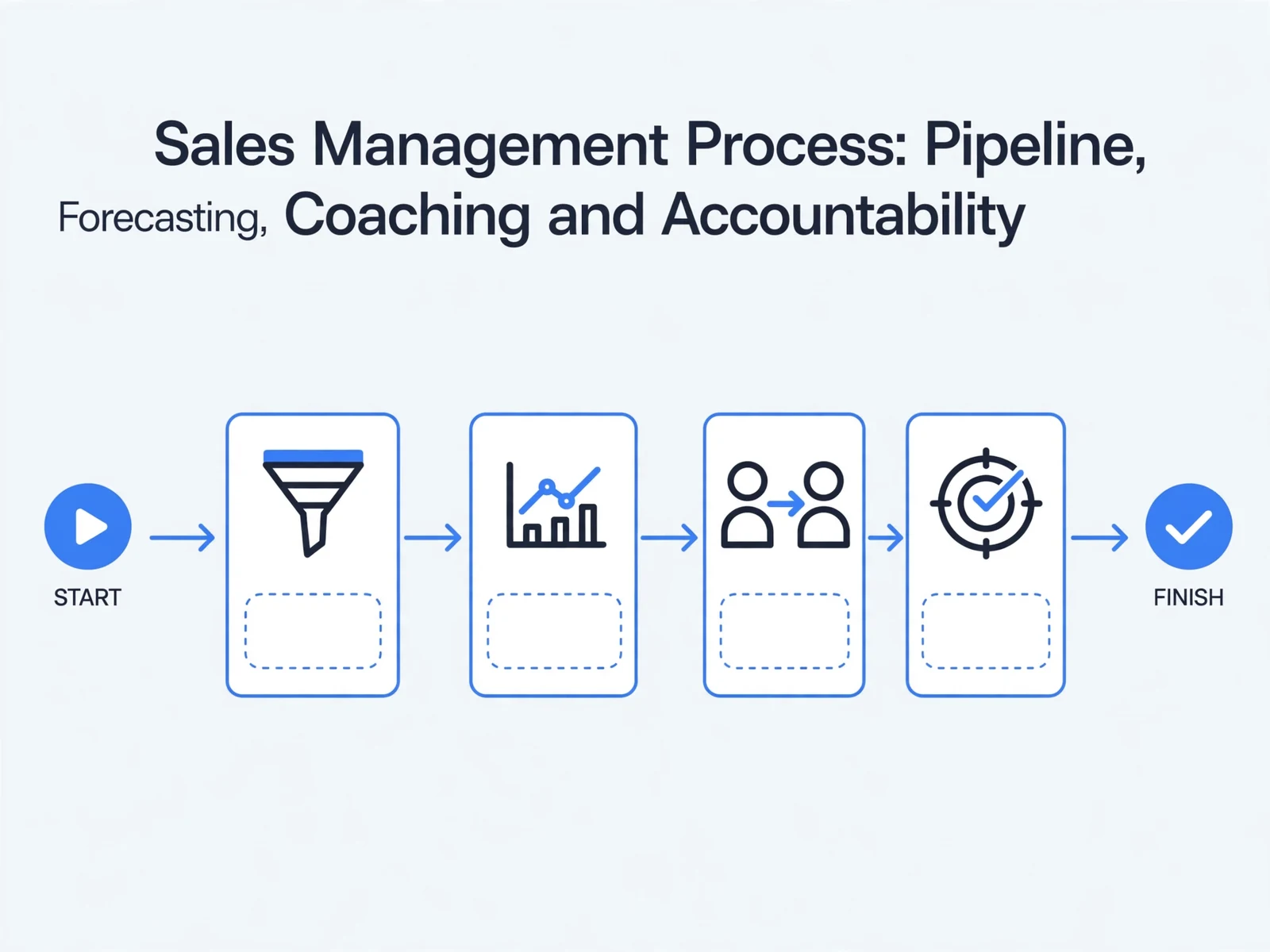
A sales manager does not improve performance by asking for more activity at the end of the month. Strong sales management creates a repeatable operating rhythm around pipeline quality, forecasting, coaching, account decisions and accountability.
Start With the Sales System, Not Individual Heroics
A healthy sales team should be understandable even when one top performer is absent. Managers need a clear view of how opportunities enter the pipeline, how they move, what evidence justifies each stage and what happens when a deal stalls. If the process depends on memory or optimism, management becomes reactive. Define the core stages, the exit criteria for each stage, the information a seller must know, and the point at which a manager should become involved.
Define Pipeline Stages With Evidence
Stage names such as qualified, proposal or negotiation are useful only when everyone means the same thing. For each stage, write the evidence required before an opportunity moves forward. A qualified opportunity might require a defined problem, an identified decision process, a credible timing window and access to the people who influence the purchase. Evidence-based stages reduce inflated pipelines and make coaching conversations more specific.
Separate Pipeline Coverage From Pipeline Quality
A large pipeline can still be weak. Managers should look at both quantity and quality. Useful questions include whether opportunities have a clear business problem, whether the buyer has a reason to act, whether decision-makers are known, whether the next step is concrete and whether the deal has progressed recently. Coverage tells you whether there is enough potential value. Quality tells you whether that value is real enough to manage.
Build a Forecast From Evidence, Not Hope
Forecasting should not be a monthly negotiation between a manager and a seller. Use a consistent forecast method that distinguishes committed deals, probable deals and upside. Review the assumptions behind each category. Ask what buyer action supports the forecast, what could still stop the deal, whether commercial terms are unresolved and whether the close date reflects the customer’s process rather than the seller’s target.
Use One-to-Ones for Coaching, Not Status Collection
If every one-to-one is spent reading CRM fields aloud, the manager is wasting the most valuable coaching time. Written updates can handle routine status. Live conversations should focus on judgement. Pick one or two opportunities, listen to the seller’s analysis, challenge assumptions and ask what they recommend. The goal is to improve how the seller thinks, not simply to supply the answer.
Create a Weekly Sales Management Rhythm
A practical rhythm might include a short pipeline review, a forecast review focused on exceptions, individual coaching, strategic-account attention and a monthly performance review. Each meeting should have a distinct purpose. Do not combine everything into one long meeting where deals, admin, coaching and performance issues compete for attention.
Make Accountability Specific
Accountability is strongest when expectations are observable. Instead of telling a seller to be more proactive, define the behavior or output required. That might mean every priority account has an agreed next step, stalled opportunities are either recovered or removed, account plans are updated before review, or forecast changes are explained with evidence. Clear standards make follow-up fairer and more useful.
Use Sales Metrics Carefully
Revenue matters, but it is a lagging result. Managers also need indicators that explain what is likely to happen next. Depending on the sales model, useful measures may include qualified pipeline created, progression rate, average time in stage, conversion, forecast accuracy, strategic-account activity, renewal exposure and quality of next steps. Do not build a dashboard so large that the team cannot see what action should change.
Coach the Cause, Not Only the Number
When results miss target, diagnose the cause before prescribing more activity. The gap may come from weak targeting, poor discovery, low conversion, pricing, account access, long cycle times, inconsistent follow-up or insufficient opportunities. Different causes require different coaching. A manager who treats every problem as an activity problem can create more work without improving sales quality.
A Simple Sales Management Review
Use five questions in each management cycle: What changed in the pipeline? Which opportunities need a decision or intervention? What changed in the forecast and why? Which seller needs coaching on a repeatable skill? What management action should happen before the next review? These questions keep the conversation connected to decisions rather than reporting for its own sake.
Practical Template
- Pipeline stage and required evidence
- Current value and probability
- Customer problem and urgency
- Decision-makers and influencers
- Next buyer action
- Commercial risk
- Manager support required
- Forecast category and rationale
- Coaching focus
- Review date
Common Mistakes to Avoid
- Allowing sellers to move deals based on optimism rather than evidence
- Using CRM compliance as a substitute for sales management
- Treating all opportunities as equally important
- Changing forecast categories without recording the reason
- Taking over difficult deals instead of coaching the seller
- Reviewing only end results and missing process problems
Questions Managers Should Ask
- Which pipeline stage is least reliable today?
- Which deal is in the forecast without enough buyer evidence?
- Which seller pattern needs coaching rather than deal rescue?
- Which metric creates action, and which is only noise?
- What should be different by the next review?
Diagnose the Sales System Before Changing Targets
When performance is weak, do not begin by raising activity expectations. Trace where the system is breaking. If pipeline creation is low, inspect targeting and prospecting. If opportunities enter but do not progress, inspect qualification, discovery and stakeholder access. If deals reach proposal but stall, inspect value, commercial alignment and decision process. If forecast accuracy is weak, inspect stage discipline and evidence. This diagnosis prevents managers from applying the same remedy to different problems.
What Sales Management Maturity Looks Like
At a basic level, managers know the pipeline total and monthly target. A stronger system adds consistent stages, evidence-based qualification, weekly review and individual coaching. A mature system connects pipeline quality, forecast accuracy, account priorities, coaching themes and resource decisions. The goal is not more process. It is better visibility and earlier management action.
Build a Manager Action Log
After each review, record the few actions the manager owns: executive support for one account, pricing approval, coaching on one capability, removal of a blocked opportunity or a decision about resources. This prevents the sales review from becoming a meeting where sellers leave with actions while management leaves with none.
A 30-Day Application Plan
- Week 1: diagnose the current process and identify one material weakness.
- Week 2: apply the framework to one live case and record what changed.
- Week 3: review the result with a manager or peer and tighten the method.
- Week 4: decide what should become a repeatable team standard and what should remain situational.
A Practical Weekly Sales Manager Agenda
A focused weekly review can run through five blocks. First, confirm material changes in qualified pipeline. Second, review forecast exceptions rather than every opportunity. Third, select one or two deals where manager intervention is genuinely useful. Fourth, identify one recurring capability theme for coaching. Fifth, agree manager and seller actions before the next review. This structure keeps the meeting decision-oriented and protects coaching time.
What to Standardize Across the Team
Standardize the parts of sales management that improve shared visibility: stage definitions, minimum evidence, forecast categories, account-review fields and escalation rules. Do not standardize every conversation or selling style. Sellers still need judgement and adaptability. The purpose of standardization is to make the management system comparable enough to diagnose and support performance.
Connect pipeline coverage with the work sellers can actually influence
A sales management system has to link four different questions: are we creating suitable opportunities, progressing them for defensible reasons, forecasting them accurately and helping sellers improve? A pipeline report that mixes these issues often produces noise. A large headline value may hide stalled opportunities, weak customer fit or revenue that depends on unconfirmed procurement decisions. Managers need definitions of lead qualification, meaningful stage progress and what counts as evidence of a buyer commitment.
Begin with a small set of observable facts: source and suitability of opportunities, customer problem and decision process, agreed next interaction, obstacles to progression, forecast category and responsible owner. Review the quality of the evidence, not just the number of fields filled. Encourage sellers to flag uncertainty early rather than promoting deals to satisfy a coverage target. A credible pipeline is one a manager can question without punishing honesty.
Make the management cycle visual
Infographic: from customer evidence to coaching
Customer need and ability to buy
Evidence of a meaningful buying step
Probable outcome and dependencies
Improve the seller’s next decision
Review the same opportunity using these lenses, but do not confuse activity with customer commitment.
A worked sales review: an attractive deal that is not yet committed
A salesperson reports a large opportunity as likely to close this month because the prospect likes the product and has attended two demonstrations. The sales manager asks what the customer has actually agreed, who controls the budget, which alternatives the buyer is considering and what approval steps remain. The salesperson reveals that procurement has not reviewed terms and the economic decision-maker has not confirmed timing. The opportunity may be real, but its forecast classification is unsupported.
Instead of demanding more calls, the manager coaches a next conversation that tests the remaining uncertainty: clarify decision criteria, stakeholders, commercial dependencies and the customer’s timeline. The next review examines whether those facts changed. If a credible buying step occurs, the forecast can be updated. If no evidence appears, the deal should not stay in a high-confidence category merely to maintain a pleasing dashboard. This preserves trust in the forecast and gives the salesperson practical coaching.
Build a forecast meeting around exceptions and decisions
Sales managers should separate the team forecast from wishful deal-by-deal narratives. Define what qualifies as committed, likely or exploratory using customer evidence relevant to the business. Investigate changes since the last review: material new opportunities, slips, scope reductions, changed buying groups and gaps in next-step ownership. Ask about concentration in a few accounts and whether later-stage opportunities have real customer actions scheduled.
Document a manager decision only when one is needed: approve a commercial exception, bring in a technical expert, resolve a capacity constraint, or decide how to allocate time. If the seller needs coaching, give feedback on a real customer interaction and practise the next question. Forecast review should be brief enough to support action, not become a ritual of reading all CRM records aloud.
| Signal | Question | Action |
|---|---|---|
| Stage changed | What customer action proves progress? | Confirm or correct stage |
| Close date slipped | What new dependency changed timing? | Revise plan and forecast |
| Discount requested | What commercial value or trade is involved? | Authorize or reject exception |
Use one-to-one coaching to improve judgement
For each seller, choose a recent decision to examine rather than applying generic motivation. A discovery call might reveal that the seller asks too many product questions and too few questions about the customer’s problem. A negotiation might show they conceded price without clarifying the requested trade. A lost deal might involve an unseen stakeholder. Ask the seller to reconstruct what happened, test alternative approaches and practise the next conversation.
Keep coaching distinct from pressure to inflate forecasts. If people learn that uncertainty is punished, they will hide it. Use examples of strong judgment even when the result was not a win: qualifying out an unsuitable customer, clarifying a risky contract term or identifying that a close date cannot be justified. This can improve customer trust and resource allocation over time.
Measure performance beyond activity counts
Activity measures can help diagnose effort and process, but they do not establish pipeline health on their own. Review qualification quality, evidence of customer progression, win/loss reasons, forecast accuracy over consistent periods and the consequences of commercial exceptions. Compare like-for-like segments where possible. A change in deal mix or market conditions may explain a metric without proving a salesperson’s behavior improved or deteriorated.
Close the loop between evidence, coaching and management action. A good sales operating rhythm makes the pipeline more credible, the team more capable and the customer’s buying process easier to understand. It does not merely produce a larger number on a dashboard.
Where to Go Next
The Sales Management Process related course develops this capability through live instructor-led practice, scenarios and work application. Related programs include Key Account Management and Strategic Client Growth and Business Communication and Presentation Skills.
Use the framework to make the next decision clearer, then refine it from what happens in practice.
Develop this capability in your organization