Stakeholder Management and Strategic Engagement
View Dates & OptionsStakeholder management is not a contact list. It is the discipline of understanding who can affect an outcome, what matters to them and how engagement should change as the situation evolves.
Course Overview
This program is for managers, project leaders, specialists and business partners who depend on people outside their direct authority. It develops a practical approach to stakeholder analysis, influence and engagement.
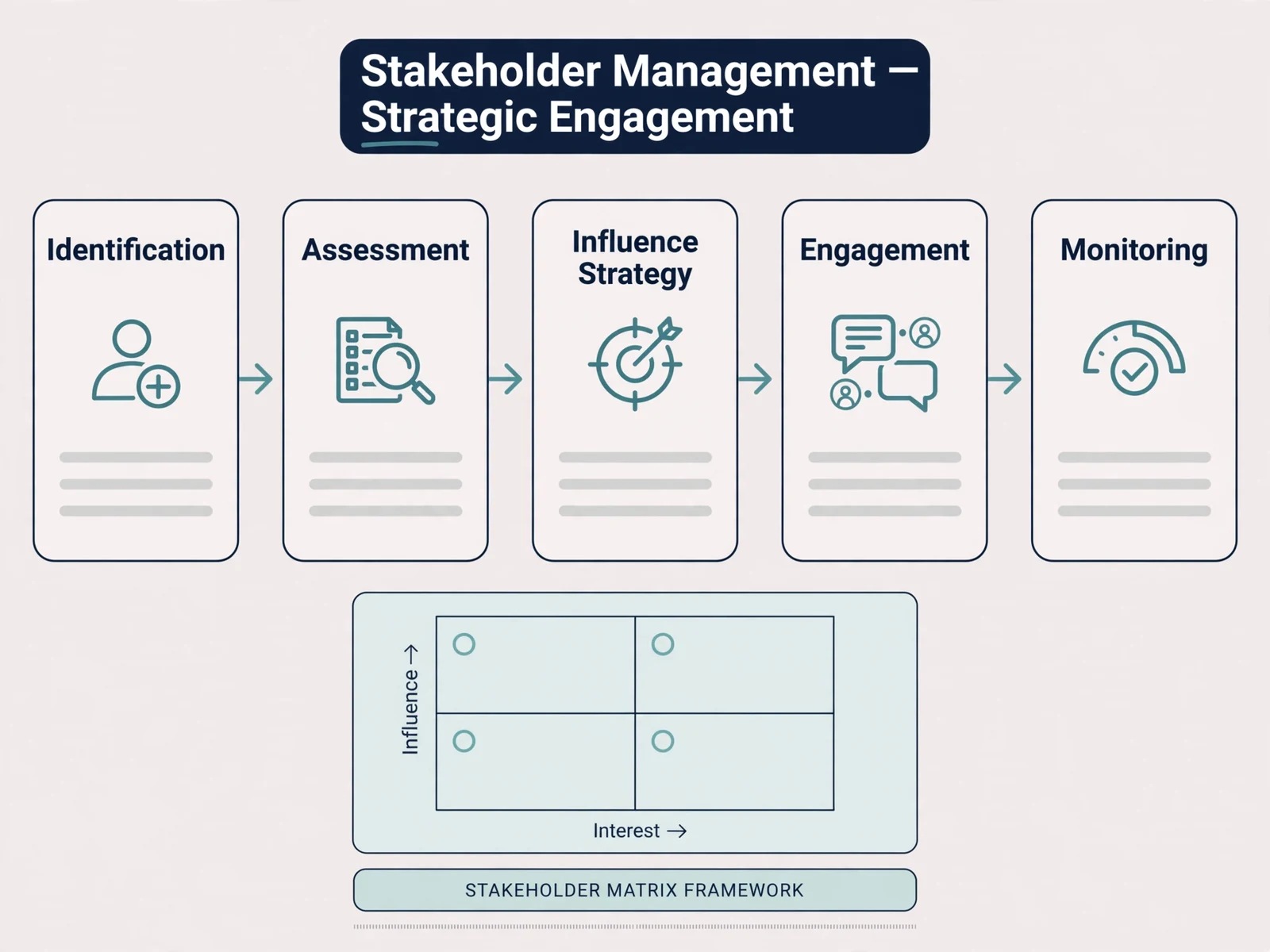
Participants map stakeholder power, interest, position, relationships and information needs; prepare difficult conversations; and build engagement plans linked to real decisions.
For organizations, the course can support project, transformation, HR, commercial and leadership populations where cross-functional influence is essential.
Where this program fits
Managers, project leaders, HR business partners, transformation teams and specialists working across functions
Live classroom, live online or private in-house. Depth and schedule are tailored to the cohort.
Stakeholder analysis, influence, interests, relationships, communication, engagement and escalation
A stakeholder strategy for a live initiative or decision
Built for Corporate Cohorts
Private delivery can be aligned to participant roles, business priorities, internal terminology and real workplace scenarios. HR, L&D and functional sponsors can use the course alone or inside a broader academy.
What Participants Will Learn
Identify who can enable, block or reshape an outcome.
Look beyond stated positions to underlying concerns and incentives.
Match timing, channel and message to the stakeholder and decision.
Use credibility, reciprocity, framing and coalition-building appropriately.
Prepare for difficult conversations and competing priorities.
Review stakeholder position as the situation changes.
Business Problems This Program Is Designed to Address
Course Outline
Applied Practice and Scenario Work
Participants use realistic situations to practise analysis, decisions, stakeholder communication and application. Private cohorts can adapt scenarios to the organization’s context while protecting confidential information.
Participants analyze interests, incentives and a targeted engagement response.
Participants redesign the map around influence and decision impact.
Participants frame trade-offs and identify the decision authority.
Participants plan re-engagement without pretending earlier choices are still fully open.
Practical Tools and Work Products
What Strong Practice Looks Like
Stakeholder management begins with the outcome and decision. Without that anchor, teams can spend large amounts of time communicating without changing anything material.
Interests often matter more than positions. A stakeholder may oppose a proposal because of workload, control, risk, past experience or performance incentives rather than because of the proposal itself. Understanding those drivers improves the quality of engagement.
Influence is broader than persuasion. It includes credibility, evidence, relationships, coalition-building, timing and the design of choices. Managers should not rely on personal rapport alone when formal interests are misaligned.
Engagement should be honest about what is open for input. Asking stakeholders to participate after a decision is effectively fixed can damage trust. Participants distinguish consultation, co-design, communication and approval.
Stakeholder maps should change. Power, interest and support can move as decisions progress, leadership changes or new consequences become visible. Regular review prevents engagement plans from becoming static.
Questions Participants Learn to Ask
Which stakeholder can materially change the outcome?
What interest sits underneath the stated position?
What decision or commitment do we actually need from this stakeholder?
What has changed since the last stakeholder assessment?
Implementation Pitfalls and Cross-Functional Interfaces
Capability in this topic depends on how decisions move across the organization. Private cohorts can map where ownership, information or incentives currently break down and use those interfaces as part of the learning design.
- Project and program teams for delivery dependencies
- Leadership for sponsorship and escalation
- HR and change teams for adoption
- Commercial and external-relations teams for partner and customer engagement
A common implementation mistake is to add a framework without changing the management routine around it. Participants identify where the tool will be used, who needs to be involved, what evidence is required and what decision or behavior should become different after application.
Advanced Application Considerations
Stakeholder strategies can fail when teams overfocus on seniority. Informal experts, gatekeepers and network connectors may have less formal authority but significant practical influence. Participants identify both formal and informal power.
Another challenge is stakeholder fatigue. Organizations often run several initiatives that approach the same leaders repeatedly. Coordinating engagement across projects can improve credibility and reduce contradictory messages.
Influence also has ethical boundaries. The course distinguishes transparent persuasion and relationship-building from manipulation. Strong stakeholder practice aims for informed decisions and workable commitments, not hidden pressure.
Before the Program Begins
For a private cohort, participants can identify one current case, decision or recurring problem related to the topic. Anonymized patterns can be used to weight practice without turning the program into a review of confidential internal matters.
After the Program
Participants can use one work product in the next relevant work cycle and discuss the result with a manager or peer. The goal is to reinforce application while the participant has a live opportunity to use the capability.
Manager Reinforcement and Evidence of Application
Sponsors can look for observable changes such as clearer decisions, stronger preparation, better use of the relevant work product, improved ownership or better escalation. These are indicators that the capability is being applied, not automatic claims that attendance caused a business result.
Participants should select one or two applications first rather than trying to use every concept at once. Managers can ask what was tried, what response followed and what should be adjusted next time.
Designing a Private Cohort Around Real Work
Before private delivery, the sponsor can define participant roles, experience level, common workplace situations, internal terminology and one or two practical outputs that would be useful after the program.
- Participant roles and experience.
- Recurring decisions or problems the cohort needs to handle better.
- Relevant internal frameworks or governance.
- Practical work products participants can use afterward.
- How managers will reinforce application.
Capability Maturity and Management Judgement
Stakeholder plans also need sequencing. Some stakeholders should be engaged before options are narrowed; others need a clear proposal before discussion becomes productive. Participants learn to time engagement so stakeholders can genuinely influence what is still open while avoiding endless consultation.
Commitments should be recorded carefully. A stakeholder may express support in principle without committing resources, behavior or a formal decision. The course helps participants separate sentiment from concrete commitment and identify what still needs to be secured.
Stakeholder strategy also benefits from network thinking. A difficult relationship may be influenced by trusted peers, technical experts or sponsors who shape how the stakeholder interprets the issue. Participants map these indirect influence paths without treating them as manipulation.
For corporate cohorts, these questions can be used to compare current practice with a stronger operating model and identify the smallest change that would materially improve decision quality, execution or governance.
Stakeholder management maturity also includes knowing when to stop persuading and escalate a decision. Some conflicts reflect legitimate competing objectives that cannot be resolved through more communication. Participants learn to recognize when the issue needs formal sponsorship, governance or an explicit trade-off rather than another engagement cycle.
For sponsors, this creates a practical distinction between course completion and capability maturity. Participants should be able to explain why they selected a method, what evidence informed the choice, how stakeholders were involved and what review point will show whether the approach is working.
A further leadership question is transparency. Stakeholders should understand what information can be shared, what is still uncertain and which constraints are non-negotiable. Clear boundaries reduce the risk that relationship-building creates expectations the organization cannot fulfill.
That discipline makes stakeholder strategy more credible because promises, constraints and escalation paths remain explicit.
Who Should Attend
- Managers and team leaders
- Project and program professionals
- HR business partners
- Transformation and cross-functional specialists
Organizational Benefits
- Improve cross-functional influence
- Reduce stakeholder surprises
- Strengthen difficult engagement
- Improve sponsorship and commitment
- Build more adaptive stakeholder strategies
Delivery and Pricing
The program is live and instructor-led. It can be delivered in the classroom, live online or in-house. Duration is flexible and should reflect participant level, selected depth, organizational objectives and the amount of applied practice required.
Public and private pricing: current public fees are confirmed with scheduled cohorts. Private and customized programs are quoted according to cohort size, location, scope and customization. Request a proposal.
Frequently Asked Questions
Can this be delivered privately for one organization?
Yes. Private cohorts can be calibrated to participant roles, business context and priority scenarios.
Is the duration fixed?
No. Delivery depth and schedule are adapted to the cohort and learning objective.
Can we use our own scenarios?
Yes. Organization-relevant situations can be used while protecting confidential information.
Can this sit inside a broader academy?
Yes. It can be combined with related programs into a role, function or leadership pathway.
Is this self-paced?
No. TheSkillGrid programs are live and instructor-led.
Related Programs
- Business Communication and Presentation Skills
- Program Management and PMO Leadership
- Change Management and Organizational Transformation
- Strategic Thinking and Decision Making
Build a Cohort Around the Capability Need
TheSkillGrid can combine this course with adjacent programs into a coherent corporate pathway.
Upcoming Dates & Venues
Explore proposed 2027 dates and venues for this course. The city, trainer, venue, duration and fee are subject to confirmation. Use the proposed-date link to request availability, not a confirmed booking.
Request course availability with your preferred date, location and group size. We will confirm available public-session and private-team options before any booking or payment.
Ready to Take the Next Step?
Register your interest for a public session or request private in-house delivery for your team.