Innovation becomes manageable when teams can frame the problem, test assumptions cheaply and decide what deserves more investment before enthusiasm becomes sunk cost.
Course Overview
This program is for managers, strategy teams, product leaders and transformation professionals responsible for new products, services, processes or business models.
Participants move from opportunity framing to hypotheses, experiments, evidence and portfolio decisions. The emphasis is disciplined learning rather than idea generation alone.
Organizations can use the course in innovation programs, strategy academies and transformation portfolios.
Where this program fits
Innovation, strategy, product and transformation leaders
Live classroom, live online, or private in-house delivery. Depth and schedule are tailored to the cohort.
Opportunity framing, assumptions, experiments, evidence, portfolio choices, sponsorship and scaling
An experiment and decision plan for a live opportunity
Built for Corporate Cohorts
Private delivery can be calibrated to participant roles, internal frameworks, business priorities and real workplace scenarios. HR, L&D and functional sponsors can use the program as a standalone intervention or inside a broader academy, leadership pathway or capability initiative.
What Participants Will Learn
Define the customer or business problem before choosing a solution.
Make the beliefs behind a proposal explicit.
Design experiments that reduce uncertainty before major investment.
Separate learning from enthusiasm.
Balance strategic fit, uncertainty and resources.
Identify what must be true before wider investment.
Business Problems This Program Is Designed to Address
The course is organized around workplace problems that managers and organizations can observe, not around theory alone.
Course Outline
Applied Practice and Scenario Work
Participants use realistic situations to practise analysis, decisions, stakeholder communication and application. Private cohorts can adapt the scenarios to the organization’s environment while keeping sensitive information protected.
Practical Tools and Work Products
How Participants Work During the Program
The learning design moves through diagnosis, practice, challenge and application. Participants define a real problem, test a framework or conversation, build a work product, receive challenge and identify where the learning will be used after the course. This keeps the program anchored in actual work rather than passive attendance.
Define the real problem or decision.
Test tools, language and decisions.
Create a work product for the role.
Set the first workplace action and evidence.
Who Should Attend
- Innovation managers
- Strategy and transformation professionals
- Product leaders
- Managers responsible for new initiatives
Organizational Benefits
- Create more disciplined innovation decisions
- Reduce waste from poorly tested ideas
- Improve portfolio visibility
- Strengthen sponsorship conversations
- Connect innovation to strategy
For HR, L&D and Program Sponsors
Before private delivery, sponsors can define the target population, current responsibilities, capability gaps, organizational terminology and priority scenarios. Participants can then be asked to apply one or two tools to live work and review what happened with their manager after the program. This creates observable application without making unsupported claims that attendance alone caused a business result.
What Strong Innovation Management Looks Like in Practice
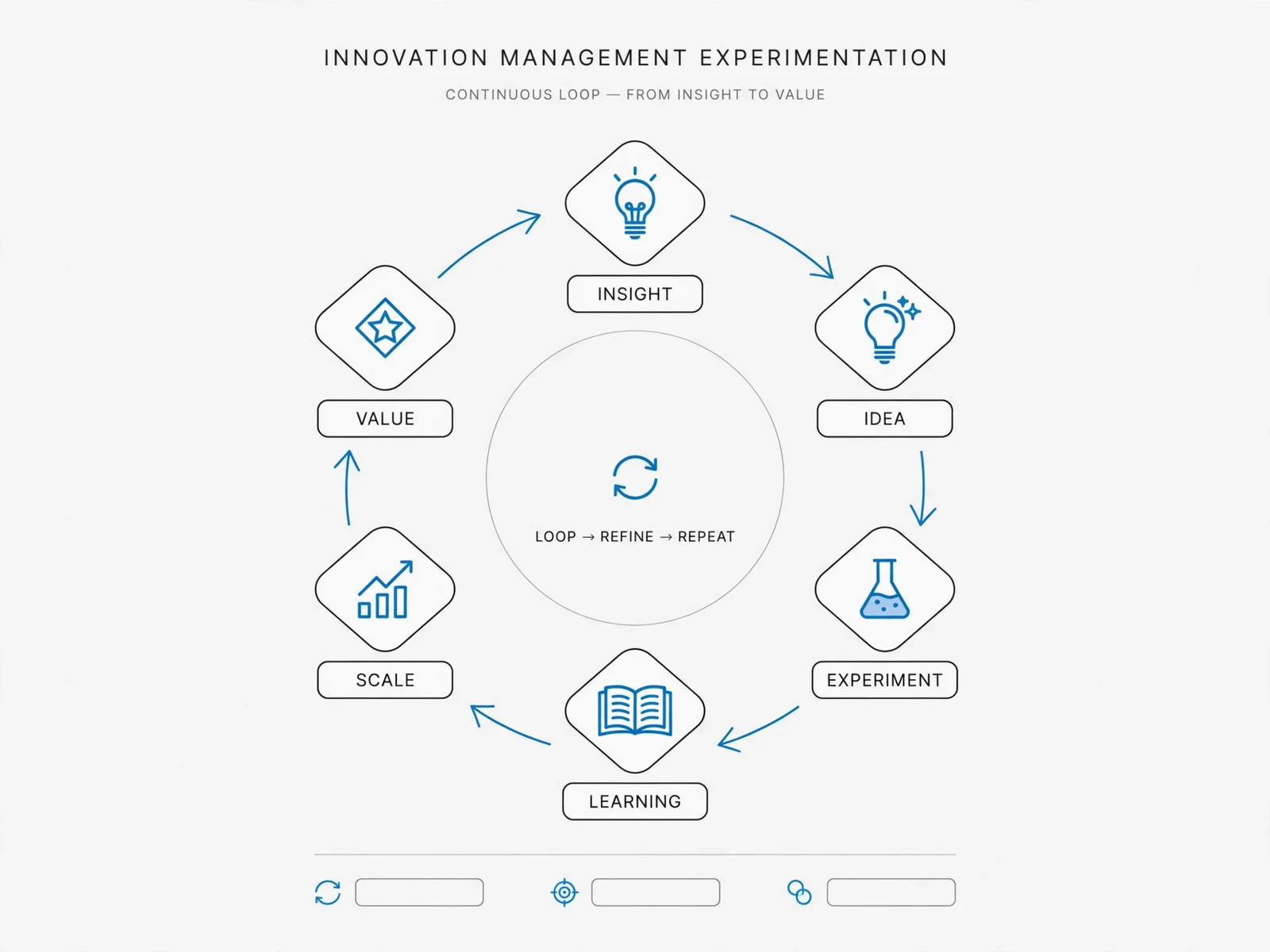
Innovation management creates a disciplined bridge between ideas and investment. The first task is to define a meaningful problem or opportunity. Teams that fall in love with a solution too early often spend time validating the idea they already prefer rather than learning whether the underlying need is important.
Assumptions should then be made explicit. A new product may depend on customer demand, technical feasibility, pricing, channel access or an operational capability that does not yet exist. Different assumptions require different tests, and some can be examined much more cheaply than building a full solution.
Experiments are useful when they reduce uncertainty. A prototype, interview, simulation, manual service or limited pilot should be designed around a clear hypothesis and decision. The point is not to generate positive feedback. It is to learn whether the evidence is strong enough to continue, change direction or stop.
Portfolio management adds another level. Leaders need to compare opportunities across strategic fit, uncertainty, expected value, resources and timing. A healthy portfolio includes the ability to stop weak ideas so resources remain available for stronger ones.
Questions Participants Learn to Ask
What problem or opportunity are we actually trying to validate?
Which assumption creates the greatest uncertainty?
What is the smallest test that could change the decision?
What evidence would justify further investment or stopping?
Manager Reinforcement and Evidence of Application
For employer-sponsored participants, the program can be connected to a live work priority before delivery begins. The participant and manager can agree where the learning is most likely to be useful, what decision or conversation is approaching, and which course tool should be tested first.
Immediately after the course, participants should select a small number of applications rather than trying to use everything at once. The manager can review what was tried, what evidence was used, what response followed and what should be adjusted next time.
At cohort level, HR, L&D or the functional sponsor can look for patterns such as clearer decision briefs, stronger preparation, better use of a work product, more explicit trade-offs or improved ownership. These are observable signs of application, not automatic claims that the course caused a business result.
Implementation Pitfalls and Cross-Functional Interfaces
Innovation programs can become biased toward ideas with charismatic sponsors. Participants learn to use common evidence and decision criteria so resources are not allocated only to the proposals with the strongest internal advocates.
A second pitfall is designing experiments that cannot change the decision. Collecting positive feedback or usage data is not enough if the team has not defined what outcome would cause it to continue, modify or stop the initiative.
Scaling creates another transition. What works as a pilot may depend on exceptional people, manual effort or a narrow customer segment. The course helps leaders identify which assumptions must be retested before a concept becomes a repeatable operating model.
Important Cross-Functional Interfaces
- Finance for investment gates and resource allocation
- Operations for scalability and delivery feasibility
- Technology or product teams for technical assumptions
- Commercial or customer teams for demand and value evidence
For a private cohort, these interfaces can be used to make the learning more realistic. Participants can map where decisions move between functions, where information is lost and where clearer ownership or escalation is required. When the program sits inside a wider academy, the same issues can be revisited in later modules so capability development is connected across subjects.
Designing a Private Cohort Around Real Work
When Innovation Management and Experimentation is delivered for one organization, the strongest starting point is not a generic request to cover the topic in more detail. The sponsor should identify the participant population, the situations those participants are expected to handle, the decisions that currently create difficulty and any internal frameworks or terminology the facilitator should understand before delivery.
The course can then be calibrated without becoming a narrow internal-process briefing. The core professional principles remain intact, while examples, scenario emphasis and work products reflect the responsibilities of the cohort. This is particularly useful when participants come from several functions and need a shared language without pretending their roles are identical.
- Participant roles and experience level.
- Two or three recurring workplace situations where stronger capability is needed.
- Relevant internal language, governance or decision frameworks.
- One practical output participants could use after the program.
- How managers will support application once participants return to work.
Delivery and Pricing
The program is live and instructor-led. It can be delivered in a classroom, live online, or in-house. Duration is flexible and should reflect participant level, selected depth, organizational objectives and the amount of applied practice required.
Public and private pricing: current public fees are confirmed with scheduled cohorts. Private and customized programs are quoted according to cohort size, location, scope and customization. Request a proposal.
Frequently Asked Questions
Can this be delivered privately for one organization?
Yes. The course can be delivered as a dedicated cohort and calibrated to the participant population and operating context.
Is the duration fixed?
No. Delivery depth and schedule are adapted to the cohort and learning objective.
Can we use our own scenarios?
Yes. Private cohorts can use role-relevant situations and internal terminology while protecting confidential material.
How should managers reinforce the learning?
Agree one or two work applications and review what the participant tried, what changed and what further support is needed.
Can this sit inside a larger academy?
Yes. The course can be combined with related programs into a function-specific or leadership pathway.
Is this a self-paced course?
No. TheSkillGrid programs are live and instructor-led.
Related Programs
- Strategic Planning and Execution
- AI for Business Leaders
- Change Management and Organizational Transformation
- Project Management Fundamentals
Build a Cohort Around Your Capability Priorities
TheSkillGrid can combine this program with adjacent courses into a structured corporate academy or pathway.
Upcoming Dates & Venues
Explore proposed 2027 dates and venues for this course. The city, trainer, venue, duration and fee are subject to confirmation. Use the proposed-date link to request availability, not a confirmed booking.
Request course availability with your preferred date, location and group size. We will confirm available public-session and private-team options before any booking or payment.
Ready to Take the Next Step?
Register your interest for a public session or request private in-house delivery for your team.