Sustainability leadership is not a reporting exercise. It requires leaders to connect environmental and social priorities to strategy, operating decisions, governance, investment and the evidence used to support claims.
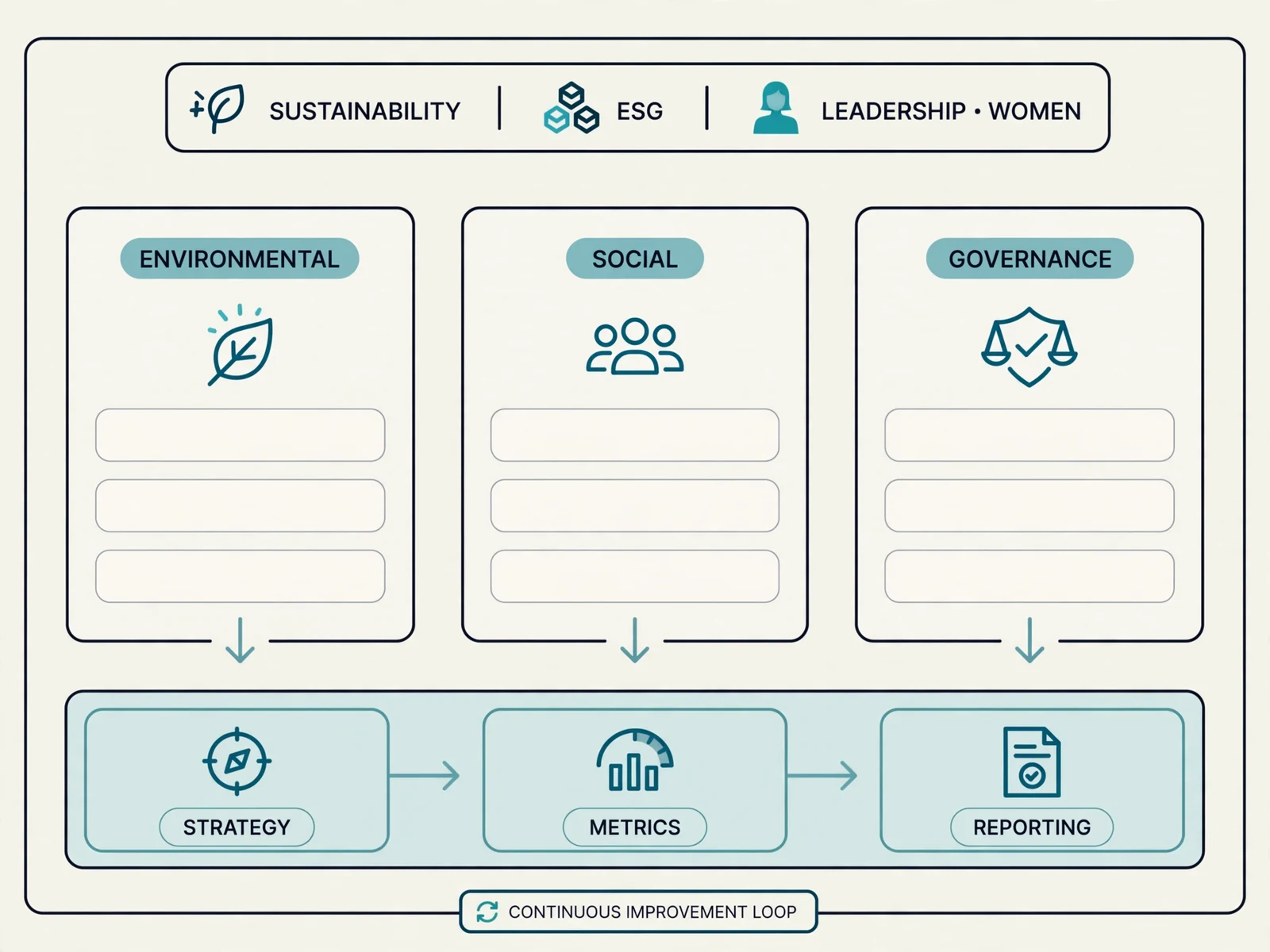
Course Overview
This program is designed for women managers and leaders who sponsor, influence or implement sustainability, ESG, responsible-business or climate-related priorities. It focuses on leadership and decision-making rather than on one reporting framework or jurisdiction.
Participants work with scenarios involving materiality, competing stakeholder expectations, investment trade-offs, supply chain considerations, targets, data quality, governance and the risk of making claims that are stronger than the evidence supports.
For organizations, the course can support sustainability leadership pipelines, ESG committees, functional leaders, transformation programs and women-in-leadership initiatives where participants need to integrate sustainability into normal business decisions.
Where this program fits
Women sustainability leaders, functional managers, ESG contributors and senior leaders with sustainability responsibilities
Live classroom, live online, or private in-house delivery. Depth and schedule are tailored to the cohort.
Sustainability strategy, material issues, governance, stakeholder expectations, implementation and credible evidence
A sustainability leadership agenda and decision framework for a live organizational priority
Built for Corporate Cohorts
Private delivery can be aligned to the sponsor’s capability goals, participant roles, internal frameworks, business priorities and real workplace scenarios. HR, L&D, Talent and functional leaders can use the program as a standalone intervention or inside a wider academy, succession or women-in-leadership pathway.
What Female-Forward Means in This Program
The program develops strategic and governance capability for women taking on increasingly visible sustainability responsibilities, without assuming one function or professional background owns the agenda.
What You Will Learn
Move from isolated initiatives to business priorities, risk and value creation.
Focus attention on the environmental, social and governance topics that matter most to the organization and stakeholders.
Clarify decision rights, ownership, oversight and escalation.
Separate ambition from evidence and avoid targets or claims the organization cannot support.
Translate sustainability goals into operational, supply chain, people and investment decisions.
Explain priorities, progress, uncertainty and trade-offs with appropriate transparency.
Course Outline
Who Should Attend
- Women sustainability and ESG managers
- Functional leaders with sustainability responsibilities
- Senior women leaders and high-potentials
- Organizations building sustainability leadership capability
Organizational Benefits
- Build stronger sustainability leadership beyond specialist teams
- Improve governance and decision quality around ESG priorities
- Reduce the risk of unsupported claims
- Connect sustainability to procurement, operations and strategy
- Develop women for visible sustainability and governance roles
Business Problems This Program Is Designed to Address
This program is built around observable workplace problems and business decisions, not generic empowerment themes.
Applied Practice and Scenario Work
Participants use realistic situations to practise analysis, stakeholder communication, trade-offs and decision-making. Private cohorts can adapt the scenarios to the organization without exposing sensitive information.
Practical Tools and Work Products
Participants leave with practical outputs that can be refined and used in their roles after the program.
How Participants Work During the Program
The learning design moves repeatedly between concept, diagnosis, practice and workplace application. Participants define a real problem, test tools or language, build a work product, receive challenge and identify where the learning will be used after the course. This keeps the program anchored in decisions and responsibilities that resemble the roles participants actually hold.
For employer-sponsored cohorts, a participant and manager can agree one live application before delivery, then review what was tried, what changed and what still needs adjustment. Cohort-level patterns can inform future development priorities without pretending that attendance alone caused a business result.
How Participants Work During the Program
Sustainability and ESG Leadership for Women Leaders is designed as an applied learning experience. Participants repeatedly move from concept to diagnosis, from diagnosis to practice, and from practice to a concrete workplace application. The point is not to finish with a larger set of notes. It is to leave with clearer decisions, stronger language, usable tools and a defined next step in a real role.
Participants define the actual business or leadership problem before selecting a tool or solution.
They test decisions, conversations and frameworks in realistic scenarios where assumptions can be challenged safely.
They create practical outputs such as Materiality prioritization canvas, Sustainability governance map, Target-readiness checklist, Stakeholder map, Implementation action plan, Sustainability leadership agenda for use after the course.
Peer and facilitator challenge exposes weak assumptions, missing stakeholders and hidden trade-offs.
Each participant identifies where the learning will be used, who must be involved and what evidence will show progress.
The core pathway covers Sustainability Leadership Fundamentals, Materiality and Priority Setting, Governance and Accountability, Targets, Data and Credible Claims, Embedding Sustainability Into Decisions, Sustainability Leadership Action Plan. Private cohorts can place more practice around the modules most relevant to the sponsor’s capability priorities while preserving the integrity of the wider program.
For HR, L&D and Program Sponsors
For employer-sponsored cohorts, the strongest design begins with the population and business context. Sponsors can define the participant level, current responsibilities, common decision situations, capability gaps and the work products that would be useful after delivery. This allows examples and practice to feel relevant without reducing the program to organization-specific process training.
- Before delivery: identify one live situation where each participant is likely to use the learning.
- During delivery: use role-relevant scenarios, peer challenge and course-specific work products.
- After delivery: managers can review what was tried, what response it produced and what still needs adjustment.
- At pathway level: cohort patterns can inform the next development priority without treating course attendance as proof of business impact.
Evidence of Application
Useful evidence can include a clearer decision brief, stronger stakeholder preparation, a live map or plan being used in a business process, improved escalation, a better-defined trade-off, or a manager observing more disciplined use of the course framework. These are observable applications rather than guaranteed performance claims.
From ESG Agenda to Business Decisions
Sustainability becomes operational when it changes real choices. Leaders may need to weigh capital expenditure, supplier standards, product design, workforce practices, energy use, customer expectations, risk and the credibility of public commitments. Those decisions rarely belong to a sustainability team alone. They require coordination across Finance, Procurement, Operations, HR, Legal, Risk, Strategy and business leadership.
The program helps participants distinguish three questions that are often blurred together: what matters strategically, what the organization can evidence today, and what capability or governance must be built before a stronger commitment is made. This is particularly important when leaders are under pressure to move quickly or communicate progress before data quality, ownership and controls are mature.
Delivery Format
The program is live and instructor-led. It can be delivered in a classroom, live online, or in-house. Duration is flexible and should reflect participant level, selected depth, organizational objectives and the amount of applied practice required.
For HR, L&D and business leaders: Explore in-house training or request a customized cohort.
Pricing
The public-course fee follows the current Women at Work offering structure for Saudi Arabia and the GCC. Program length and structure may vary by cohort. Public fees exclude VAT or other applicable taxes.
For in-house or customized delivery, request a proposal.
Frequently Asked Questions
Can this be delivered privately for one organization?
Yes. Private cohorts can be aligned to the participant population, business context, internal language and priority scenarios.
Is the duration fixed?
No. Delivery depth and schedule are adapted to the cohort and organizational objective.
Can we use our own scenarios?
Yes. The facilitator can calibrate practice around common workplace situations while keeping confidential material appropriately protected.
How should managers reinforce the learning?
Agree one or two work applications and review what the participant tried, what changed and what further support is needed.
Can this sit inside a broader development pathway?
Yes. It can be combined with adjacent Women at Work and core TheSkillGrid programs for a defined leadership or functional population.
Is the program only relevant to women?
The program is female-forward in positioning and workplace context, while the underlying professional standards and capabilities are rigorous and business-focused.
Related Programs
- Corporate Governance Essentials
- Strategic Planning and Execution
- Strategic Procurement Management
- Finance for Senior Executives
Build the Right Development Pathway
TheSkillGrid can combine this course with adjacent programs into a coherent private cohort or development pathway.
Upcoming Dates & Venues
Explore proposed 2027 dates and venues for this course. The city, trainer, venue, duration and fee are subject to confirmation. Use the proposed-date link to request availability, not a confirmed booking.
Request course availability with your preferred date, location and group size. We will confirm available public-session and private-team options before any booking or payment.
Ready to Take the Next Step?
Register your interest for a public session or request private in-house delivery for your team.