A team does not become high-performing because everyone is talented. It becomes reliable because people understand what matters, who owns what, how decisions are made, and how work is reviewed.
That is the purpose of a team operating system.
The phrase sounds formal, but the idea is simple: define a small set of management routines so performance does not depend on the manager remembering everything or personally chasing every task.
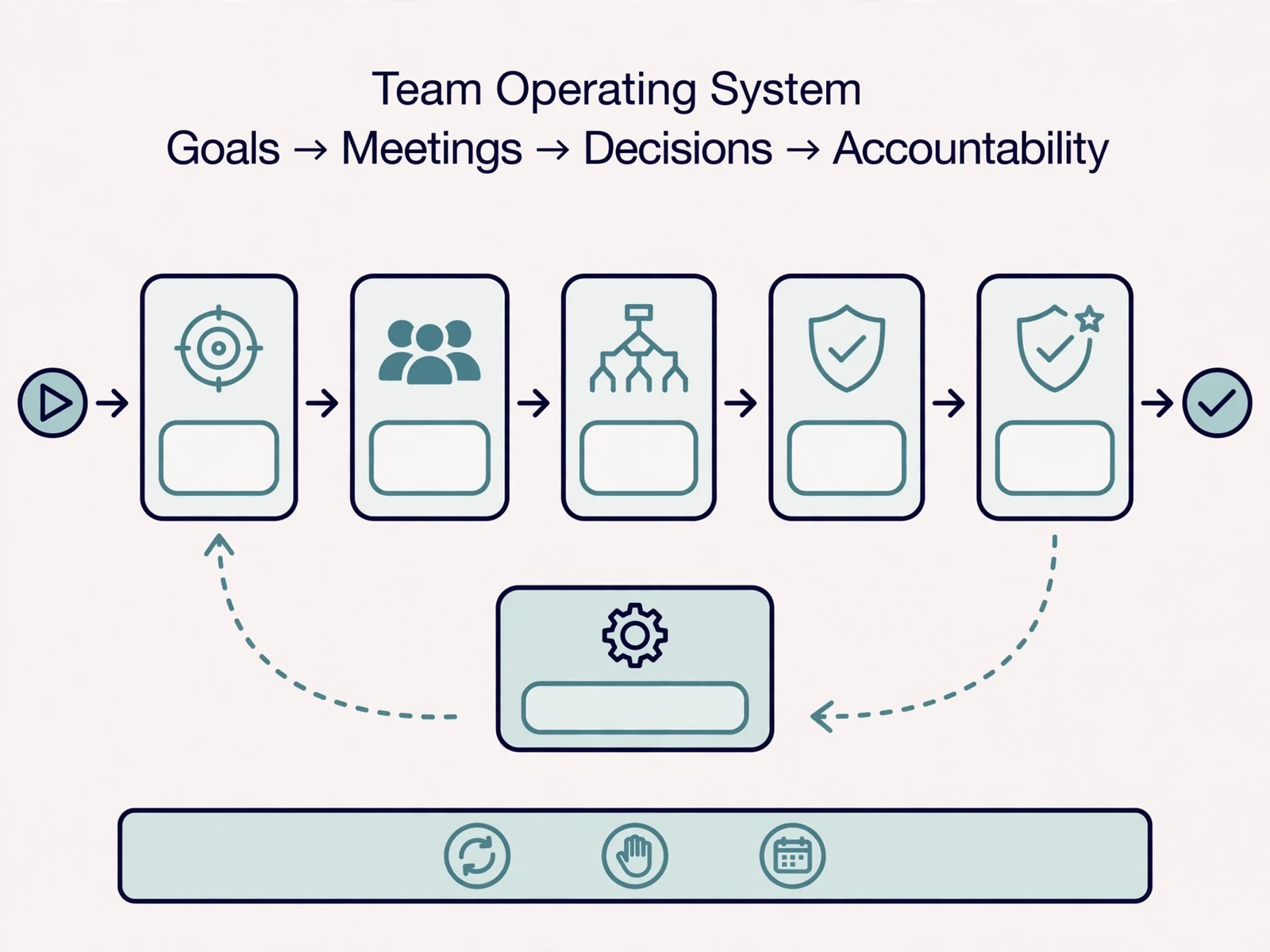
Start With Team Outcomes
Write the few outcomes the team is responsible for creating.
Do not begin with a list of activities. Outcomes should answer:
- What is the team accountable for?
- What would good performance look like?
- What matters most this quarter?
- What trade-offs are acceptable?
If the team cannot name its outcomes, every task can begin to look equally important.
Clarify Roles and Decision Rights
Teams lose time when ownership is fuzzy.
For recurring work, define:
- who owns the outcome;
- who contributes;
- who decides;
- who must be consulted;
- who only needs to be informed.
Use whatever framework fits the organization. The important thing is that the same decision is not being privately owned by three people and publicly owned by nobody.
Create a Weekly Team Rhythm
A weekly team meeting should focus on coordination and decisions.
Useful agenda:
- priority changes;
- key outcomes;
- risks and blockers;
- decisions required;
- cross-team dependencies;
- actions and owners.
Move information-only updates into a written format where possible.
Use One-to-Ones for Individual Management
The team meeting is not the place for every performance, workload, or development issue.
One-to-ones should cover:
- individual priorities;
- feedback;
- capacity;
- development;
- support;
- career or role issues.
Design an Escalation Rule
Employees should know which problems need the manager immediately and which they should solve themselves.
Examples of escalation triggers might include:
- customer risk;
- budget threshold;
- deadline slip beyond an agreed tolerance;
- safety or compliance concern;
- conflicting executive direction;
- critical dependency failure.
Make Decisions Visible
Teams become inefficient when people repeatedly reopen old decisions because no shared record exists.
Keep a lightweight decision log:
- decision;
- date;
- owner;
- reason;
- conditions that would justify review.
Build Accountability Into the Work
Accountability is not the manager asking more often.
It comes from:
- clear outcomes;
- clear ownership;
- visible deadlines;
- agreed checkpoints;
- consequences when commitments are repeatedly missed.
Use a Monthly Team Review
Step back from immediate tasks.
Review:
- progress against outcomes;
- recurring blockers;
- capacity;
- quality;
- customer or stakeholder feedback;
- process problems;
- team-development needs.
Stop Doing Work That Creates No Value
A team operating system should remove unnecessary work as well as organize necessary work.
Ask:
- Which meetings can stop?
- Which approvals add no control?
- Which reports nobody uses?
- Which recurring tasks exist only because nobody challenged them?
Protect Manager Capacity
If the manager remains the answer to every question, the operating system has not done its job.
Review your own week:
- Which decision should someone else own?
- Which approval can be removed?
- What did I do that should have been delegated?
- Where am I checking work that already meets the standard?
A Simple Team Operating System Canvas
- Team outcomes:
- Quarter priorities:
- Role owners:
- Decision rights:
- Weekly meeting:
- One-to-one rhythm:
- Escalation triggers:
- Decision log:
- Monthly review:
- Work to stop:
Define What the Team Will Not Own
Role clarity improves when the team understands its boundaries as well as its responsibilities. Write down the work that belongs elsewhere, the decisions that require another function, and the issues that should be escalated rather than absorbed.
This prevents capable teams from becoming the default owner of every unresolved organizational problem.
Create a Standard for Handoffs
Many team failures happen between people rather than inside individual tasks. A handoff should make clear what is complete, what remains open, what deadline applies, and what the receiving person is expected to do next.
For recurring handoffs, define a checklist rather than relying on memory.
Use Capacity as a Management Variable
When new work appears, ask what will move. Do not simply add another priority to the same people.
A useful capacity conversation includes:
- current commitments;
- new request;
- business priority;
- work that can stop, move or be delegated;
- risk created by overload.
Audit the System Every Quarter
Teams change. People join, processes mature, stakeholders shift, and old controls become unnecessary. Review the operating system each quarter and remove routines that no longer create value.
Ask the team which meeting, approval, report or recurring task they would redesign first and why.
Manager Self-Check
- Are team outcomes clear?
- Does every recurring decision have an owner?
- Can employees escalate without waiting for a crisis?
- Are one-to-ones happening consistently?
- Are decisions recorded?
- Is low-value work being stopped?
- Can the team function when the manager is unavailable?
Example: Turning an Informal Team Into a Managed System
Imagine a five-person client team where work is allocated through chat, deadlines live in individual calendars, and the manager is copied on every customer message. The manager feels essential because information keeps flowing through them.
A simple operating system might introduce:
- three quarterly team outcomes;
- clear account ownership;
- a weekly decision-and-risk meeting;
- one-to-ones every two weeks;
- a shared action tracker;
- defined client-escalation rules;
- a monthly capacity review.
None of these changes is sophisticated. Together they reduce dependence on memory and manager intervention.
Measure Whether the Operating System Is Working
Look for behavioural evidence:
- fewer repeated questions;
- faster decisions;
- clearer ownership;
- fewer missed handoffs;
- less manager rework;
- earlier escalation of real risks.
If the team still waits for the manager to interpret every situation, the system needs more clarity or more capability.
Where to Go Next
The Leading High-Performing Teams for Women Managers program helps managers build this complete operating system through delegation, coaching, performance, meetings, culture, and cross-functional leadership. The Performance Management and Employee Engagement course goes deeper into goals, feedback, performance and accountability.
A strong team operating system creates clarity before the manager has to create urgency.
Develop this capability in your organization