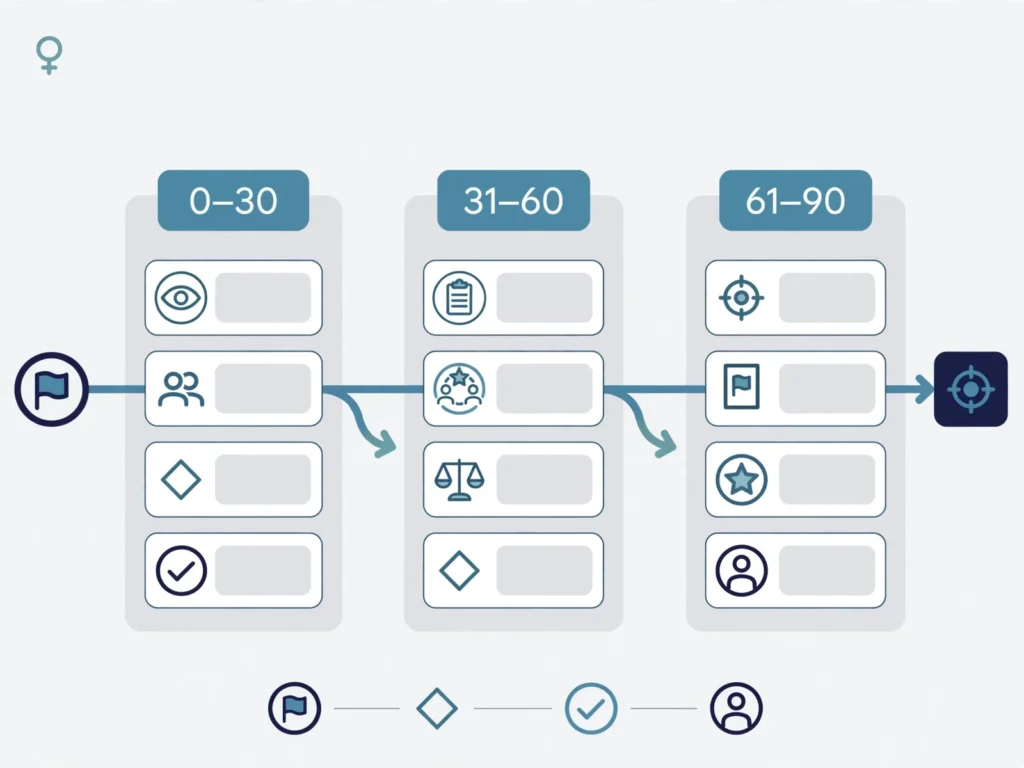
Your first 90 days as a manager are not about proving that you can personally solve every problem faster than the team.
They are about learning the system you now lead, establishing clear expectations, building trust, and creating a management rhythm that can survive after the initial energy of the promotion disappears.
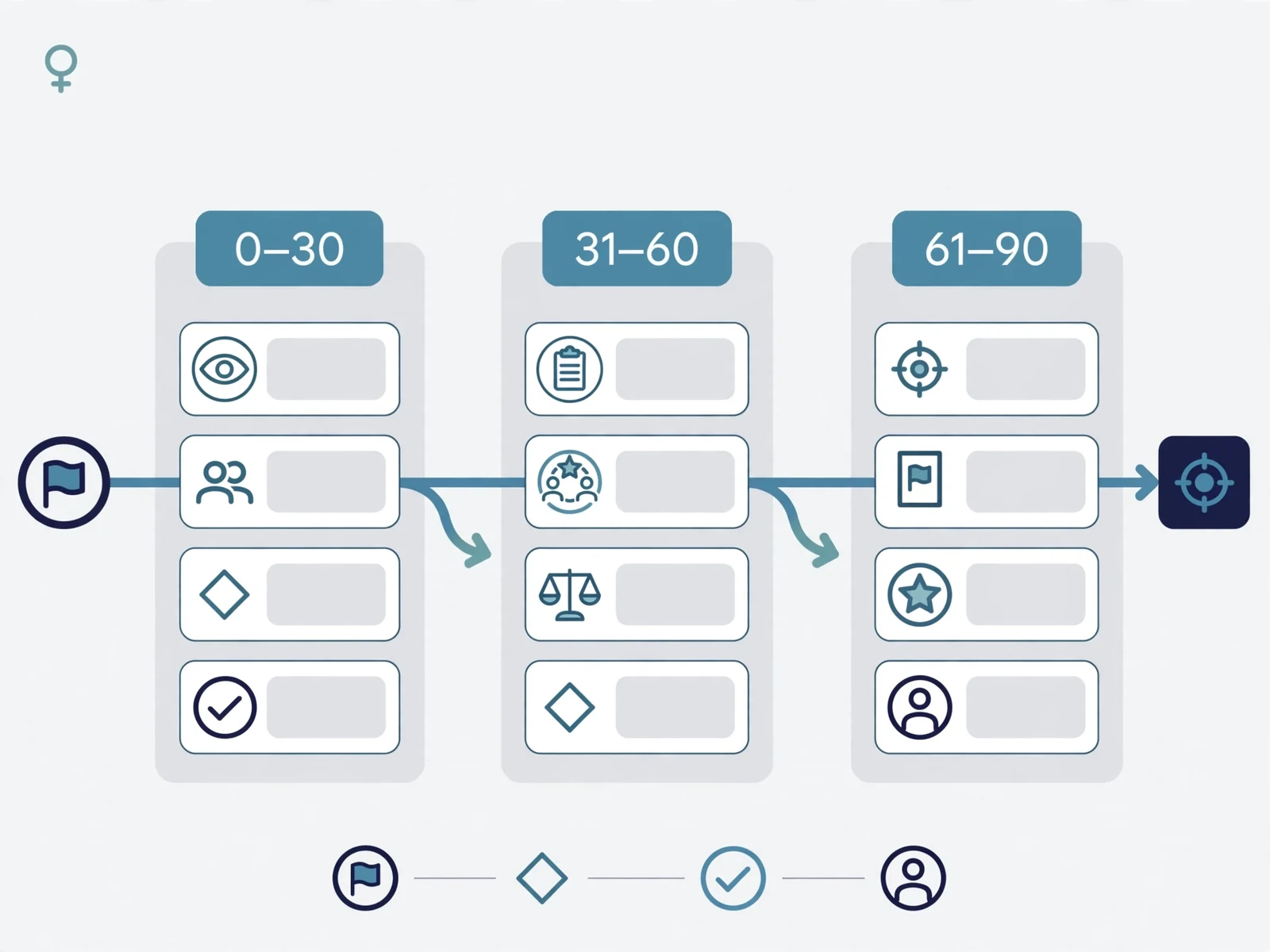
Days 1-30: Diagnose Before You Redesign
The first month should be heavy on observation and structured conversation.
Meet every direct report
Ask:
- What are you responsible for?
- What is working well?
- What creates unnecessary friction?
- What decisions are unclear?
- What do you need from your manager?
- What should I understand before changing anything?
Map the work
Understand:
- team priorities;
- recurring deadlines;
- key customers or stakeholders;
- dependencies;
- performance risks;
- informal expertise;
- decision bottlenecks.
Clarify your own mandate
Meet your manager and ask what success looks like over the next six to twelve months.
Do not assume the job description is enough.
If You Are Managing Former Peers
Acknowledge the transition instead of pretending nothing changed.
You do not need a dramatic speech. You do need consistency.
Be clear that:
- you value the existing relationship;
- your responsibilities have changed;
- confidential information will remain confidential;
- standards will apply consistently;
- you still want honest input.
Trying to prove you are still “one of the team” often creates more problems than a respectful reset.
Days 31-60: Establish the Management System
Create a one-to-one rhythm
Every direct report should know when regular management conversations happen and what they are for.
A useful structure is:
- current priorities;
- risks or blockers;
- feedback;
- development;
- support needed;
- commitments before the next meeting.
Clarify team expectations
Make standards visible.
- How do we communicate?
- How do we escalate?
- What does good work look like?
- How do we make decisions?
- What deadlines are non-negotiable?
- What belongs in a meeting and what does not?
Start delegating deliberately
Do not wait until you are overloaded.
Choose work that should move out of your hands and define the outcome, authority, standard, checkpoint, and escalation rule.
Days 61-90: Improve the Team, Not Just Your Calendar
Address the issues you have been observing
By this point you should have enough evidence to act on recurring problems.
Examples might include:
- unclear ownership;
- one person carrying too much knowledge;
- missed performance standards;
- unproductive meetings;
- slow decisions;
- stakeholder frustration;
- work the team should stop doing.
Strengthen stakeholder relationships
Your team does not operate in isolation.
Identify the people who affect your team’s success and make sure you understand what they need from you.
Build a development view
Ask of each team member:
- What are they already strong at?
- What capability would make them more effective?
- What work could help build it?
- What feedback have I not yet given?
What Not to Do in the First 90 Days
- Do not redesign everything to prove you are decisive.
- Do not keep doing your old job while trying to manage on top of it.
- Do not delay difficult feedback until you feel completely comfortable.
- Do not promise changes before you understand the dependencies.
- Do not become the approval point for every small decision.
- Do not assume people know your expectations.
A Weekly Manager Checklist
At the end of each week ask:
- What did I learn about the team?
- What decision did I clarify?
- What did I delegate?
- Who needs feedback?
- What stakeholder relationship needs attention?
- What did I do this week that only a manager should be doing?
Women and the Management Transition
There is no single female management style, and not every woman experiences the transition in the same way.
What can be useful in a women-focused cohort is the ability to examine situations such as authority, boundaries, visibility, former-peer relationships, or expectations without treating them as evidence that the participant lacks leadership potential.
The objective remains good management.
Build Credibility Without Trying to Prove Everything Immediately
New managers often feel pressure to justify the promotion quickly. That can lead to unnecessary changes, overwork, and taking on every difficult task personally.
Credibility is usually built more reliably through a pattern of behaviour:
- keep commitments;
- make expectations clear;
- follow up consistently;
- listen before changing systems you do not yet understand;
- make decisions when a decision is genuinely needed;
- admit what you are still learning;
- protect the team from avoidable ambiguity.
Have a 30-Day Conversation With Your Manager
At the end of the first month, do not wait for formal review. Ask for a focused conversation.
Discuss:
- what you now understand about the team;
- where priorities appear unclear;
- what risks you have identified;
- where you need more authority or context;
- what your manager expects you to change next;
- what success should look like by day 90.
This helps prevent a common failure mode in which a new manager is busy but not aligned with the expectations of the person evaluating the role.
Use Day 90 as a Reset, Not a Finish Line
By day 90 you should have a clearer view of the team and your own management patterns. Use that point to reset the next quarter.
Choose three priorities only: one team-performance priority, one stakeholder priority, and one personal management capability to improve. The first 90 days establish the system. The next 90 should improve it.
Where to Go Next
The First-Time Manager Program for Women turns this 90-day plan into a full management toolkit. The existing Effective Leadership Skills for New Managers course provides the broader core management framework.
Your first 90 days do not need to be dramatic. They need to create clarity, trust, and a management system that makes good performance easier.
Develop this capability in your organization