Build delivery leadership across projects, change, operations and data-informed management.
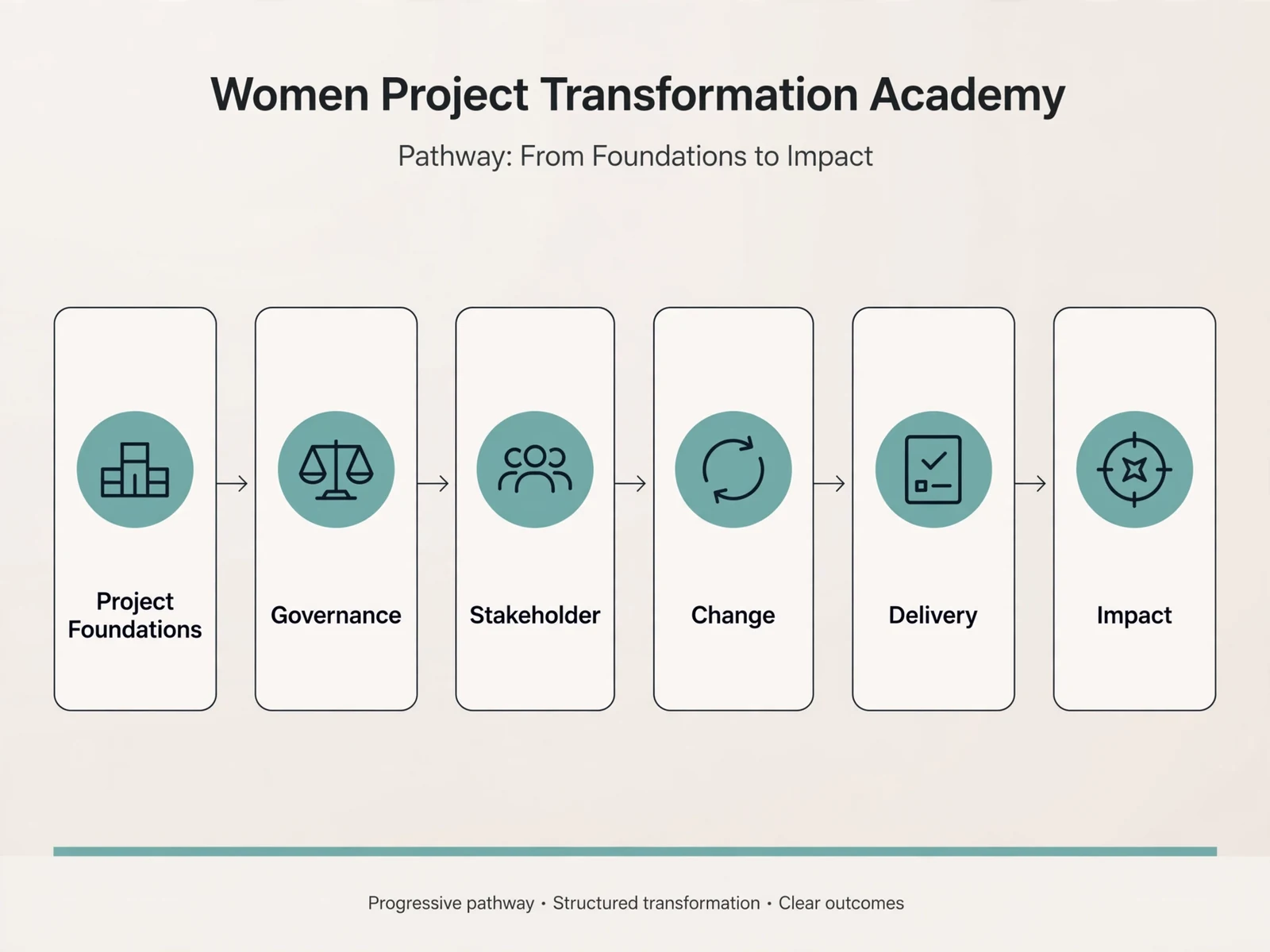
Who This Pathway Is For
Women leading projects, transformation, operations and cross-functional delivery, and organizations developing women for visible execution roles.
Designed as a B2B Capability Pathway
This is not a fixed-duration package. The selected programs can be sequenced around the cohort’s role level, capability gaps and business calendar. Private delivery can use organization-specific scenarios, terminology and work products while keeping the underlying professional standards intact.
Programs in the Pathway
Women in Project Leadership
Move from coordination into visible delivery ownership, governance and stakeholder leadership.
Women Leading Change and Transformation
Lead adoption, sponsorship, resistance and organizational change.
Women in Operations and Process Improvement
Strengthen process visibility, problem-solving and operational improvement.
Data-Driven Decision Making for Women Managers
Use evidence, metrics and uncertainty more effectively in management decisions.
Organizational Outcomes
- Prepare women for high-visibility delivery roles
- Strengthen project and transformation leadership
- Build operational and data decision capability
- Create a stronger pipeline for PMO, transformation and operations leadership
Business Problems This Pathway Can Address
How the Academy Is Designed
Participants can use a live project, transformation or process priority as the application thread across the academy.
Sponsors can select the modules that match PMO, transformation-office, operations or high-potential populations.
The pathway does not need to be delivered as one uninterrupted block. Programs can be spaced to allow workplace application between modules, and the sponsor can choose a core sequence plus optional electives. TheSkillGrid can also adjust the order where the participant population already has strength in one area and needs greater depth elsewhere.
A practical deployment model
- Diagnose: define the population, capability gaps and business situations that matter.
- Sequence: choose the courses and order that fit the cohort rather than forcing a generic package.
- Apply: participants use course tools on live work between programs.
- Reinforce: managers and sponsors review application and decide what capability should be built next.
Workplace Application and Evidence
A pathway is more valuable when each program produces something participants can use at work. Depending on the courses selected, that may include stakeholder maps, decision briefs, project plans, negotiation preparation, operating models, talent reviews, action plans or other practical tools. Sponsors can look for more consistent use of these outputs and stronger management conversations without treating course attendance as automatic proof of business impact.
How to Structure the Cohort
A strong academy does not simply enroll the same people in every course. The cohort should be defined by role level, current responsibilities and the decisions participants are expected to handle differently after the pathway. Some organizations use one intact cohort because shared language matters. Others use a core group with selected electives where functional responsibilities diverge.
TheSkillGrid can help sponsors separate core capability from role-specific depth. Core programs establish the common foundation. Electives can then be added for participants who need extra capability in finance, projects, AI, communication, risk or another adjacent area. This prevents the pathway from becoming unnecessarily long while still allowing meaningful depth.
The shared programs every participant needs for a common management or functional baseline.
Additional programs selected for role-specific decisions, responsibilities or progression paths.
A live challenge, project, account, workforce issue or decision participants revisit between programs.
Manager or sponsor check-ins focused on what participants actually applied and what changed.
Between-Program Application
Spacing between programs can be used deliberately. Instead of treating the pathway as a sequence of classroom events, participants can apply one or two tools after each program and bring the result into the next stage. That creates continuity and helps the cohort see how different capabilities interact in real work.
A participant might test a stakeholder map, decision brief, coaching conversation, project plan or financial analysis, then reflect on what happened. The next program can build on that experience rather than starting again from zero. For managers and sponsors, this also creates natural points for reinforcement without requiring a heavy assessment system.
What Sponsors Can Measure
The pathway should be judged by more than attendance, but measurement should remain proportionate. The most useful evidence is usually connected to the work participants are expected to improve. Sponsors can define a small number of observable behaviors, decisions or work products before the academy begins and review them over time.
- Application: whether participants are using the relevant tools or frameworks on real work.
- Decision quality: whether recommendations, trade-offs and escalation become clearer.
- Manager observation: whether managers see more consistent behavior in the capability being developed.
- Work products: whether plans, analyses, stakeholder maps or other outputs are being used in normal processes.
- Pipeline or talent evidence: where relevant, whether participants are becoming ready for broader responsibility or more complex assignments.
TheSkillGrid does not present attendance as proof of ROI. Where organizations want stronger evaluation, the measurement approach should be designed around the business context, available evidence and the decisions the sponsor needs to make about future development.
When to Use an Academy Instead of a Single Course
A single course is often the right choice when the capability gap is narrow and well defined. An academy becomes more useful when participants need several connected capabilities, when the organization is developing a population over time, or when shared language across functions matters. It is also useful when the sponsor wants workplace application between modules rather than one concentrated training event.
The pathway should not be made longer simply because more courses are available. The design principle is the opposite: include only the programs that contribute to the target capability and use electives where the participant population genuinely differs.
Investment
This academy is quoted as a private organizational pathway according to selected programs, cohort profile and delivery requirements.
VAT or other applicable taxes are excluded unless explicitly stated. Private delivery may also involve location-specific travel, venue or accommodation costs where relevant.
Frequently Asked Questions
Do we have to use every course listed?
No. The pathway can be configured around the cohort. Some organizations use the full sequence; others select a core group and add electives.
Is the duration fixed?
No. Program depth, spacing and sequence are flexible and should reflect the participant population and organizational objective.
Can the pathway be delivered in-house?
Yes. It can be delivered in-house, live online, in the classroom, or through a combination suited to the cohort.
Can we use our own scenarios and frameworks?
Yes. Private cohorts can use organization-relevant terminology, frameworks and situations while protecting confidential information.
Can this be part of a larger talent program?
Yes. Academies can sit inside succession, high-potential, returnship, manager-development or function-specific capability programs.
Build the Right Cohort
Start with the population and capability gap rather than the course list. Contact TheSkillGrid with the participant level, approximate cohort size, locations and development priorities, and we can shape the pathway around the outcome you need.
View all training bundles and academies.
Request a Proposal for This Pathway
Tell us about your team, delivery preferences and development goals. We will discuss a tailored proposal; this is not a booking or a confirmed fee.