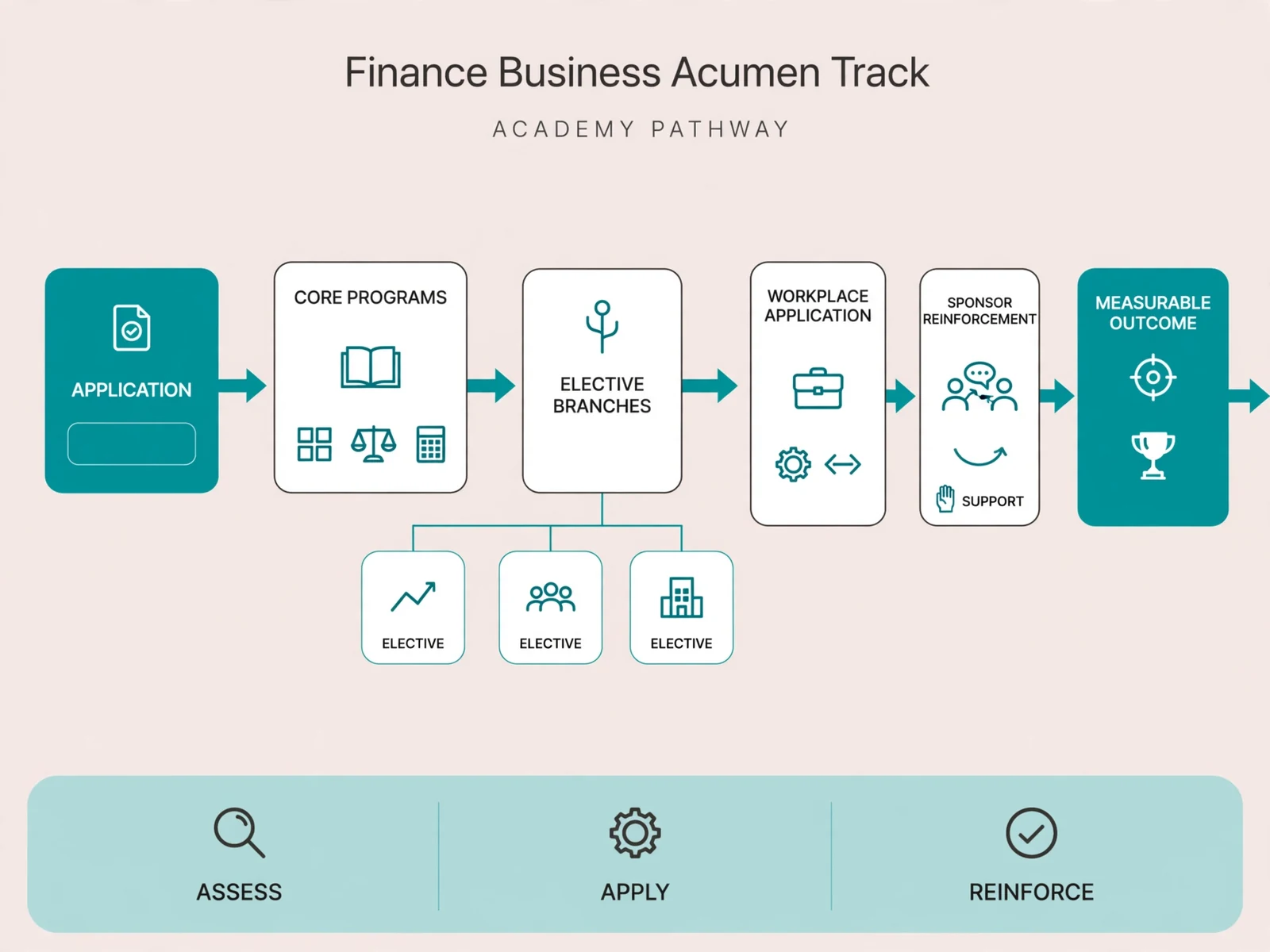
Progress from practical financial literacy through budgeting and forecasting to more strategic financial judgement.
Who This Pathway Is For
Non-finance managers, department heads, project and operational leaders, and senior managers whose decisions affect budgets, revenue, cost, investment or business performance.
Designed as a B2B Capability Pathway
This is not a fixed-duration package. The selected programs can be sequenced around the cohort’s role level, capability gaps and business calendar. Private delivery can use organization-specific scenarios, terminology and work products while keeping the underlying professional standards intact.
Programs in the Pathway
Financial Management for Non-Finance Managers
Build the ability to read financial information and connect operational choices to financial consequences.
Budgeting, Forecasting and Cost Control
Strengthen planning, variance analysis, forecasting, cost management and resource decisions.
Finance for Senior Executives
Develop strategic financial decision-making, capital allocation and investment judgement.
Organizational Outcomes
- Improve financial confidence across management populations
- Build better budget ownership outside Finance
- Strengthen business-case and resource-allocation decisions
- Create a progression from financial literacy to strategic judgement
Business Problems This Pathway Can Address
How the Academy Is Designed
Participants can apply the pathway to current budgets, forecasts, investment choices and business cases rather than learning finance in isolation.
For a private cohort, Finance and L&D can identify the decisions participants are expected to improve and calibrate examples around the organization’s commercial model.
The pathway does not need to be delivered as one uninterrupted block. Programs can be spaced to allow workplace application between modules, and the sponsor can choose a core sequence plus optional electives. TheSkillGrid can also adjust the order where the participant population already has strength in one area and needs greater depth elsewhere.
A practical deployment model
- Diagnose: define the population, capability gaps and business situations that matter.
- Sequence: choose the courses and order that fit the cohort rather than forcing a generic package.
- Apply: participants use course tools on live work between programs.
- Reinforce: managers and sponsors review application and decide what capability should be built next.
Workplace Application and Evidence
A pathway is more valuable when each program produces something participants can use at work. Depending on the courses selected, that may include stakeholder maps, decision briefs, project plans, negotiation preparation, operating models, talent reviews, action plans or other practical tools. Sponsors can look for more consistent use of these outputs and stronger management conversations without treating course attendance as automatic proof of business impact.
How to Configure the Pathway
A corporate academy should not be configured simply by choosing the largest number of courses. The stronger approach is to identify the transition or business capability the cohort needs, then decide which programs are essential and which should remain elective. This keeps the pathway coherent and avoids asking participants to attend training that does not match their role.
Capabilities every participant in the target population should build.
Additional programs selected for particular functions, levels or career paths.
Space between programs for participants to use the tools on live work.
Short checkpoints to identify what is being applied and what capability should come next.
Before the first program
The sponsor should define the cohort, current role expectations and the decisions or behaviors the organization wants to improve. Useful inputs include leadership frameworks, performance standards, common stakeholder situations and examples of work participants are expected to handle. This gives the facilitator enough context to make exercises relevant without turning the academy into internal policy training.
Between programs
Participants should apply selected tools to current work rather than waiting until the entire pathway is complete. A manager conversation, peer review or short sponsor checkpoint can help participants explain what they tried, what happened and what needs further practice. This creates continuity between modules and makes later sessions more useful because participants return with real experience to discuss.
What sponsors can monitor
TheSkillGrid does not treat attendance as automatic evidence of impact. More useful signals include whether participants use the work products, prepare decisions more clearly, handle stakeholder situations with greater structure, create better ownership or show more consistent management routines. The exact evidence should reflect the capability being developed and the participant’s role.
Choosing the Right Version of the Pathway
The default course sequence is a starting architecture, not a requirement to purchase every component. For a relatively experienced cohort, the organization may skip a foundation program and replace it with a more advanced elective. For a mixed cohort, a common core can be followed by smaller role-based groups. The design should reflect the capability gap rather than the size of the catalogue.
A useful design conversation normally covers four questions: what participants already do well, which decisions or responsibilities are becoming more complex, what the organization expects them to handle next, and which evidence would show that the pathway is being applied. Those answers determine the right sequence far more reliably than choosing courses by title alone.
Investment
This pathway is quoted for the organization based on the programs selected, cohort size, delivery format, location, schedule and level of customization. It is not tied to a fixed per-delegate bundle price.
Request a proposal once the participant group and delivery requirements are clear. Any applicable taxes, venue, travel or accommodation costs are confirmed in the proposal where relevant.
Frequently Asked Questions
Do we have to use every course listed?
No. The pathway can be configured around the cohort. Some organizations use the full sequence; others select a core group and add electives.
Is the duration fixed?
No. Program depth, spacing and sequence are flexible and should reflect the participant population and organizational objective.
Can the pathway be delivered in-house?
Yes. It can be delivered in-house, live online, in the classroom, or through a combination suited to the cohort.
Can we use our own scenarios and frameworks?
Yes. Private cohorts can use organization-relevant terminology, frameworks and situations while protecting confidential information.
Can this be part of a larger talent program?
Yes. Academies can sit inside succession, high-potential, returnship, manager-development or function-specific capability programs.
Build the Right Cohort
Start with the population and capability gap rather than the course list. Contact TheSkillGrid with the participant level, approximate cohort size, locations and development priorities, and we can shape the pathway around the outcome you need.
View all training bundles and academies.
Request a Proposal for This Pathway
Tell us about your team, delivery preferences and development goals. We will discuss a tailored proposal; this is not a booking or a confirmed fee.