Boards become ineffective when they either make too many management decisions or fail to govern decisions that genuinely belong at board level.
Clear decision rights protect both oversight and executive accountability.
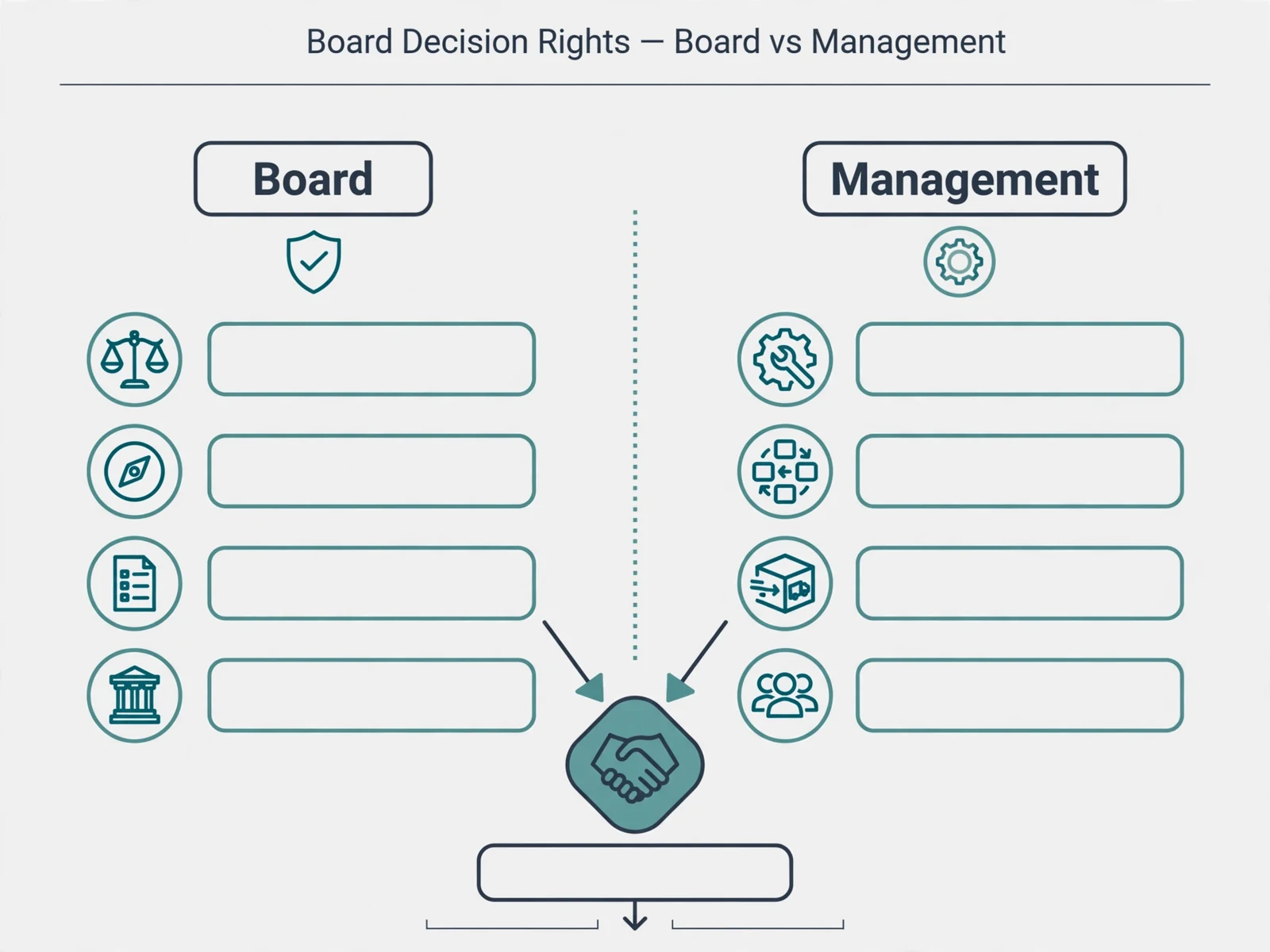
Start With the Governance Principle
The board governs. Management manages.
That simple phrase still requires careful design because some decisions sit near the boundary.
What the Board Typically Owns
Depending on law, constitution, ownership structure and governance model, board responsibilities often include:
- strategy approval;
- risk appetite;
- major capital commitments;
- executive appointment and succession;
- material transactions;
- governance policies;
- oversight of financial reporting;
- certain reserved matters.
Organizations should define these explicitly rather than rely on habit.
What Management Typically Owns
Management usually owns execution within the authority delegated by the board.
This includes:
- operating decisions;
- team leadership;
- day-to-day resource allocation;
- customer and supplier management;
- implementation of approved strategy;
- performance management;
- routine commercial decisions within limits.
Create a Reserved Matters Schedule
A reserved matters schedule lists decisions that require board approval.
Examples may include:
- investment above a threshold;
- acquisition or disposal;
- borrowing;
- major contracts;
- entry into a new country;
- changes to capital structure;
- appointment of key executives.
Use Delegation of Authority
Below board level, define who can approve what.
A delegation framework may set limits by:
- financial value;
- risk;
- contract length;
- type of commitment;
- role level.
Avoid Board Micromanagement
A board may drift into management when it:
- approves minor operating expenditure;
- directs individual employees;
- rewrites detailed implementation plans;
- intervenes in routine supplier decisions;
- requires approval for matters already delegated.
This weakens management accountability because executives cannot be fully responsible for decisions they are not allowed to make.
Avoid Management Overreach
The opposite problem appears when executives make material commitments without appropriate board oversight.
Clear thresholds reduce ambiguity.
Distinguish Oversight From Approval
The board can question, challenge and monitor an issue without owning the operating decision.
For example, the board may oversee cybersecurity risk while management chooses specific operational controls and vendors within approved policy.
Use Decision Papers That Match the Authority
When a matter requires board decision, the paper should state:
- decision requested;
- context;
- options;
- recommendation;
- financial effect;
- risk;
- governance implications.
Review Decision Rights After Growth
Decision frameworks become outdated as organizations grow, add subsidiaries, enter markets or change ownership.
Review:
- thresholds;
- committees;
- delegations;
- reserved matters;
- executive roles.
Family and Founder-Led Businesses
Governance becomes especially important when the same individuals are owners, directors and executives.
Clarify which hat a person is wearing when a decision is made.
An owner preference, board decision and management instruction are not the same thing.
A Simple Decision-Rights Map
- Board: reserved and governance decisions.
- Committee: delegated oversight or specialist decisions.
- CEO: enterprise management within board authority.
- Executive team: cross-functional operating decisions.
- Managers: defined operational authority.
Use Decision Thresholds, Not Personality
Governance becomes unstable when decisions rise to the board simply because a particular director wants to be involved.
Define thresholds by value, risk, legal significance or strategic consequence so the system survives changes in personalities.
Example: Capital Investment
A delegation framework might allow management to approve routine capital expenditure within budget, require a board committee to review investments above a defined threshold, and reserve acquisitions or transformational commitments for the full board.
The exact thresholds depend on the organization. The principle is that authority should be clear before the decision arrives.
Example: Executive Hiring
Management may own most recruitment, while the board or remuneration committee owns appointment, succession and compensation decisions for the chief executive and selected senior roles.
Write these boundaries explicitly.
What Boards Should Ask Without Taking Over
Good oversight questions include:
- What decision has management made?
- What evidence supports it?
- What risk remains?
- Is the decision within delegated authority?
- How will performance be monitored?
The board can challenge deeply while leaving the operating decision with management.
What Management Should Escalate Early
Executives should not wait until after a material commitment to discover that board approval was required.
Escalate early where an issue approaches a reserved threshold, creates unusual risk, changes strategy, or could materially affect reputation or capital.
Review Committee Overlap
Audit, risk, remuneration, nomination and other committees can create duplication if mandates are unclear. Map which committee reviews, recommends or decides each matter and how it reaches the board.
Decision-Rights Review Questions
- Are reserved matters current?
- Are financial thresholds still appropriate?
- Does management understand its authority?
- Does the board revisit matters already delegated?
- Are committee roles overlapping?
- Can urgent decisions be made when the board is not meeting?
Handle Conflicts of Interest Explicitly
Decision rights are not enough when a director or executive has a personal, family or commercial interest in the matter. Governance should define disclosure, recusal and independent review requirements.
Design for Urgent Decisions
Boards cannot always wait for the next scheduled meeting. Define how urgent matters can be approved between meetings, what quorum or written consent is required, and how the decision will be recorded.
Document Delegated Authority
When the board delegates, the delegation should be specific enough that management can act confidently. Unclear delegation encourages either unnecessary escalation or management overreach.
Annual Governance Review
At least once a year, review reserved matters, committee mandates, delegation limits and major authority thresholds against the organization’s current size, risk and structure.
Where to Go Next
The Corporate Governance Essentials course covers board roles, decision rights, risk, oversight, accountability and governance practice. Senior leaders can combine it with Finance for Senior Executives for stronger board-level financial judgement.
Good governance does not mean the board makes more decisions. It means the right decisions are made at the right level with clear accountability.
Develop this capability in your organization