A useful AI prompt is not a magic phrase. It is a clear brief.
Managers get better results when they provide context, task, constraints, output format, and review criteria.
The examples below are templates. Replace bracketed text with your own context and do not enter confidential information into tools that are not approved for it.
1. Meeting Agenda
Prompt: “Create a 45-minute meeting agenda for [purpose]. Participants are [roles]. The decisions we need are [decisions]. Avoid status-reporting that can be read asynchronously. Include time boxes and a final action review.”
2. One-to-One Preparation
Prompt: “Help me prepare for a one-to-one with an employee. Context: [non-sensitive context]. I need to cover priorities, blockers, feedback, workload and development. Give me questions, not scripted conclusions.”
3. Difficult Feedback
Prompt: “Help me structure feedback about [behaviour]. Separate observation, impact, question, expectation and follow-up. Keep the language direct and respectful. Do not invent facts.”
4. Decision Options
Prompt: “I need to decide between [options]. Criteria are [criteria]. Build a comparison table, identify assumptions, surface missing information and give me questions I should answer before deciding. Do not make the decision for me.”
5. Pre-Mortem
Prompt: “Assume this plan failed six months from now: [plan]. Generate plausible failure causes across people, process, technology, customer, financial and execution risk. Separate preventable risks from external uncertainty.”
6. Executive Update
Prompt: “Turn these notes into an executive update with: headline, business impact, evidence, risk, recommendation and decision required. Keep it under [length]. Preserve uncertainty where it exists.”
7. Research Plan
Prompt: “Create a research plan for [question]. Break it into sub-questions, identify the types of sources I should seek, and list claims that would require primary-source verification. Do not fabricate sources.”
8. Stakeholder Map
Prompt: “Help me map stakeholders for [initiative]. For each, consider influence, interest, likely concern, required decision and engagement approach. Ask me for missing context before making assumptions.”
9. Project Risk Review
Prompt: “Review this project plan for risks. Write each risk as cause, event and impact. Suggest triggers, mitigation options and questions for the project team. Do not assign probability without evidence.”
10. Delegation Brief
Prompt: “Help me create a delegation brief for [task]. Include outcome, why it matters, definition of done, authority level, constraints, checkpoint and escalation triggers.”
11. Performance Conversation
Prompt: “Help me prepare for a performance conversation using only these facts: [facts]. Separate evidence from interpretation. Suggest questions that test root cause before I decide whether the issue is capability, clarity, resources or commitment.”
12. Weekly Prioritization
Prompt: “Here are my current responsibilities: [list]. Help me sort them into urgent, important, delegable, deferrable and stoppable work. Explain the reasoning and ask where priorities conflict.”
13. Scenario Planning
Prompt: “For [business issue], create base, upside and downside scenarios. State assumptions explicitly. Identify which management decisions would change under each scenario.”
14. Process Improvement
Prompt: “Map this process from input to outcome: [process]. Identify handoffs, repeated approvals, delays, rework and unclear ownership. Suggest experiments to test improvement before redesigning everything.”
15. Learning Coach
Prompt: “Teach me [topic] at the level of a manager who needs to make decisions, not an academic specialist. Start with core concepts, then test me with five questions and explain gaps in my answers.”
Improve Any Prompt With Five Elements
- Context: what situation is this?
- Task: what should the AI do?
- Constraints: what must it avoid or preserve?
- Format: how should the output be structured?
- Review: what should be checked before use?
Do Not Outsource Accountability
Managers remain responsible for:
- accuracy;
- confidentiality;
- judgement;
- fairness;
- decisions;
- communication actually sent.
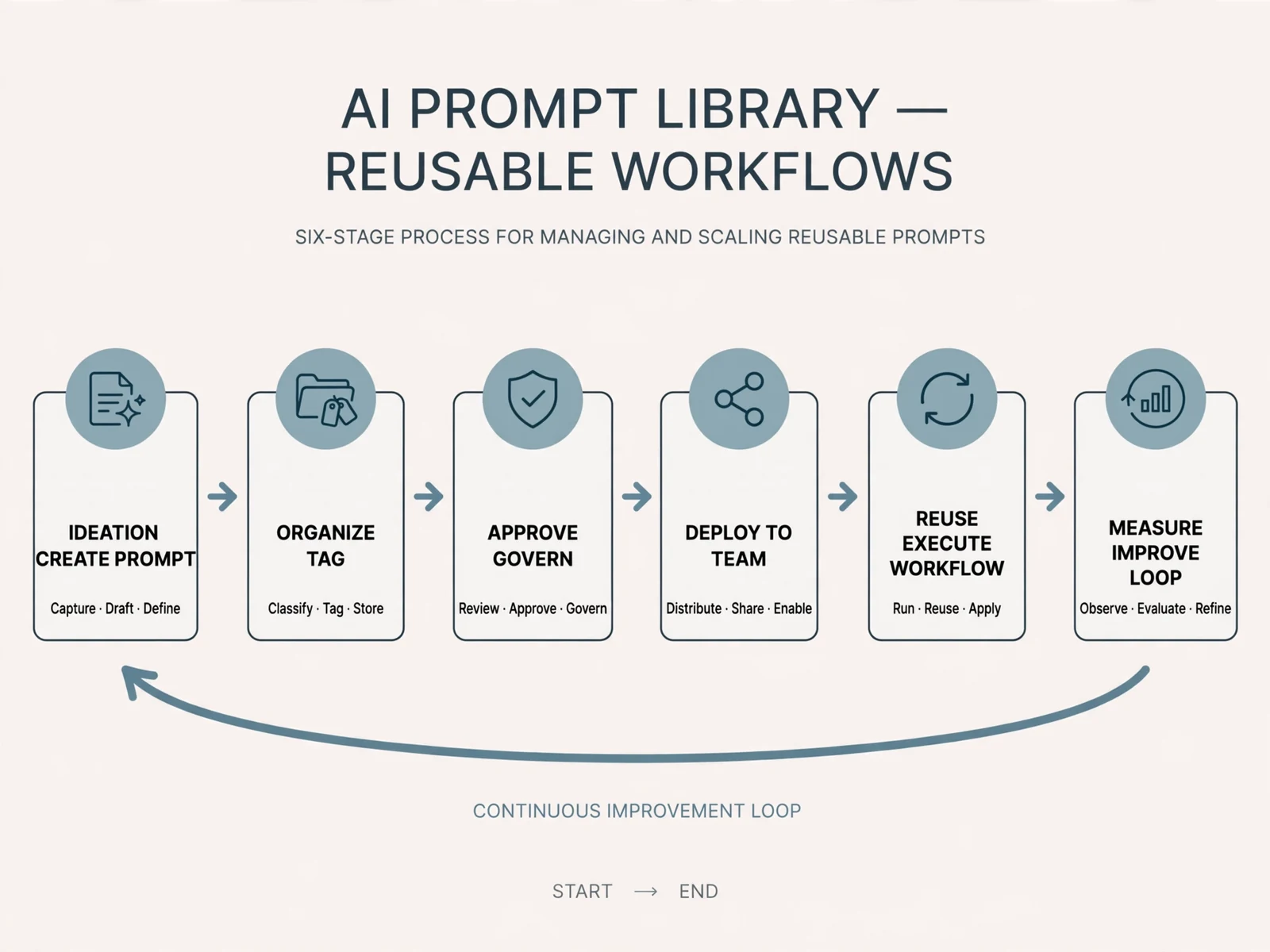
How to Turn a Prompt Into a Reusable Workflow
Do not keep rewriting the same instruction from scratch.
For recurring work, create a template with:
- fixed context;
- variables to replace;
- required output format;
- quality checks;
- human-review step.
Store the workflow where the team can use it consistently if organizational policy allows.
Add a Verification Prompt
After receiving an output, ask the model to identify:
- claims that require verification;
- assumptions it made;
- missing context;
- areas where confidence is low;
- alternative interpretations.
This does not replace human checking, but it helps structure review.
Use Examples to Improve Consistency
If you need a particular format, provide one good example. Explain what makes the example good rather than asking the model to imitate blindly.
Build Role-Specific Libraries
A useful manager library might include meeting, feedback, prioritization and decision workflows. HR may need interview, policy-drafting and learning workflows. Finance may need variance-analysis or scenario prompts.
Role-specific libraries create more value than a giant generic list.
Set Boundaries Around Sensitive Work
Before using any prompt, check whether the tool is approved for the information involved. Remove confidential data where possible and follow organizational policy.
Review Prompt Performance
If a workflow repeatedly produces weak output, do not keep blaming the model. Improve the brief, context, examples or evaluation criteria, or decide that the task is not suitable for AI.
Manager Prompt Quality Checklist
- Is the business context clear?
- Is the task specific?
- Are constraints stated?
- Is the output format defined?
- Does the prompt forbid invention where necessary?
- Is a human-review step clear?
Where to Go Next
The AI Tools for Managers and Professionals course develops practical AI workflows, prompting and professional use. The AI for Women at Work program provides the same practical capability inside the Women at Work pathway, with strong emphasis on judgement, privacy and repeatable professional systems.
The best prompt library is the one built around recurring work you actually need to improve.
Develop this capability in your organization