Build management capability across data interpretation, KPI design, strategic decisions, business cases and financial planning.
Who This Academy Is For
Managers, analysts, PMO teams and functional leaders who need stronger evidence, KPI and business-case judgement.
Built as a Corporate Capability Pathway
The academy can be used as a full pathway or configured as a core plus electives. Delivery is live and instructor-led, with sequence and spacing designed around participant level, work context and organizational priorities rather than a fixed duration.
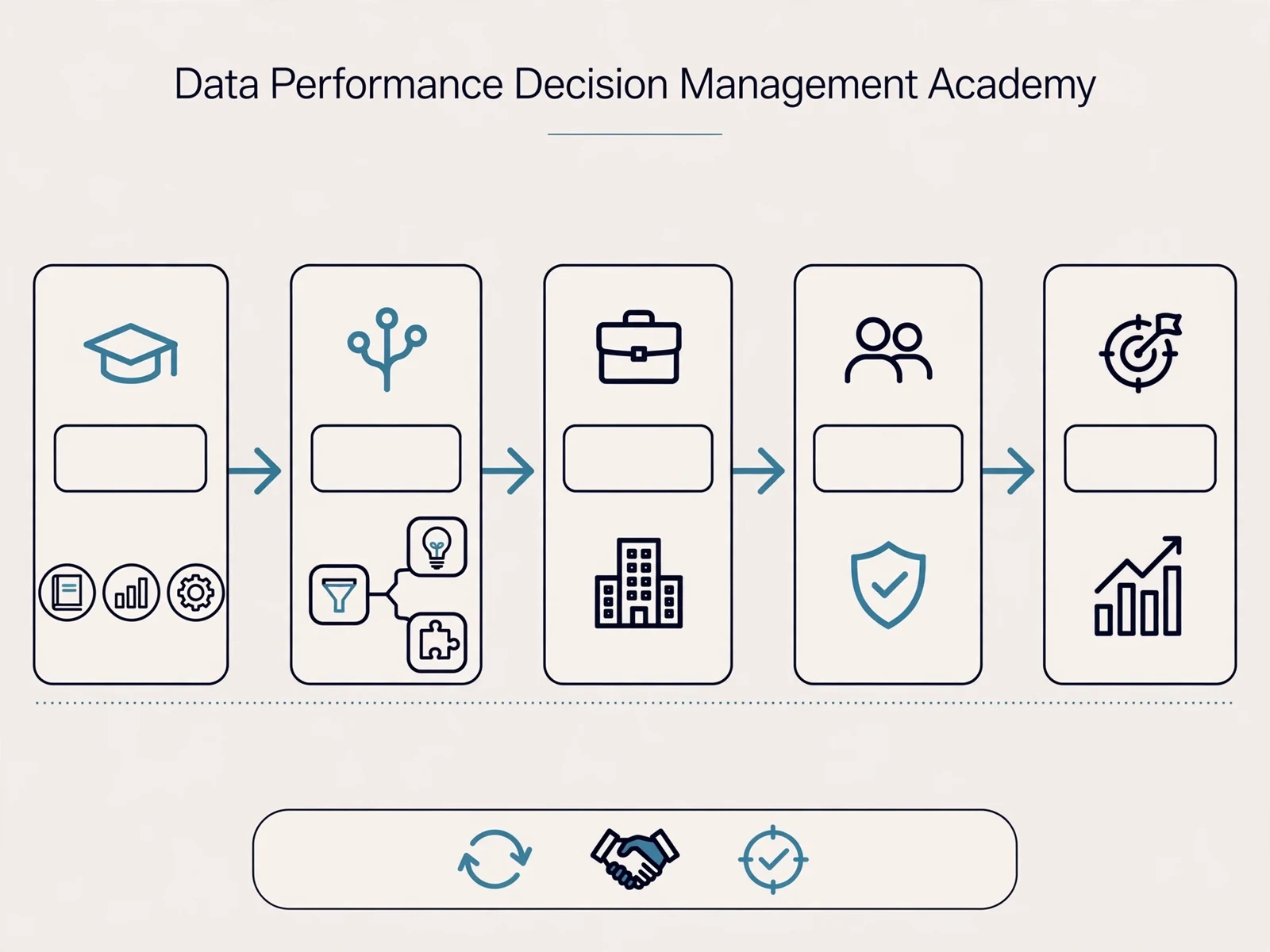
Programs in the Pathway
Data Analytics for Business Managers
Improve analytical questions, data interpretation, dashboards and evidence use.
KPI Design and Performance Measurement
Design measures, targets and review routines around management decisions.
Strategic Thinking and Decision Making
Frame complex issues, assumptions, scenarios and executive recommendations.
Business Case Development and Investment Appraisal
Turn strategic proposals into decision-ready options, costs, benefits and risks.
Budgeting, Forecasting and Cost Control
Connect plans, financial forecasts and management control.
Organizational Outcomes
- Improve evidence-based management
- Strengthen KPI and dashboard quality
- Improve investment and business-case decisions
- Connect strategic thinking to financial evidence
- Build managers who can challenge analysis without becoming data scientists
Business Problems This Academy Can Address
How to Structure the Cohort
A strong academy begins with the work participants are expected to perform. Sponsors should define current responsibility, next-level responsibility, recurring decisions, stakeholder complexity and the practical outputs the organization wants to see used more consistently.
Shared programs for the whole cohort.
Additional depth for role-specific responsibility.
Live work used between programs.
Manager and sponsor follow-up around observed application.
Capability Progression
The sequence should create progression rather than simply place courses next to one another. Early programs establish shared concepts and working methods. Later programs should increase decision complexity, cross-functional responsibility or strategic scope. More experienced cohorts can skip foundation content and use electives for targeted depth.
The pathway can also evolve after the first cohort. If participants already demonstrate one capability but struggle with another, future cohorts should be adjusted. The academy should be treated as a managed capability system, not a permanent package that never changes.
Between-Program Application
Participants can apply one or two relevant tools on live work between modules and bring that experience into the next program. This gives later sessions a practical foundation and creates evidence about what participants can actually use outside the classroom.
Managers can reinforce the pathway by reviewing the participant’s chosen application, asking what changed and helping create opportunities for further practice. They do not need to reteach the course.
What Sponsors Can Measure
Useful evidence includes application of course tools, quality of work products, clearer decisions, improved ownership, manager observations and readiness for more complex assignments where appropriate. TheSkillGrid does not treat attendance alone as proof of ROI.
- Application of relevant tools to live work.
- Quality and reuse of work products.
- Manager observation of target behaviors.
- Decision, escalation or stakeholder-management quality.
- Evidence that the capability is entering normal operating routines.
Sponsor Decisions Before Launch
Before launch, define the participant population, business problem, core programs, electives and the management routines that will reinforce application. This prevents an academy from becoming an oversized course bundle and keeps development tied to the capability objective.
The sponsor should also decide how much evidence is sufficient. A strategic leadership academy may use manager observation and work products, while a technical process academy may use stronger standards and control evidence. Evaluation should fit the decision the organization needs to make.
How the Academy Should Progress
The pathway should become more demanding as participants progress. Early programs establish a shared language and a practical operating method. Later programs should ask participants to integrate several capabilities at once, make more complex decisions and work across a wider set of stakeholders. This progression matters more than simply increasing the number of classroom hours.
Sponsors can also vary depth by participant. A common core may be appropriate for the whole cohort, while experienced participants take an advanced elective or live application assignment. This prevents the pathway from becoming repetitive for stronger participants while still creating a consistent organizational baseline.
Workplace Application Between Modules
Between modules, participants should apply one or two tools in the normal course of work. The purpose is not to create additional academic assignments. It is to connect the learning to real decisions, work products and operating routines while the topic is still fresh.
A participant might test a process map, stakeholder plan, business case, KPI definition, audit finding, facilitation design or another relevant output. The next session can then use that experience as a practical reference point, allowing the cohort to compare what happened and what needs to change.
Manager and Sponsor Role
Managers reinforce the academy by creating opportunities to apply the capability and reviewing the result. They do not need to reteach the course. A useful manager conversation asks what the participant tried, what evidence informed the decision, what happened and what should be adjusted next time.
Sponsors can look across the cohort for recurring patterns. If several participants struggle with the same interface, decision or work product, that may indicate a process issue, a missing elective, a need for manager reinforcement or a wider organizational constraint that training alone cannot solve.
When to Use a Shorter Version
Not every population needs the full pathway. A team with a specific gap may benefit from two connected programs rather than a full academy. TheSkillGrid can reduce the pathway to the minimum combination that addresses the capability need, or use one program as a diagnostic starting point before a broader rollout.
This keeps the academy commercially and operationally disciplined. The goal is not to maximize the number of programs purchased. The goal is to build the capability the organization actually needs and create enough reinforcement for that capability to become usable at work.
Private Delivery and Investment
This academy is quoted as a private organizational pathway. Pricing depends on selected programs, cohort size, locations, delivery format and customization. Delivery can combine classroom, live online and in-house formats where appropriate. VAT and location-specific expenses are excluded unless explicitly stated.
Frequently Asked Questions
Do we need every course?
No. The pathway can use a common core with electives.
Is the academy a fixed duration?
No. Sequence, depth and spacing are designed around the cohort and business need.
Can we use internal frameworks and scenarios?
Yes. Private delivery can align to relevant terminology, frameworks and anonymized workplace situations.
Can participants apply the learning between programs?
Yes. Between-program application is a core part of the academy design.
Design the Right Cohort
Contact TheSkillGrid with the participant population, approximate cohort size and capability priorities to shape the pathway.
View all Training Bundles and Corporate Academies.
Request a Proposal for This Pathway
Tell us about your team, delivery preferences and development goals. We will discuss a tailored proposal; this is not a booking or a confirmed fee.