Business Case Development and Investment Appraisal
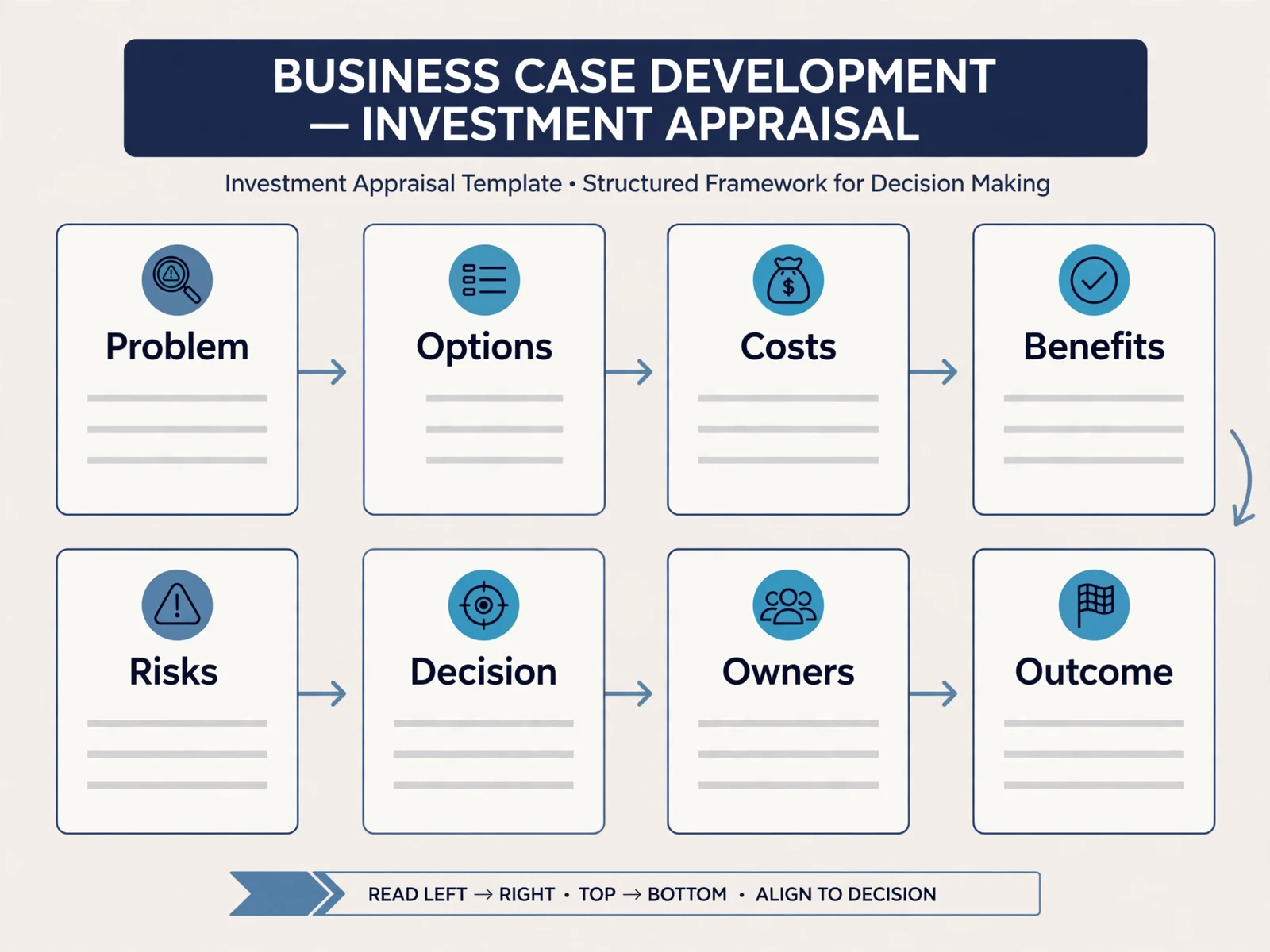
View Dates & OptionsA business case should make a decision easier. It should explain the problem, credible options, value, cost, risk and assumptions clearly enough that leaders can choose what to do next.
Course Overview
This program is for managers, project sponsors, finance partners and professionals who prepare or review proposals for investment, change, technology or new initiatives. It combines strategic logic with practical financial appraisal.
Participants define the need, compare options, estimate costs and benefits, identify assumptions, use common financial appraisal concepts and present a recommendation with risk and sensitivity clearly stated.
For organizations, the course can improve investment governance, project initiation and the quality of proposals reaching executive committees.
Where this program fits
Managers, project sponsors, finance partners and professionals preparing investment proposals
Live classroom, live online or private in-house. Depth and schedule are tailored to the cohort.
Problem definition, options, benefits, costs, financial appraisal, risk, assumptions and recommendation
A decision-ready business case outline for a live proposal
Built for Corporate Cohorts
Private delivery can be aligned to participant roles, business priorities, internal terminology and real workplace scenarios. HR, L&D and functional sponsors can use the course alone or inside a broader academy.
What Participants Will Learn
Describe the problem, opportunity and consequence of doing nothing.
Compare alternatives rather than presenting only a preferred solution.
Make assumptions visible and avoid double counting.
Apply practical concepts such as payback, NPV and sensitivity at the appropriate level.
Show how key assumptions affect the recommendation.
Present the recommendation, evidence and required decision clearly.
Business Problems This Program Is Designed to Address
Course Outline
Applied Practice and Scenario Work
Participants use realistic situations to practise analysis, decisions, stakeholder communication and application. Private cohorts can adapt scenarios to the organization’s context while protecting confidential information.
Participants test assumptions, ownership and realization conditions.
Participants frame the decision using both financial and non-financial evidence.
Participants compare sensitivity and implementation exposure.
Participants show why the current-state consequence is part of the decision.
Practical Tools and Work Products
What Strong Practice Looks Like
A business case is an argument for a decision, not a justification document written after the preferred solution has already been selected. Strong cases make alternatives and trade-offs visible.
Benefits need evidence and ownership. A saving may depend on headcount, volume, behavior or system adoption. If the organization cannot explain how the benefit will actually be realized, the number should not be treated as guaranteed.
Costs should also include implementation and transition. Purchase price alone can omit integration, training, internal effort, migration, support and temporary productivity effects.
Financial appraisal helps compare timing and value, but no single metric captures every decision. Participants use appraisal methods appropriately and make limitations explicit rather than allowing a formula to replace judgement.
Sensitivity analysis is especially useful when uncertainty is high. Leaders can see which assumptions most affect the recommendation and where further evidence would meaningfully improve confidence.
Questions Participants Learn to Ask
What happens if we do nothing?
Which option is genuinely different from the preferred solution?
Which benefit depends on the weakest assumption?
What evidence would make us change the recommendation?
Implementation Pitfalls and Cross-Functional Interfaces
Capability in this topic depends on how decisions move across the organization. Private cohorts can map where ownership, information or incentives currently break down and use those interfaces as part of the learning design.
- Finance for appraisal and assumptions
- Project and transformation teams for implementation estimates
- Operations for benefit realization
- Executive sponsors for strategic fit and risk appetite
A common implementation mistake is to add a framework without changing the management routine around it. Participants identify where the tool will be used, who needs to be involved, what evidence is required and what decision or behavior should become different after application.
Advanced Application Considerations
Business cases also need governance after approval. Material changes in cost, scope, timing or benefit assumptions should trigger revalidation rather than allowing an obsolete case to remain the justification for continued investment.
Another maturity issue is optimism bias. Sponsors naturally understand the upside of their proposal better than the downside. Structured challenge, reference comparisons and sensitivity help decision-makers see where enthusiasm may be exceeding evidence.
The quality of a business case also depends on option architecture. Alternatives should be plausible and sufficiently developed to compare. Including a deliberately weak option only to make the preferred solution look better reduces decision quality.
Capability Maturity in Practice
A mature practitioner can explain not only which tool was used, but why it was appropriate, what evidence supported the choice, which stakeholders needed to be involved and what review point will show whether the approach is working. Private cohorts can compare current practice with this stronger operating model and identify one realistic improvement to apply immediately.
This maturity lens also helps sponsors distinguish course attendance from application. The objective is not to use every technique after the program; it is to improve the quality and consistency of the decisions that matter most in the participant’s role.
Before the Program Begins
For a private cohort, participants can identify one current case, decision or recurring problem related to the topic. Anonymized patterns can be used to weight practice without turning the program into a review of confidential internal matters.
After the Program
Participants can use one work product in the next relevant work cycle and discuss the result with a manager or peer. The goal is to reinforce application while the participant has a live opportunity to use the capability.
Manager Reinforcement and Evidence of Application
Sponsors can look for observable changes such as clearer decisions, stronger preparation, better use of the relevant work product, improved ownership or better escalation. These are indicators that the capability is being applied, not automatic claims that attendance caused a business result.
Participants should select one or two applications first rather than trying to use every concept at once. Managers can ask what was tried, what response followed and what should be adjusted next time.
Designing a Private Cohort Around Real Work
Before private delivery, the sponsor can define participant roles, experience level, common workplace situations, internal terminology and one or two practical outputs that would be useful after the program.
- Participant roles and experience.
- Recurring decisions or problems the cohort needs to handle better.
- Relevant internal frameworks or governance.
- Practical work products participants can use afterward.
- How managers will reinforce application.
Capability Maturity and Leadership Judgement
Business cases also need to separate sunk cost from future decision value. Money or effort already spent may explain context, but it should not automatically justify continued investment. Participants learn to focus the decision on future costs, benefits, risks and strategic consequences.
Another maturity issue is benefit interaction. Two initiatives may claim the same saving or growth benefit, creating double counting across the portfolio. Participants identify dependencies and ownership so the same outcome is not credited repeatedly.
Affordability and value are related but different. An option may have attractive long-term value while still exceeding near-term cash or capacity constraints. The course helps managers present both dimensions clearly to decision-makers.
For corporate cohorts, these maturity questions give sponsors a practical way to distinguish basic tool use from stronger professional judgement. Participants should be able to explain why a method was selected, what evidence supported it, which stakeholders were involved and what review point will show whether the approach remains effective.
Who Should Attend
- Managers and project sponsors
- Finance business partners
- Project and transformation professionals
- Professionals preparing investment proposals
Organizational Benefits
- Improve investment decision quality
- Strengthen benefit and cost assumptions
- Reduce solution-first proposals
- Improve financial and risk appraisal
- Create clearer executive recommendations
Delivery and Pricing
The program is live and instructor-led. It can be delivered in the classroom, live online or in-house. Duration is flexible and should reflect participant level, selected depth, organizational objectives and the amount of applied practice required.
Public and private pricing: current public fees are confirmed with scheduled cohorts. Private and customized programs are quoted according to cohort size, location, scope and customization. Request a proposal.
Frequently Asked Questions
Can this be delivered privately for one organization?
Yes. Private cohorts can be calibrated to participant roles, business context and priority scenarios.
Is the duration fixed?
No. Delivery depth and schedule are adapted to the cohort and learning objective.
Can we use our own scenarios?
Yes. Organization-relevant situations can be used while protecting confidential information.
Can this sit inside a broader academy?
Yes. It can be combined with related programs into a role, function or leadership pathway.
Is this self-paced?
No. TheSkillGrid programs are live and instructor-led.
Related Programs
- Financial Management for Non-Finance Managers
- Budgeting, Forecasting and Cost Control
- Strategic Thinking and Decision Making
- Program Management and PMO Leadership
Build a Cohort Around the Capability Need
TheSkillGrid can combine this course with adjacent programs into a coherent corporate pathway.
Upcoming Dates & Venues
Explore proposed 2027 dates and venues for this course. The city, trainer, venue, duration and fee are subject to confirmation. Use the proposed-date link to request availability, not a confirmed booking.
Request course availability with your preferred date, location and group size. We will confirm available public-session and private-team options before any booking or payment.
Ready to Take the Next Step?
Register your interest for a public session or request private in-house delivery for your team.