Facilitation Skills for Managers and Team Leaders
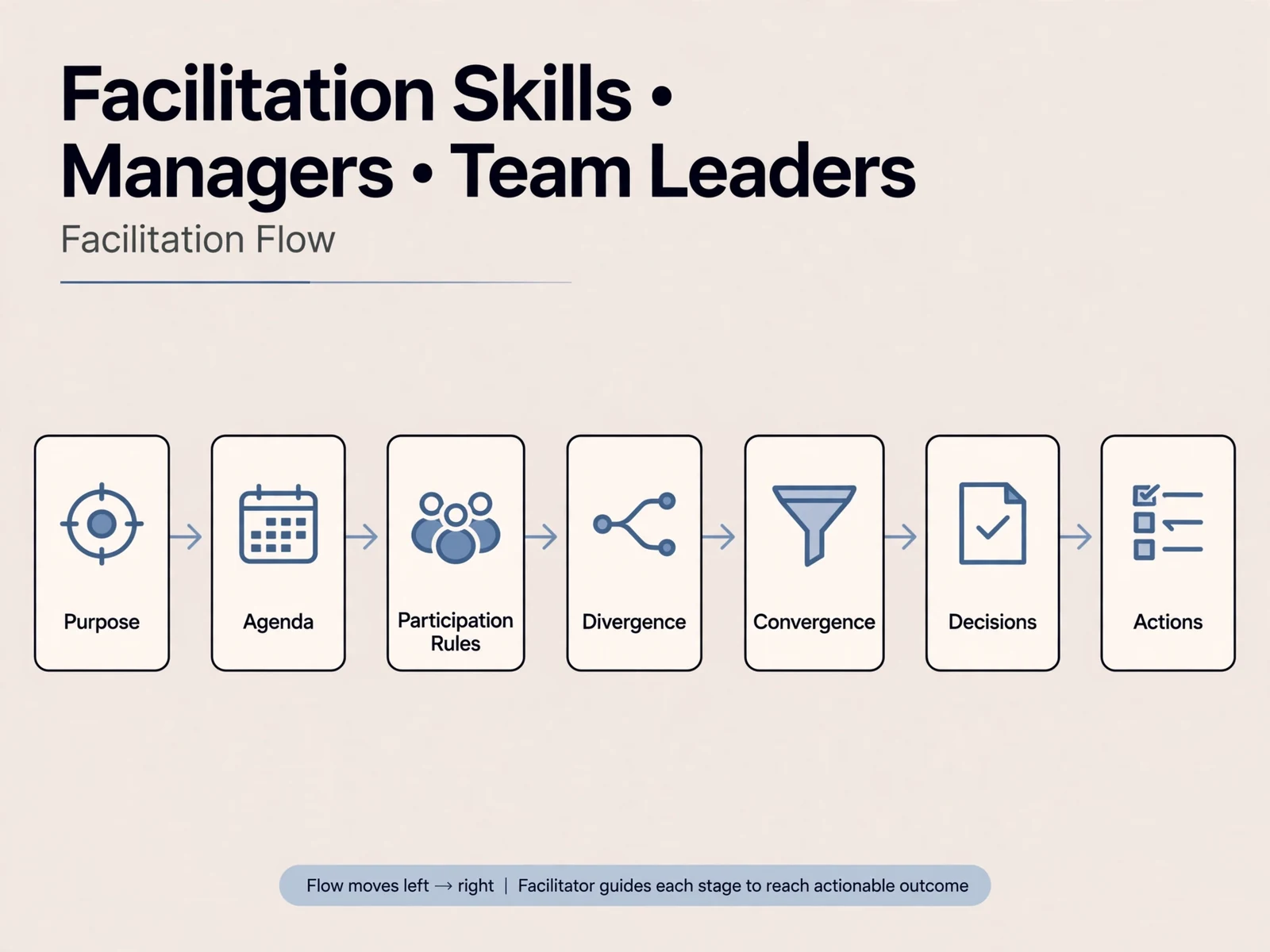
View Dates & OptionsFacilitation is the skill of helping a group think and decide well together. The facilitator manages the process without taking over the group’s ownership of the content.
Course Overview
This program is for managers, team leaders, project professionals and internal facilitators who run workshops, problem-solving sessions, planning meetings or cross-functional discussions.
Participants design sessions around outcomes, choose participation methods, ask better questions, manage dominant and quiet voices, work with conflict and move groups toward clear decisions and actions.
For organizations, the course can improve meeting quality, project workshops, strategy sessions and collaborative problem-solving.
Where this program fits
Managers, team leaders, project professionals and internal facilitators who lead group sessions
Live classroom, live online or private in-house. Depth and schedule are tailored to the cohort.
Purpose, agenda design, participation, questions, group dynamics, decision methods and follow-through
A facilitation plan for a real upcoming workshop or meeting
Built for Corporate Cohorts
Private delivery can be aligned to participant roles, business priorities, internal terminology and real workplace scenarios. HR, L&D and functional sponsors can use the course alone or inside a broader academy.
What Participants Will Learn
Clarify what the group needs to understand, create or decide.
Use methods that involve the right people at the right time.
Move the group from description toward analysis and decision.
Handle dominance, silence, side conversations and conflict.
Make options, criteria and commitment visible.
Translate discussion into owners, next steps and follow-up.
Business Problems This Program Is Designed to Address
Course Outline
Applied Practice and Scenario Work
Participants use realistic situations to practise analysis, decisions, stakeholder communication and application. Private cohorts can adapt scenarios to the organization’s context while protecting confidential information.
Participants intervene without undermining the leader’s role.
Participants facilitate evidence and assumptions before jumping to solutions.
Participants reset the process around the decision authority and minimum information needed.
Participants improve ownership, specificity and follow-up.
Practical Tools and Work Products
What Strong Practice Looks Like
Facilitation begins with purpose. A meeting to inform, explore, design and decide requires different methods. Confusion about purpose often produces long sessions with no clear endpoint.
The facilitator manages process rather than owning every answer. That can be difficult for managers who are also subject experts. Participants learn when to contribute content and when to protect the group’s thinking process.
Participation design matters because speaking order shapes whose ideas are heard. Silent reflection, pairs, small groups and structured rounds can improve contribution before open discussion, especially where hierarchy is strong.
Conflict can be productive when it is about evidence, assumptions or trade-offs. The facilitator helps the group make disagreement explicit without letting the discussion become personal or circular.
Closure should state what was decided, what remains open, who owns each action and when it returns for review. A good workshop is judged partly by what happens afterward.
Questions Participants Learn to Ask
What must be different by the end of this session?
Whose contribution is necessary for a good decision?
What group dynamic is preventing useful discussion?
What exactly has been decided and who owns the next action?
Implementation Pitfalls and Cross-Functional Interfaces
Capability in this topic depends on how decisions move across the organization. Private cohorts can map where ownership, information or incentives currently break down and use those interfaces as part of the learning design.
- Leadership teams for strategy and decision workshops
- Project teams for planning and retrospectives
- HR and L&D for learning sessions
- Transformation teams for cross-functional design
A common implementation mistake is to add a framework without changing the management routine around it. Participants identify where the tool will be used, who needs to be involved, what evidence is required and what decision or behavior should become different after application.
Advanced Application Considerations
Facilitators also need to manage their own bias. The questions they ask, order of discussion and summaries they provide can steer the group unintentionally. Participants practise making assumptions visible and checking whether summaries reflect the group rather than the facilitator’s preference.
Another maturity issue is designing for power differences. People may not challenge senior colleagues openly. Structured methods can surface concerns before public discussion and reduce the risk that silence is mistaken for agreement.
Virtual facilitation requires additional discipline around attention, turn-taking and visual information. The same principles apply, but the session design may need shorter cycles, clearer instructions and more deliberate participation.
Before the Program Begins
For a private cohort, participants can identify one current case, decision or recurring problem related to the topic. Anonymized patterns can be used to weight practice without turning the program into a review of confidential internal matters.
After the Program
Participants can use one work product in the next relevant work cycle and discuss the result with a manager or peer. The goal is to reinforce application while the participant has a live opportunity to use the capability.
Manager Reinforcement and Evidence of Application
Sponsors can look for observable changes such as clearer decisions, stronger preparation, better use of the relevant work product, improved ownership or better escalation. These are indicators that the capability is being applied, not automatic claims that attendance caused a business result.
Participants should select one or two applications first rather than trying to use every concept at once. Managers can ask what was tried, what response followed and what should be adjusted next time.
Designing a Private Cohort Around Real Work
Before private delivery, the sponsor can define participant roles, experience level, common workplace situations, internal terminology and one or two practical outputs that would be useful after the program.
- Participant roles and experience.
- Recurring decisions or problems the cohort needs to handle better.
- Relevant internal frameworks or governance.
- Practical work products participants can use afterward.
- How managers will reinforce application.
Capability Maturity and Management Judgement
Facilitators also need to manage decision rights explicitly. Consensus is useful for some choices, but forcing consensus where one accountable leader must decide can waste time and obscure accountability. Participants learn to match the decision method to the actual authority structure.
Energy and cognitive load matter too. A session can fail because participants are overloaded, not because they lack commitment. Strong facilitators vary activity, build in reflection and sequence difficult thinking so the group can maintain quality over time.
Documentation should capture decisions and reasoning without turning the facilitator into a transcription service. Participants learn to record what the group will need later: choices, assumptions, owners, unresolved questions and follow-up points.
For corporate cohorts, these questions can be used to compare current practice with a stronger operating model and identify the smallest change that would materially improve decision quality, execution or governance.
Facilitation maturity also means knowing when a group session is the wrong tool. Some issues require individual preparation, a sponsor decision or bilateral conflict resolution before a workshop can succeed. Participants learn to diagnose whether the group is ready to work productively before investing in a large session.
For sponsors, this creates a practical distinction between course completion and capability maturity. Participants should be able to explain why they selected a method, what evidence informed the choice, how stakeholders were involved and what review point will show whether the approach is working.
Facilitators should also debrief significant sessions. Reviewing where the process supported or blocked participation helps them improve future design and distinguish a content problem from a facilitation problem.
That reflection turns facilitation from a collection of techniques into a repeatable leadership capability.
Who Should Attend
- Managers and team leaders
- Project and program professionals
- Internal facilitators
- HR and L&D professionals
Organizational Benefits
- Improve meeting and workshop quality
- Increase participation
- Handle difficult group dynamics more confidently
- Improve decision clarity
- Strengthen action follow-through
Delivery and Pricing
The program is live and instructor-led. It can be delivered in the classroom, live online or in-house. Duration is flexible and should reflect participant level, selected depth, organizational objectives and the amount of applied practice required.
Public and private pricing: current public fees are confirmed with scheduled cohorts. Private and customized programs are quoted according to cohort size, location, scope and customization. Request a proposal.
Frequently Asked Questions
Can this be delivered privately for one organization?
Yes. Private cohorts can be calibrated to participant roles, business context and priority scenarios.
Is the duration fixed?
No. Delivery depth and schedule are adapted to the cohort and learning objective.
Can we use our own scenarios?
Yes. Organization-relevant situations can be used while protecting confidential information.
Can this sit inside a broader academy?
Yes. It can be combined with related programs into a role, function or leadership pathway.
Is this self-paced?
No. TheSkillGrid programs are live and instructor-led.
Related Programs
- Business Communication and Presentation Skills
- Coaching Skills for Managers and Leaders
- Stakeholder Management and Strategic Engagement
- Change Management and Organizational Transformation
Build a Cohort Around the Capability Need
TheSkillGrid can combine this course with adjacent programs into a coherent corporate pathway.
Upcoming Dates & Venues
Request course availability with your preferred date, location and group size. We will confirm available public-session and private-team options before any booking or payment.
Ready to Take the Next Step?
Register your interest for a public session or request private in-house delivery for your team.