Quality Management Systems and Continuous Improvement
View Dates & OptionsQuality management is strongest when it helps people control work, learn from failure and improve performance, not when it becomes a separate layer of documentation.
Course Overview
This program is for quality professionals, operations managers, process owners and functional leaders who need a practical understanding of quality management systems and continuous improvement. It focuses on how quality is built into processes, roles, evidence and management routines.
Participants examine customer and stakeholder requirements, process controls, nonconformance, corrective action, performance measures, audits and improvement priorities. The course is principles-based and can be aligned to an organization’s existing quality framework without claiming certification.
For organizations, the program can support quality academies, operational excellence, management-system maturity and managers who need to own quality rather than delegate it entirely to a quality department.
Where this program fits
Quality professionals, process owners, operations managers and functional leaders responsible for consistent performance
Live classroom, live online or private in-house. Depth and schedule are tailored to the cohort.
Requirements, process ownership, controls, evidence, nonconformance, corrective action, improvement and management review
A practical quality-system improvement plan for one process or service
Built for Corporate Cohorts
Private delivery can be aligned to participant roles, business priorities, internal terminology and real workplace scenarios. HR, L&D and functional sponsors can use the course alone or inside a broader academy.
What Participants Will Learn
Connect customer requirements, process control and leadership responsibility.
Define who owns performance, control and improvement across a process.
Move from symptom correction toward structured cause analysis and corrective action.
Select measures and records that support decisions rather than documentation for its own sake.
Turn quality reporting into priorities, actions and accountability.
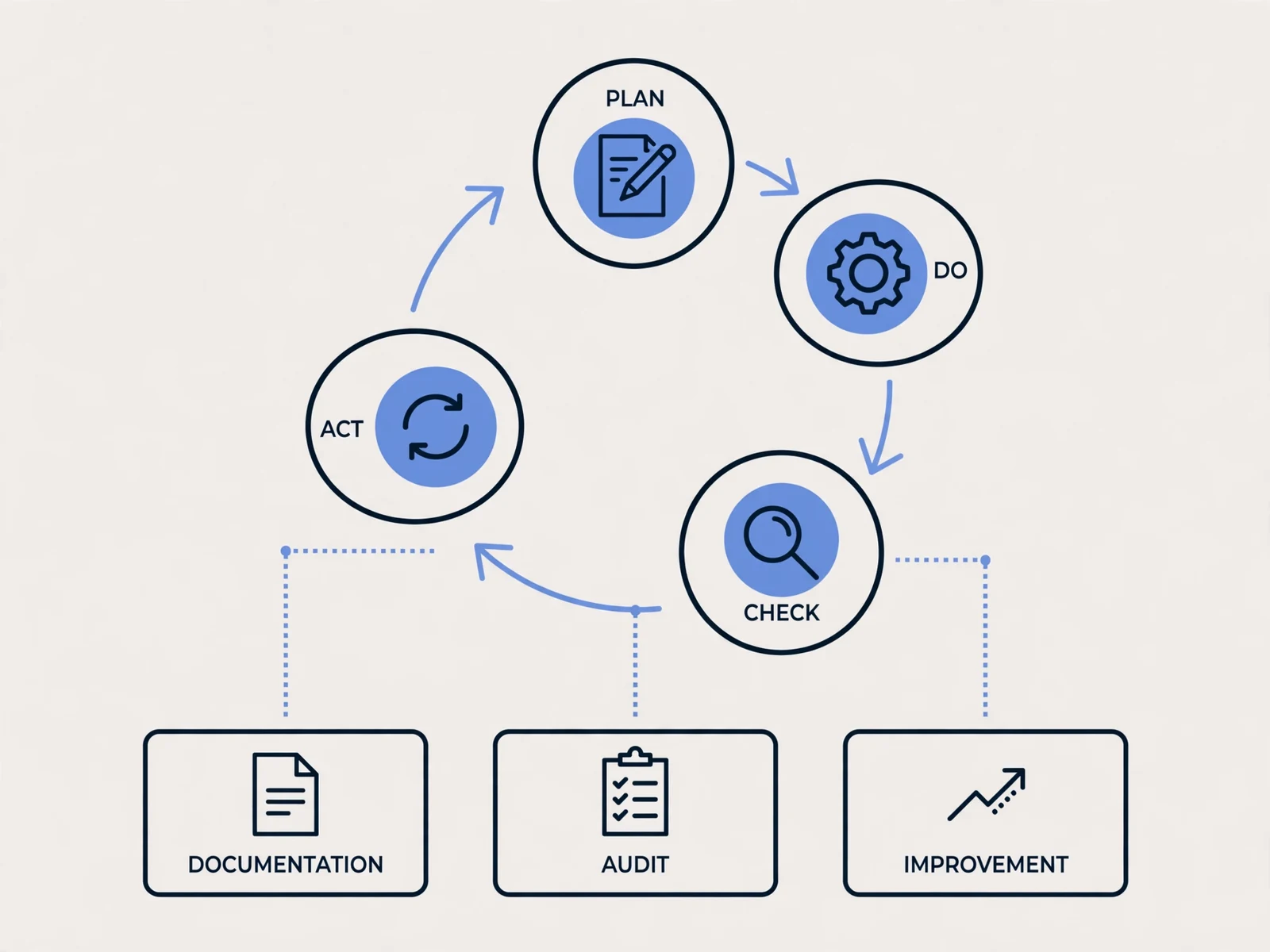
Create a disciplined cycle for learning and process improvement.
Business Problems This Program Is Designed to Address
Course Outline
Applied Practice and Scenario Work
Participants use realistic situations to practise analysis, decisions, stakeholder communication and application. Private cohorts can adapt scenarios to the organization’s context while protecting confidential information.
Participants identify why the operating process differs from the documented one and what should change.
Participants separate containment from corrective action and define an effectiveness check.
Participants identify which measures should trigger management decisions.
Participants map process ownership across the handoffs.
Practical Tools and Work Products
What Strong Practice Looks Like
Quality management works through the operating system of the organization. Requirements need to be understood, processes need owners, controls need purpose and evidence needs to support decisions. A document is useful only when it helps people perform or verify the work.
Process thinking is especially important because customer outcomes usually cross organizational boundaries. A local team can meet its own target while the end-to-end process still fails. Participants learn to define process boundaries and handoffs rather than managing quality only inside departments.
Nonconformance should create learning. Immediate correction may restore service, but recurrence is reduced only when the organization understands why the problem happened and changes the relevant process, control, capability or condition.
Management review should also be selective. Leaders need trends, significant failures, unresolved risks, improvement progress and evidence that controls remain effective. A long presentation of every metric can hide the issues requiring leadership action.
Continuous improvement becomes sustainable when improvements are standardized, measured and incorporated into normal ownership. The goal is not a permanent project team but a management routine that can identify, test and sustain better ways of working.
Questions Participants Learn to Ask
What requirement is this process designed to satisfy?
Which control prevents or detects the most important failure?
What evidence shows the corrective action actually worked?
Which quality issue requires management rather than local process action?
Implementation Pitfalls and Cross-Functional Interfaces
Capability in this topic depends on how decisions move across the organization. Private cohorts can map where ownership, information or incentives currently break down and use those interfaces as part of the learning design.
- Operations for process ownership and execution
- Customer-facing teams for requirement and complaint insight
- Risk and audit teams for assurance
- Leadership for priorities, resources and management review
A common implementation mistake is to add a framework without changing the management routine around it. Participants identify where the tool will be used, who needs to be involved, what evidence is required and what decision or behavior should become different after application.
Advanced Application Considerations
A mature quality system distinguishes control from bureaucracy. More approvals and records do not automatically create better quality. Controls should be justified by the risk of failure and should make correct performance easier to achieve or verify.
Quality maturity also requires a disciplined approach to change. When processes, suppliers, systems or roles change, organizations should consider what quality risks change with them rather than waiting for defects to reveal the new exposure.
Improvement portfolios should be prioritized. Some issues need urgent corrective action, some require redesign and some can be monitored. Participants use customer impact, recurrence, risk and effort to decide where management attention belongs.
Before the Program Begins
For a private cohort, participants can identify one current case, decision or recurring problem related to the topic. Anonymized patterns can be used to weight practice without turning the program into a review of confidential internal matters.
After the Program
Participants can use one work product in the next relevant work cycle and discuss the result with a manager or peer. The goal is to reinforce application while the participant has a live opportunity to use the capability.
Manager Reinforcement and Evidence of Application
Sponsors can look for observable changes such as clearer decisions, stronger preparation, better use of the relevant work product, improved ownership or better escalation. These are indicators that the capability is being applied, not automatic claims that attendance caused a business result.
Participants should select one or two applications first rather than trying to use every concept at once. Managers can ask what was tried, what response followed and what should be adjusted next time.
Designing a Private Cohort Around Real Work
Before private delivery, the sponsor can define participant roles, experience level, common workplace situations, internal terminology and one or two practical outputs that would be useful after the program.
- Participant roles and experience.
- Recurring decisions or problems the cohort needs to handle better.
- Relevant internal frameworks or governance.
- Practical work products participants can use afterward.
- How managers will reinforce application.
Capability Maturity and Management Judgement
Quality leaders also need to distinguish assurance from improvement. Assurance asks whether the current system is being followed and remains effective. Improvement asks whether the system itself should change. Confusing the two can produce audits that merely confirm existing practice without challenging whether that practice is still the best way to meet requirements.
Supplier quality and outsourced processes also need to fit the same management system. The organization remains responsible for the outcome even when part of the work is performed externally. Participants consider how requirements, evidence, escalation and improvement should extend across supplier interfaces.
Another maturity issue is document control. Procedures, forms and records should remain current enough to support work, but documentation should not expand without purpose. Participants learn to distinguish controlled information that guides or proves the process from material that simply adds maintenance burden.
For corporate cohorts, these maturity questions can be used to compare current practice with a stronger operating model and identify one or two realistic changes that would improve control, decision quality or performance.
Who Should Attend
- Quality managers and specialists
- Operations and process managers
- Functional leaders and process owners
- Managers responsible for management-system performance
Organizational Benefits
- Strengthen quality ownership outside the quality function
- Improve corrective-action discipline
- Reduce documentation without decision value
- Connect audits and reviews to improvement
- Build a more practical continuous-improvement culture
Delivery and Pricing
The program is live and instructor-led. It can be delivered in the classroom, live online or in-house. Duration is flexible and should reflect participant level, selected depth, organizational objectives and the amount of applied practice required.
Public and private pricing: current public fees are confirmed with scheduled cohorts. Private and customized programs are quoted according to cohort size, location, scope and customization. Request a proposal.
Frequently Asked Questions
Can this be delivered privately for one organization?
Yes. Private cohorts can be calibrated to participant roles, business context and priority scenarios.
Is the duration fixed?
No. Delivery depth and schedule are adapted to the cohort and learning objective.
Can we use our own scenarios?
Yes. Organization-relevant situations can be used while protecting confidential information.
Can this sit inside a broader academy?
Yes. It can be combined with related programs into a role, function or leadership pathway.
Is this self-paced?
No. TheSkillGrid programs are live and instructor-led.
Related Programs
- Operational Excellence and Process Improvement
- Risk Management in Projects
- Customer Experience and Service Excellence
- Change Management and Organizational Transformation
Build a Cohort Around the Capability Need
TheSkillGrid can combine this course with adjacent programs into a coherent corporate pathway.
Upcoming Dates & Venues
Request course availability with your preferred date, location and group size. We will confirm available public-session and private-team options before any booking or payment.
Ready to Take the Next Step?
Register your interest for a public session or request private in-house delivery for your team.