Third-party risk is not managed by collecting documents once a year. It requires a clear view of which vendors matter, what can fail, who owns the relationship and what evidence should change a decision.
Course Overview
This program is for procurement, risk, compliance, technology, legal and business leaders who rely on suppliers, service providers, outsourced partners or technology vendors. It develops a practical approach to third-party risk across the relationship lifecycle.
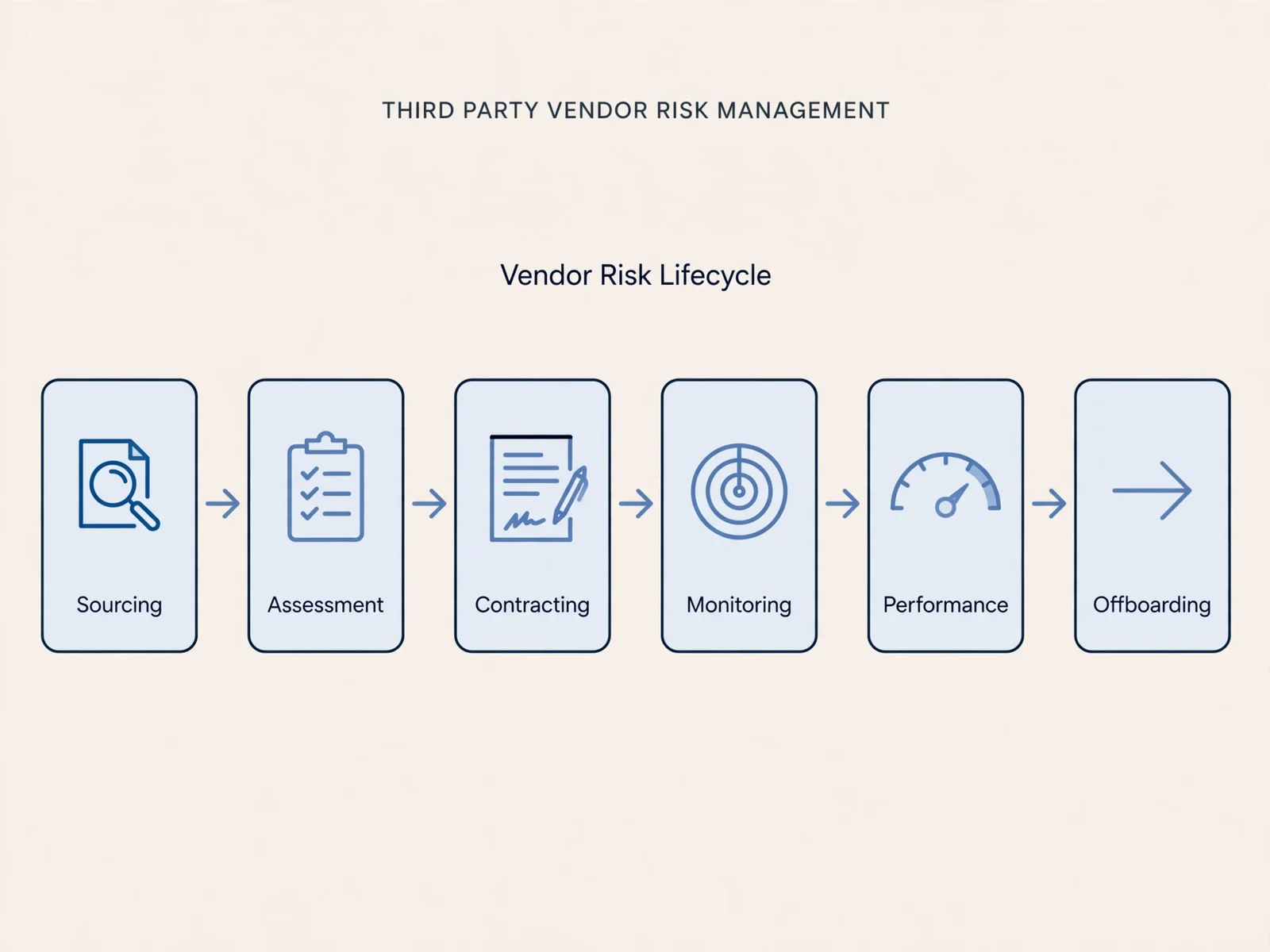
Participants classify vendors, identify critical dependencies, design due diligence, connect contractual protections to operating controls, define monitoring and plan for disruption or exit.
For organizations, the course can support vendor-risk programs, procurement academies, outsourcing governance and cross-functional third-party oversight.
Where this program fits
Risk, procurement, vendor-management, technology, compliance and business leaders responsible for important third parties
Live classroom, live online or private in-house. Depth and schedule are tailored to the cohort.
Vendor criticality, due diligence, contracting, controls, monitoring, concentration, incidents and exit
A third-party risk framework and review plan for a critical vendor population
Built for Corporate Cohorts
Private delivery can be aligned to participant roles, business priorities, internal terminology and real workplace scenarios. HR, L&D and functional sponsors can use the course alone or inside a broader academy.
What Participants Will Learn
Apply proportionate oversight based on criticality and consequence.
Focus evidence on the risks that matter for the service being purchased.
Translate contractual protections into operating ownership.
Define evidence, thresholds and review cadence after onboarding.
Identify critical dependencies and single points of failure.
Plan escalation, contingency, transition and offboarding.
Business Problems This Program Is Designed to Address
Course Outline
Applied Practice and Scenario Work
Participants use realistic situations to practise analysis, decisions, stakeholder communication and application. Private cohorts can adapt scenarios to the organization’s context while protecting confidential information.
Participants decide what additional evidence, controls or terms are required before approval.
Participants map concentration and continuity exposure.
Participants structure remediation, escalation and contingency.
Participants build an exit and transition plan.
Practical Tools and Work Products
What Strong Practice Looks Like
Strong third-party risk management begins with criticality. The organization should know which vendors could materially affect customers, operations, data, compliance or strategic delivery if they fail. That determines how much diligence, contractual protection and monitoring is justified.
Due diligence should be relevant to the service. Asking every vendor for the same long questionnaire can create administrative volume without better decisions. Participants match evidence to actual risk domains and the consequence of failure.
Contract terms matter only when they are operationalized. Audit rights, service levels, data obligations, insurance requirements or continuity commitments need owners who know when and how those provisions will be used.
Monitoring should also adapt to change. A vendor that was low risk at onboarding may become critical as usage expands, data changes or the organization consolidates suppliers. The program includes triggers for reclassification and deeper review.
Questions Participants Learn to Ask
What makes this third party critical to the organization?
Which evidence is material to the service and risk?
Who owns each contractual control after signature?
What would make us restrict, remediate or exit the relationship?
Implementation Pitfalls and Cross-Functional Interfaces
Capability in this topic depends on how decisions move across the organization. Private cohorts can map where ownership, information or incentives currently break down and use those interfaces as part of the learning design.
- Procurement for supplier lifecycle and commercial leverage
- Legal for contract terms and remedies
- Technology and security for cyber, data and access risk
- Business owners for service dependence, performance and contingency
A common implementation mistake is to add a framework without changing the management routine around it. Participants therefore identify where the tool will be used, who needs to be involved, what evidence is required and what decision or behavior should become different after application.
Advanced Application Considerations
Third-party risk programs can become document-heavy when teams confuse evidence collection with risk reduction. The objective is to improve decisions: approve, reject, remediate, monitor more closely, limit scope or prepare contingency. Every major control should support one of those decisions.
Fourth-party exposure is another blind spot. A vendor may depend on cloud providers, subcontractors or specialist partners that create concentration outside the direct contract. Participants consider which downstream dependencies are material enough to understand and monitor.
Exit planning is especially important for critical services because switching can take months. Data portability, knowledge transfer, access removal, alternative capacity and contractual transition support should be considered before the relationship is already in crisis.
Before the Program Begins
For a private cohort, participants can identify one current case, decision or recurring problem related to the topic. Anonymized patterns can be used to weight practice without turning the program into a review of confidential internal matters.
After the Program
Participants can use one work product in the next relevant work cycle and discuss the result with a manager or peer. The goal is to reinforce application while the participant has a live opportunity to use the capability.
How Participants Work During the Program
The learning design moves through diagnosis, practice, challenge and application. Participants begin with a real problem or decision, test a framework, receive challenge, build a practical work product and identify the first workplace action after the course.
For employer-sponsored cohorts, managers can agree one current situation before delivery and review the participant’s application afterward. This creates a direct connection between learning and work without turning development into a heavy assessment exercise.
Manager Reinforcement and Evidence of Application
Sponsors can look for observable changes such as clearer decisions, stronger preparation, better use of a work product, improved ownership or better escalation. These are indicators that the capability is being applied, not automatic claims that attendance caused a business result.
Participants should select one or two applications first rather than trying to use every concept at once. Managers can ask what was tried, what response followed and what should be adjusted next time.
Designing a Private Cohort Around Real Work
Before private delivery, the sponsor can define participant roles, experience level, common workplace situations, internal terminology and one or two practical outputs that would be useful after the program.
- Participant roles and experience.
- Recurring decisions or problems the cohort needs to handle better.
- Relevant internal frameworks or governance.
- Practical work products participants can use afterward.
- How managers will reinforce application.
Governance and Escalation Maturity
Third-party governance also needs a clear exception process. Business teams may have legitimate reasons to proceed with a vendor before every preferred control is in place. Participants learn to document the residual exposure, compensating controls, accountable approver and expiry or review point rather than allowing temporary exceptions to become permanent by default.
Risk ownership should remain close to the business relationship. A central risk team can set standards and challenge decisions, but it cannot replace the business owner’s responsibility for understanding how the vendor supports critical work and what disruption would mean operationally.
For corporate cohorts, this provides a useful bridge between individual technical knowledge and the operating governance the organization needs. Participants can compare their current escalation and review routines with a more mature model and identify one change that would materially improve control or decision quality.
Who Should Attend
- Third-party risk professionals
- Procurement and vendor-management teams
- Technology and cybersecurity managers
- Compliance, legal and business owners
Organizational Benefits
- Create proportionate vendor oversight
- Improve due-diligence quality
- Connect contract protections to operating controls
- Expose concentration risk
- Strengthen contingency and exit readiness
Delivery and Pricing
The program is live and instructor-led. It can be delivered in the classroom, live online or in-house. Duration is flexible and should reflect participant level, selected depth, organizational objectives and the amount of applied practice required.
Public and private pricing: current public fees are confirmed with scheduled cohorts. Private and customized programs are quoted according to cohort size, location, scope and customization. Request a proposal.
Frequently Asked Questions
Can this be delivered privately for one organization?
Yes. Private cohorts can be calibrated to participant roles, business context and priority scenarios.
Is the duration fixed?
No. Delivery depth and schedule are adapted to the cohort and learning objective.
Can we use our own scenarios?
Yes. Organization-relevant situations can be used while protecting confidential information.
How should managers reinforce the learning?
Agree one or two work applications, then review what the participant tried, what happened and what should change next.
Can this sit inside a broader academy?
Yes. It can be combined with related programs into a role, function or leadership pathway.
Is this self-paced?
No. TheSkillGrid programs are live and instructor-led.
Related Programs
- Vendor Management and Negotiation
- Contract Management and Administration
- Strategic Procurement Management
- Corporate Governance Essentials
Build a Cohort Around the Capability Need
TheSkillGrid can combine this course with adjacent programs into a coherent corporate pathway.
Upcoming Dates & Venues
Request course availability with your preferred date, location and group size. We will confirm available public-session and private-team options before any booking or payment.
Ready to Take the Next Step?
Register your interest for a public session or request private in-house delivery for your team.